No difference in ED length of stay between LEP and English-speaking patients
Source
Wallbrecht (2014). No difference in emergency department length of stay for patients with limited proficiency in English. Southern Medical Journal.
Description #
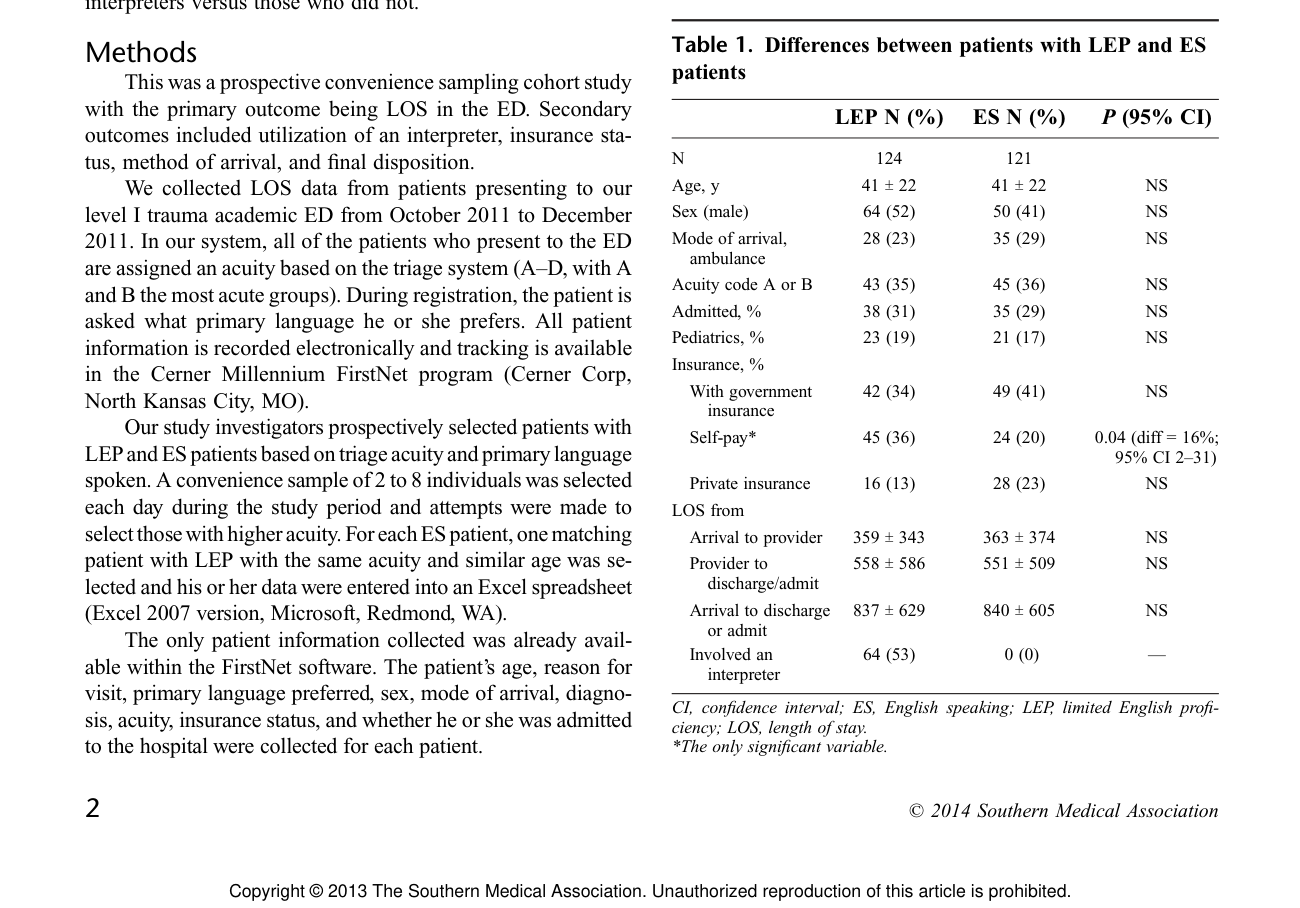
In a prospective cohort study of an adult level I trauma academic ED, there were no significant differences in mean emergency-department length of stay (LOS) between patients with limited English proficiency (LEP, n=124) and English-speaking (ES, n=121) patients at any transition point: arrival-to-provider (359 ± 343 vs 363 ± 374 min), provider-to-discharge/admit (558 ± 586 vs 551 ± 509 min), and arrival-to-discharge/admit (837 ± 629 vs 840 ± 605 min), all NS (Table 1). The two groups were comparable on age, sex, mode of arrival, acuity, admission rate, and pediatric proportion.
"There were no differences in mean LOS from time of arrival to time seen by a provider when comparing ES patients to patients with LEP, or time of arrival to discharge or admission request. This was independent of use of an interpreter (58% of non-ES patients used an interpreter; Table 1, Fig.)." (Wallbrecht, 2014, p. 3)
"Our results indicated that there was no difference in LOS between ES patients and patients with LEP." (Wallbrecht, 2014, p. 3)
Methods Context #
What? #ⓘ
The observable: mean ED length of stay in minutes, captured as time stamps at transition points (arrival, triage, provider, discharge/admission) and compared between LEP and ES groups.
"The LOS time was collected as the time stamped within the FirstNet software at a variety of transition points during the patient's visit. These points were time of arrival, time to triage, time to provider (midlevel, resident, or attending), and time to discharge or admission." (Wallbrecht, 2014, p. 2)
How? #ⓘ
Prospective convenience-sampling cohort study; investigators selected 2–8 patients per day and for each ES patient matched one LEP patient of the same acuity and similar age, comparing mean LOS with a grouped t test; 80% power to detect a 120-minute difference at >100 per group.
"This was a prospective convenience sampling cohort study with the primary outcome being LOS in the ED." (Wallbrecht, 2014, p. 2)
"For each ES patient, one matching patient with LEP with the same acuity and similar age was selected and his or her data were entered into an Excel spreadsheet." (Wallbrecht, 2014, p. 2)
Who? #ⓘ
121 ES and 124 LEP patients presenting over a 90-day period (Oct–Dec 2011) to a level I trauma academic ED (University of New Mexico, Albuquerque), the only level I trauma center and a county/tertiary center in the state; LEP languages were Spanish, Navajo, Vietnamese, Chinese, Arabic, and American Sign Language.
"During a period of 90 days, data were collected from 121 ES patients and 124 patients with LEP." (Wallbrecht, 2014, p. 2)
"Languages spoken among the patients with LEP included Spanish, Navajo, Vietnamese, Chinese, Arabic, and American Sign Language." (Wallbrecht, 2014, p. 2–3)
Other Notes #
The authors frame this null finding as consistent with Waxman and Levitt (who found no LOS difference for LEP patients limited to abdominal- and chest-pain subgroups) and as extending that result to all diagnostic groups. The only variable that differed significantly between LEP and ES groups was self-pay status (36% vs 20%, diff 16%, 95% CI 2–31), a potential confounder the authors flag rather than a LOS outcome.
Caveats #
- Non-randomized convenience sample with small N and long baseline ED wait times limited power to detect a LOS difference (Wallbrecht) Patients were selected by a non-randomized convenience sample (data collectors hand-picked 2–8 patients per day with no randomization software), creating room for selection bias, and the small sample entered over a short period combined with the site's unusually long baseline ED wait times produced very wide confidence intervals. The authors explicitly state these features may explain their inability to detect a significant overall LOS difference — so the null LEP-vs-ES result should be read as possibly underpowered rather than as evidence of no effect.