Patients in direct-Spanish consultations asked more questions and gave more unprompted speech
Source
Seible (2021). The Influence of Patient-Provider Language Concordance in Cancer Care: Results of the Hispanic Outcomes by Language Approach (HOLA) Randomized Trial. International Journal of Radiation Oncology.
Description #
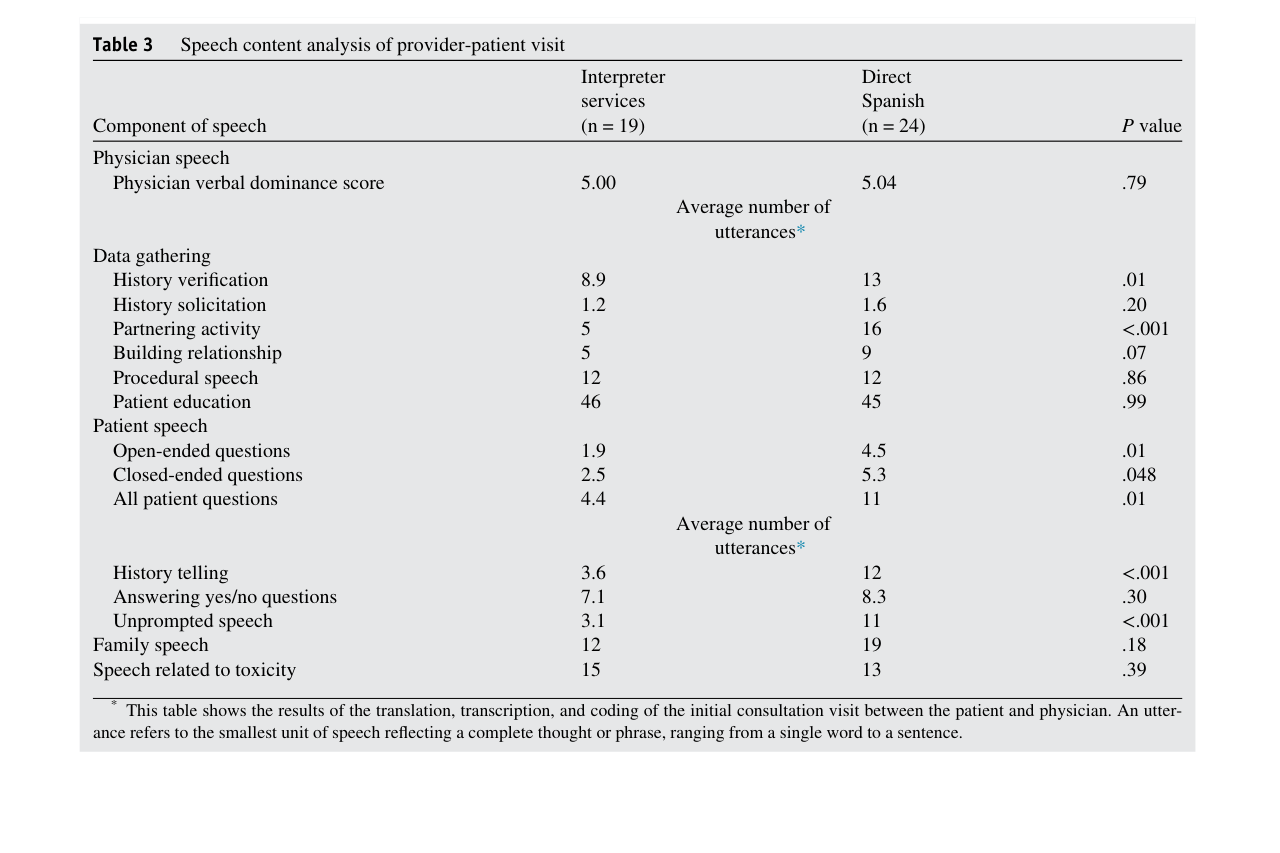
Coded consultation transcripts showed patients in the direct-Spanish arm were more verbally engaged than those in the interpreter-services arm: they asked more questions overall (mean 11 vs 4.4; P = .007/.01), including more open-ended (4.5 vs 1.9; P = .012/.01) and closed-ended questions (5.3 vs 2.5; P = .048), produced more unprompted speech (11 vs 3.1; P < .001), and more history-telling (12 vs 3.6; P < .001) (Table 3). This points to a mechanism by which concordance increases patient participation in the encounter.
"Patients in the direct-Spanish arm asked more questions during the initial consultation (mean of 11 questions vs 4.4 questions; P = .007), including both open-ended questions (4.5 questions vs 1.9 questions; P = .012) and closed-ended questions (5.3 questions vs 2.5 questions; P = .048)." (Seible, 2021, p. 858)
"patients in the direct-Spanish arm were more likely to initiate unprompted speech (mean utterances, 11 vs 3; P <.001) and asked their providers more questions (mean utterances, 11 vs 4; P = .007)." (Seible, 2021, p. 857)
Methods Context #
What? #ⓘ
The observable: mean number of patient "utterances" by category (questions, open/closed-ended questions, unprompted speech, history telling) coded from transcribed initial-consultation audio.
"When considering patient speech, the direct-Spanish arm had more patient speech focused on history telling and more unprompted patient speech." (Seible, 2021, p. 858)
How? #ⓘ
Initial-consultation audio translated, transcribed, and coded in MAXQDA per the Roter Interaction Analysis System by 2 coders (intercoder kappa 0.84); patient-utterance counts compared between arms.
"Transcripts were coded by 2 coders after verifying intercoder reliability using a kappa coefficient of 0.84 when concurrently coding 5 transcripts." (Seible, 2021, p. 858)
Who? #ⓘ
Speech-content analysis covered the final enrolled patients with captured audio: interpreter-services n = 19 and direct-Spanish n = 24 initial consultations.
"For the final 43 enrolled patients, we obtained audio recordings of the initial consultation to enable analysis of communication content." (Seible, 2021, p. 858)
Other Notes #
Family speech and toxicity-related speech did not differ significantly between arms (Table 3).
Caveats #
- HOLA interpreter arm used bilingual physicians speaking English, which may not represent a typical interpreter encounter To provide an internal control, the same 2 bilingual physicians delivered both arms — meaning the interpreter-services arm consisted of bilingual physicians speaking English through an interpreter. The authors note this may not represent an average interpreter-based encounter, since a non-bilingual physician might face greater communication challenges than a bilingual one even when both use translation. This could bias the comparison toward the null (understating the true direct-Spanish advantage over typical interpreter care).
- HOLA findings come from one community subspecialty clinic with only 2 bilingual physicians, limiting generalizability The trial's data were generated at a single community radiation oncology subspecialty clinic, using specifically video and telephonic interpreter services, and delivered by only 2 bilingual physicians. The authors note this makes it difficult to know whether the satisfaction and communication-content findings generalize to other clinical settings, interpreter modalities, or providers.
- HOLA's small sample raises possibility of arm heterogeneity influencing the findings The trial enrolled a small number of participants (83 total; 40 vs 43 per arm), which introduces the possibility of heterogeneity between study arms. Although observed patient characteristics did not statistically differ between groups, the authors note that unmeasured differences in participants could potentially influence the findings.