Direct-Spanish care raised satisfaction with overall-care domains (technical quality, interpersonal manner, communication, time spent)
Source
Seible (2021). The Influence of Patient-Provider Language Concordance in Cancer Care: Results of the Hispanic Outcomes by Language Approach (HOLA) Randomized Trial. International Journal of Radiation Oncology.
Description #
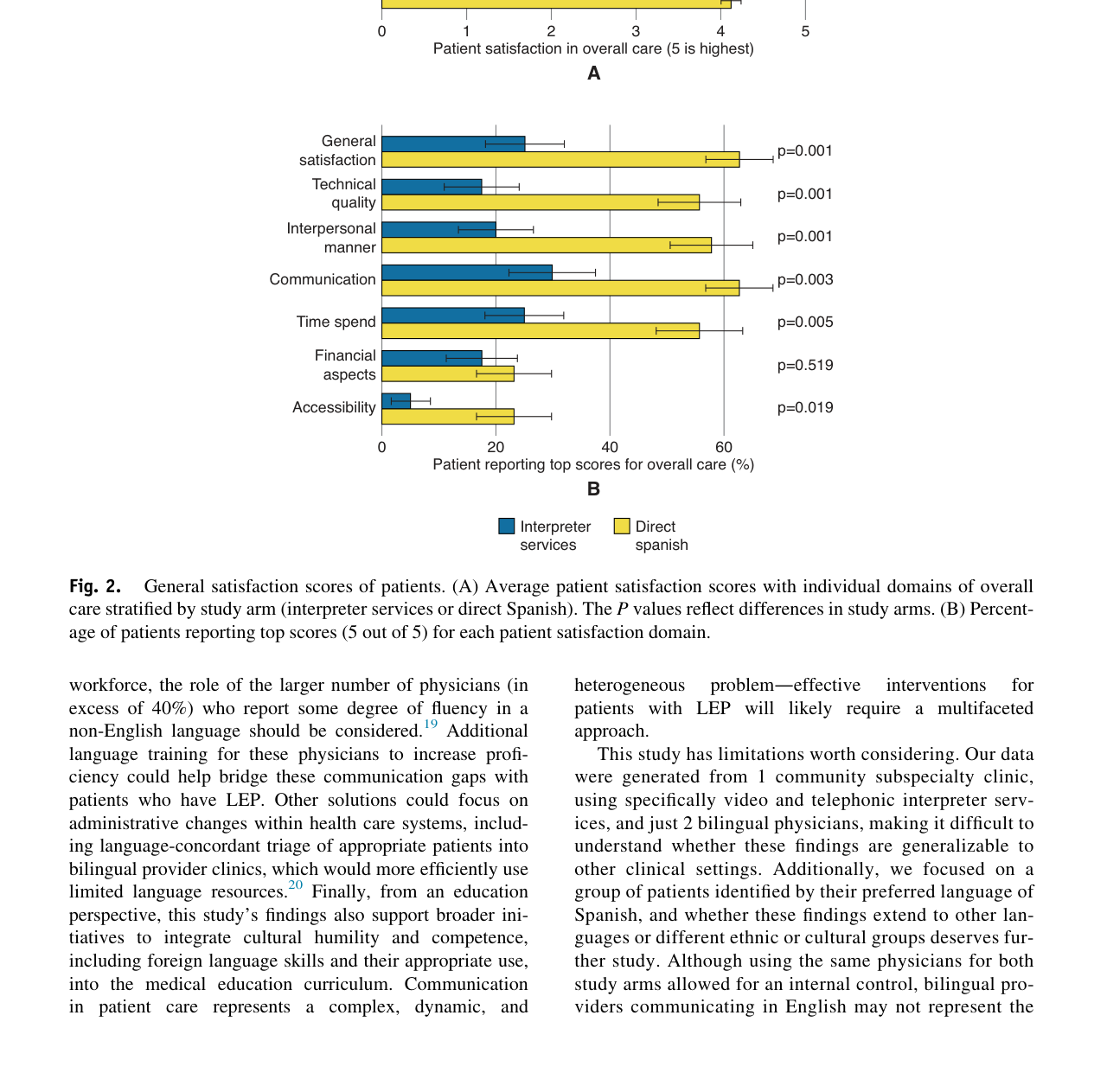
Beyond the primary endpoint, several secondary overall-care satisfaction domains measured immediately after the initial consultation were significantly higher in the direct-Spanish arm than the interpreter-services arm: technical quality (4.41 vs 4.06; P = .005), interpersonal manner (4.37 vs 3.88; P = .004), communication (4.50 vs 4.25; P = .018), and patient perception of time spent (4.30 vs 3.92; P = .028) (Fig. 2A).
"From surveys with the initial consultation, several secondary endpoints were also higher in the direct-Spanish arm, including patient satisfaction with technical quality (4.41 vs 4.06; P = .005), interpersonal manner (4.37 vs 3.88; P = .004), communication (4.50 vs 4.25; P = .018), and patient perception of time spent (4.30 vs 3.92; P = .028) (Fig. 2A)." (Seible, 2021, p. 859)
Methods Context #
What? #ⓘ
The observable: subcomponent domain composite scores of the PSQ overall-care satisfaction survey (technical quality, interpersonal manner, communication, time spent) recorded immediately after the initial consultation.
"Secondary endpoints included each subcomponent domain of both the PSQ and ISQ surveys." (Seible, 2021, p. 858)
How? #ⓘ
Randomized 1:1 to direct-Spanish vs interpreter-services arms (same 2 bilingual physicians in both); ordinal Likert satisfaction domains compared with Wilcoxon rank-sum tests, P < .05 significant.
"Similarly, when comparing outcomes between study arms, we used Wilcoxon rank-sum tests for ordinal (Likert scale) data and Fisher exact tests for categorical endpoints." (Seible, 2021, p. 858)
Who? #ⓘ
83 adult Spanish-language-preferring cancer patients referred for radiation therapy at one community radiation oncology clinic in Chula Vista, CA (40 interpreter services, 43 direct Spanish).
"Eighty-three adult Spanish-speaking patients with cancer were randomly assigned to receive care from either (1) 1 of 2 bilingual physicians speaking to the patient directly in Spanish or (2) the same physicians speaking English and using a professional interpreter service." (Seible, 2021, p. 856)
Other Notes #
Financial aspects and accessibility domains showed no significant arm difference (e.g., financial aspects P = .056) (Fig. 2A).
Caveats #
- HOLA interpreter arm used bilingual physicians speaking English, which may not represent a typical interpreter encounter To provide an internal control, the same 2 bilingual physicians delivered both arms — meaning the interpreter-services arm consisted of bilingual physicians speaking English through an interpreter. The authors note this may not represent an average interpreter-based encounter, since a non-bilingual physician might face greater communication challenges than a bilingual one even when both use translation. This could bias the comparison toward the null (understating the true direct-Spanish advantage over typical interpreter care).
- HOLA studied only Spanish-preferring patients, so findings may not extend to other languages or cultural groups The study focused on a single LEP group — patients identifying Spanish as their preferred language. The authors caution that whether the findings extend to other languages or to different ethnic or cultural groups is unknown and deserves further study.
- HOLA findings come from one community subspecialty clinic with only 2 bilingual physicians, limiting generalizability The trial's data were generated at a single community radiation oncology subspecialty clinic, using specifically video and telephonic interpreter services, and delivered by only 2 bilingual physicians. The authors note this makes it difficult to know whether the satisfaction and communication-content findings generalize to other clinical settings, interpreter modalities, or providers.
- HOLA was necessarily unblinded, so awareness of arm allocation could have introduced bias Because the communication modality cannot be hidden, the trial was necessarily conducted unblinded. The authors acknowledge that patients' and physicians' awareness of study-arm allocation could have introduced bias into the patient-reported satisfaction outcomes.
- HOLA's small sample raises possibility of arm heterogeneity influencing the findings The trial enrolled a small number of participants (83 total; 40 vs 43 per arm), which introduces the possibility of heterogeneity between study arms. Although observed patient characteristics did not statistically differ between groups, the authors note that unmeasured differences in participants could potentially influence the findings.