LEP children wore hearing aids far less per day than English-proficient peers (1.30 vs 5.19 hr)
Source
Nicole Brigham (2024). Pediatric Hearing Aid Daily Wear Time Is Significantly Impacted by Clinician-Family Language Discordance. American Journal of Audiology.
Description #
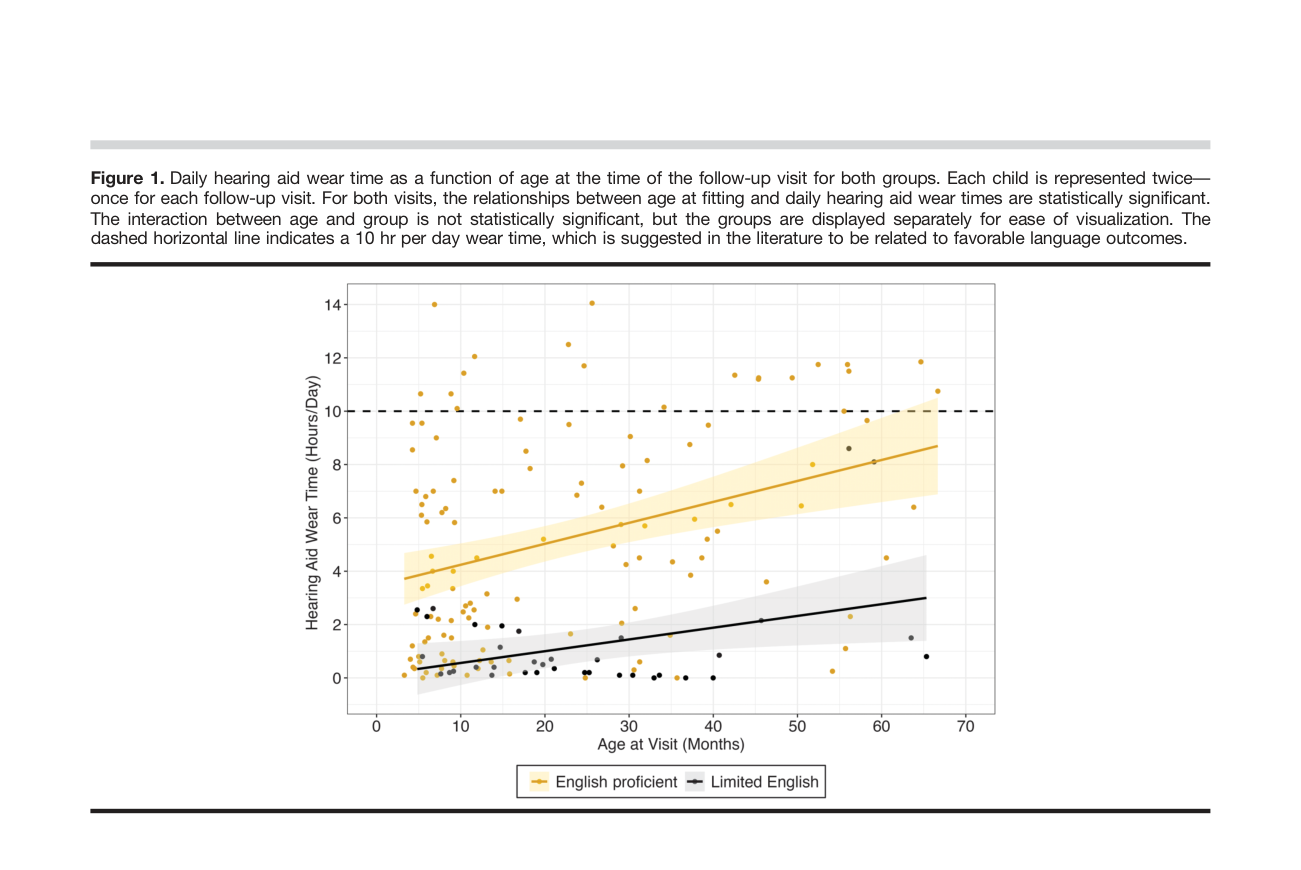
In a retrospective chart review of young children fit with hearing aids, daily hearing aid wear time (data-logged in hours) was much shorter for children from families with limited English proficiency (LEP) than for children from English-proficient (EP) families: mean 1.30 hr/day (SD = 1.93) for the LEP group versus 5.19 hr/day (SD = 3.98) for the EP group. In a linear mixed-effects model, the main effect of Group was statistically significant, F(1, 90.3) = 26.41, p < .0001, and degree of hearing loss did not explain the difference (Fig. 1).
"Analysis of the parsimonious model revealed statistically significant main effects of Group, F(1, 90.3) = 26.41, p < .0001, and Age, F(1, 109.2) = 10.80, p < .01. The Age x Group interaction was not statistically significant." (Brigham, 2024, p. 324)
"Specifically, the daily mean hearing aid wear time for the children from English-proficient families was 5.19 hr (SD = 3.98) and the mean daily wear time for the children from families with limited English proficiency was 1.30 hr (SD = 1.93)." (Brigham, 2024, p. 324)
Methods Context #
What? #ⓘ
The observable: average daily hearing aid wear time in hours, taken from the hearing aids' on-device data logging (objective use records), averaged across ears and across the two follow-up visits.
"Linear mixed-effects modeling was used to explore factors related to average hearing aid wear time with data logging (in hours) as the dependent variable, a random effect of participant, and fixed factors of Group (English proficient, limited English), Visit (first, second), Age at visit (in months), and Degree of hearing loss (mild, moderate, moderately severe)." (Brigham, 2024, p. 324)
How? #ⓘ
Retrospective chart review at one academic medical center; LEP status was operationalized by the presence of an in-person or remote interpreter at the hearing aid fitting and follow-up appointments, and wear time was compared between LEP and EP groups with a linear mixed-effects model controlling for age and hearing-loss degree.
"Wear time was compared between children who attended an interpreter-mediated appointment and those who did not have an interpreter present. The presence of an interpreter at the appointment was the study indicator that the family had limited English proficiency." (Brigham, 2024, p. 321)
Who? #ⓘ
Children aged 2-60 months with permanent bilateral hearing loss (PTA > 30 and < 90 dB HL) seen for hearing aid follow-up between April 18, 2020 and April 1, 2022 at Vanderbilt University Medical Center (Nashville, TN): 69 from English-proficient families and 24 from LEP families (79% Spanish-speaking).
"This chart review included children from one of two types of families: (a) families who were English proficient (n = 69) and (b) families with limited English proficiency (n = 24); with 79% of this group being Spanish speaking." (Brigham, 2024, p. 323)
Other Notes #
The effect is in the hypothesized direction and large in absolute terms (a ~3.9 hr/day gap), and the authors note degree of hearing loss was not retained in the parsimonious model, so the gap is not attributable to differing severity between groups. Both groups fell well short of the ~10 hr/day benchmark associated with better language outcomes.
Caveats #
- Wear-time estimates are biased by including only children with available data logging The wear-time estimates include only children who returned for a follow-up visit and for whom data logging was available; children fit with hearing aids who never returned, or who were recommended hearing aids but never returned for a fitting, are excluded. Because LEP families are generally less likely to access health care services, this selection likely biases the wear-time estimates (probably toward overestimating use among LEP children, since the most disengaged families never appear in the data).
- Small single-region LEP sample (n=24) likely unrepresentative of LEP families generally The limited-English-proficiency group was small (n = 24) and drawn from a single clinic in one geographic region (Nashville, TN), so the authors caution the sample is likely not representative of LEP families generally and the findings may not generalize to other regions or language groups.
- Socioeconomic status was confounded with language group and could not be controlled Insurance type, used as a proxy for socioeconomic status, differed sharply between groups (about 96% of LEP families on public insurance vs about 30% of English-proficient families). Because socioeconomic status (and the related caregiver educational level, which is itself associated with pediatric hearing aid wear time) could not be controlled or even measured, the observed wear-time gap cannot be cleanly attributed to language discordance rather than to socioeconomic disadvantage.