No significant difference in hospital cost between LEP patients who did and did not receive an interpreter after casemix adjustment
Source
Morris (2021). Factors associated with utilisation of health care interpreting services and the impact on length of stay and cost: A retrospective cohort analysis of audit dat. Health Promotion Journal of Australia.
Description #
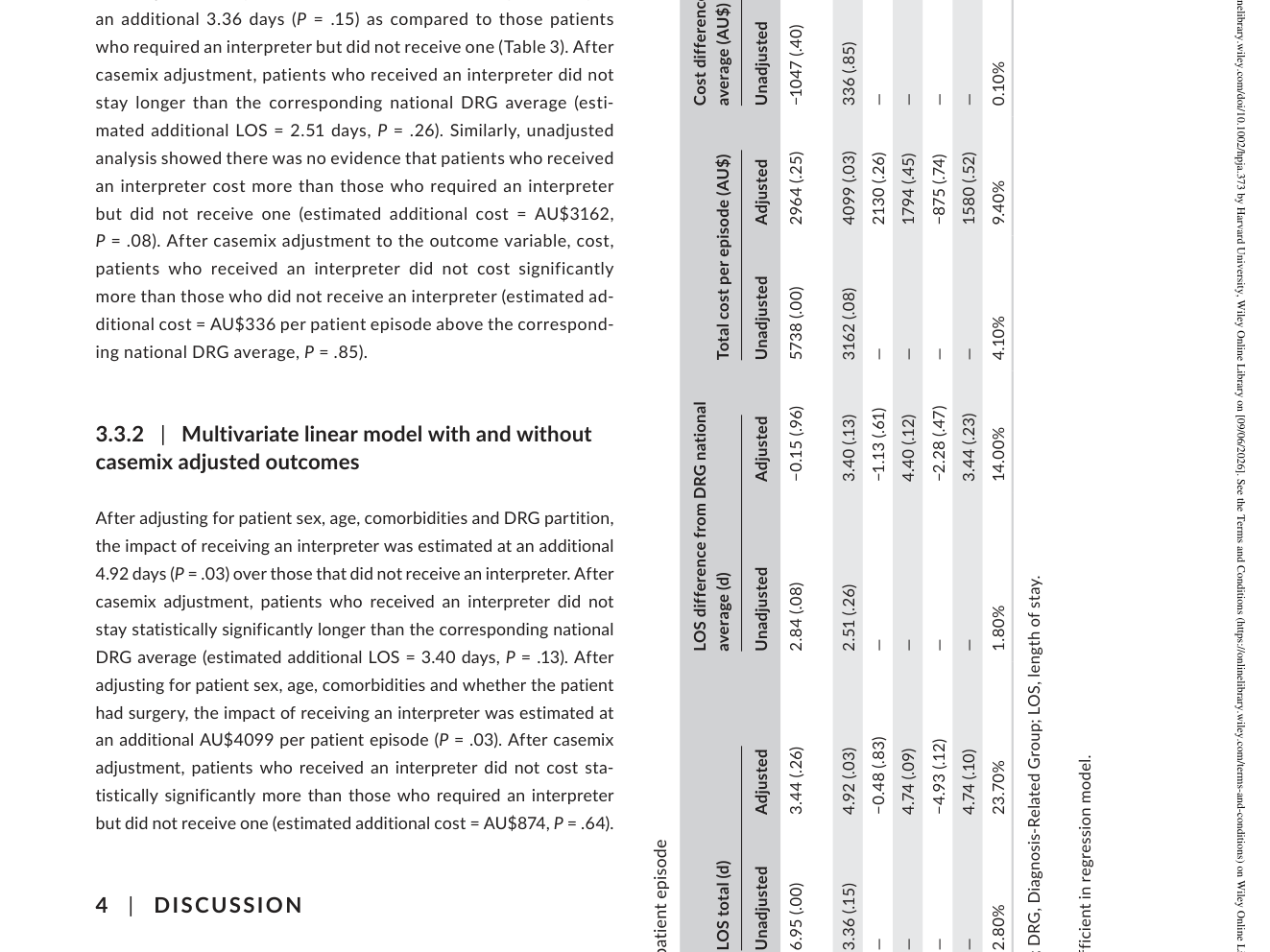
Among hospitalised LEP patients who required an interpreter, those who received one had a higher mean unadjusted episode cost (AU$8900 vs AU$5738; unadjusted regression difference AU$3162, P = .08), but after casemix adjustment (difference from the national DRG average) the cost difference was not statistically significant — an estimated additional AU$336 per episode in the simple model (P = .85) and AU$874 in the multivariate model (P = .64) (Table 3). The authors conclude there was no statistically significant cost difference after casemix adjustment.
"Similarly, unadjusted analysis showed there was no evidence that patients who received an interpreter cost more than those who required an interpreter but did not receive one (estimated additional cost = AU$3162, P = .08). After casemix adjustment to the outcome variable, cost, patients who received an interpreter did not cost significantly more than those who did not receive an interpreter (estimated additional cost = AU$336 per patient episode above the corresponding national DRG average, P = .85)." (Morris, 2021, p. 429)
"After casemix adjustment, patients who received an interpreter did not cost statistically significantly more than those who required an interpreter but did not receive one (estimated additional cost = AU$874, P = .64)." (Morris, 2021, p. 429)
Methods Context #
What? #ⓘ
The observable: patient-level hospital cost per episode (AU$), both raw and as a casemix-adjusted difference from the national DRG average, compared between patients who did vs did not receive an interpreter.
"Casemix adjusted outcomes were estimated by calculating the difference in LOS and cost from the average for the DRG based on Independent Hospital Pricing Authority National Hospital Cost Data Collection Round 20 cost weights for DRG v8.0." (Morris, 2021, p. 427)
How? #ⓘ
Retrospective cohort analysis of linked audit and admitted-patient data; cost predicted using simple and multivariate linear regression controlling for sex, age, whether the patient had surgery, and CCI group. Interpreter service costs were allocated as an equal overhead across all patients.
"In the costing process, interpreter service costs are allocated as an overhead equally across all patients." (Morris, 2021, p. 427)
Who? #ⓘ
Adult inpatients with a preferred language other than English needing an interpreter, audited across eight hospitals in one regional NSW (Australia) local health district between July 2016 and March 2018; 90 episodes / 74 patients, with patient-level cost from the Activity Based Management portal.
"Patient-level cost data for each episode was obtained from the Activity Based Management portal. In the costing process, interpreter service costs are allocated as an overhead equally across all patients." (Morris, 2021, p. 427)
Other Notes #
As with LOS, the multivariate model on the unadjusted cost outcome was significant (additional AU$4099, P = .03); only the casemix-adjusted outcome was non-significant. Because interpreter costs are spread as an equal overhead across all patients, this analysis cannot isolate the marginal cost of providing an interpreter (an author-stated limitation).
Caveats #
- Small audit sample may have lacked power to detect true LOS and cost differences from interpreter use (Morris 2021) The audit sample was relatively small (90 episodes / 74 patients), and the authors caution it may not have provided sufficient statistical power to detect true differences in length of stay or cost. The non-significant casemix-adjusted LOS and cost findings therefore cannot be read as evidence of no effect — particularly given that the unadjusted-outcome multivariate models did reach significance, and that the point estimates were in the direction of longer, costlier stays for interpreter recipients.