The interpreter-use QI bundle did not significantly change balancing measures of ED length of stay (186 min) or VRI encounter time (16.5 min)
Source
Martinez (2021). Improving Equity of Care for Patients with Limited English Proficiency Using Quality Improvement Methodology. Pediatric Quality & Safety.
Description #
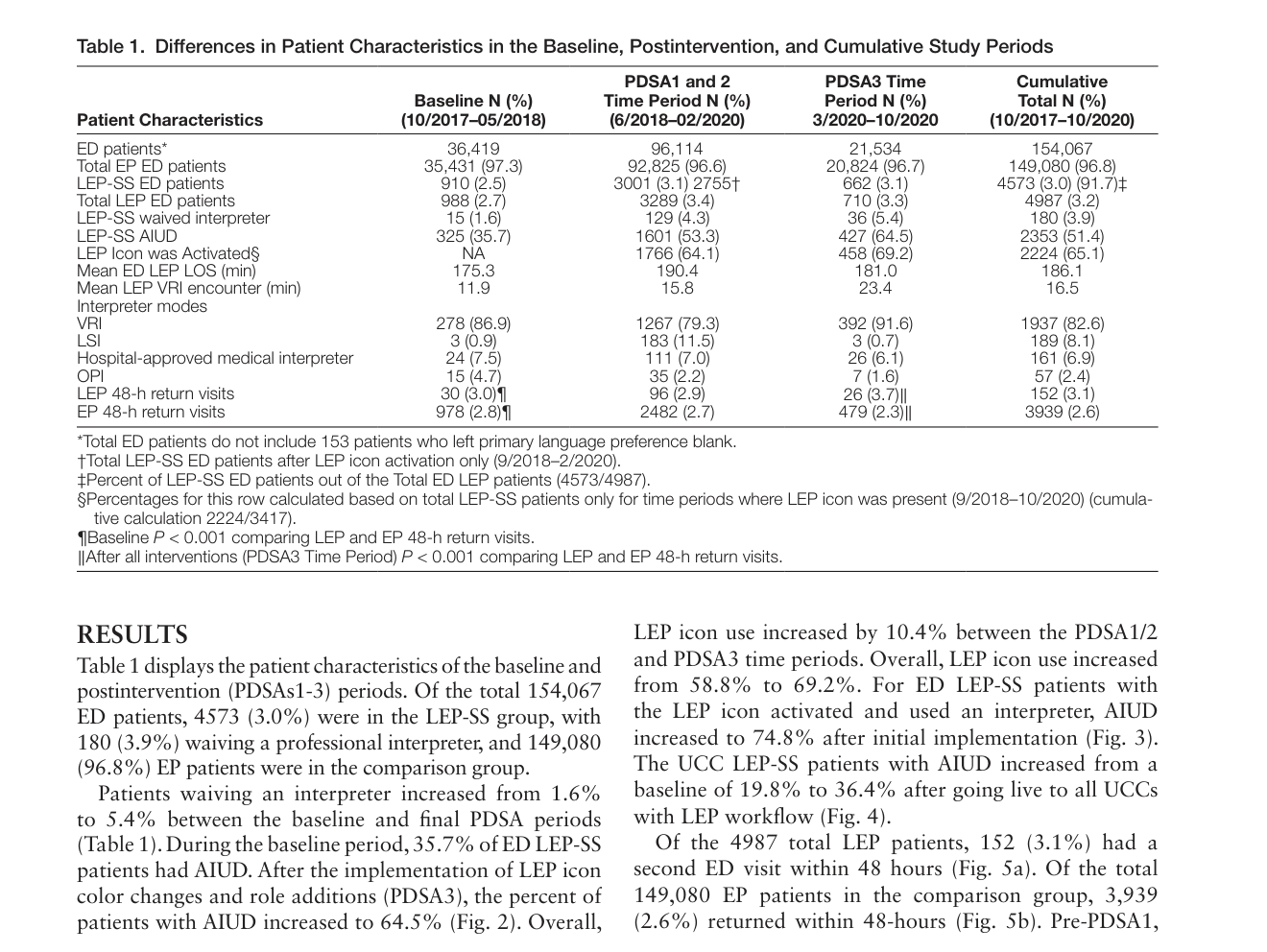
The QI bundle to increase interpreter use and documentation was tracked against two balancing measures — ED length of stay (LOS) and video-remote-interpreter (VRI) encounter time for the overall LEP ED population — to check that adding interpreter steps did not worsen throughput. Neither balancing measure changed significantly: ED LEP LOS averaged 186.1 minutes and VRI encounter time averaged 16.5 minutes cumulatively (Table 1).
"Balancing measures for all ED LEP patients saw no significant changes where ED LOS and VRI encounter time averaged 186.1 and 16.5 minutes, respectively (Table 1)." (Martinez, 2021, p. 5)
"Significant improvements in AIUD were achieved without affecting balancing measures." (Martinez, 2021, p. 1)
Methods Context #
What? #ⓘ
The observables: ED length of stay (in minutes) and mean VRI interpreter-encounter time (in minutes) for the overall LEP ED population, monitored as balancing measures alongside the primary and process measures.
"As balancing measures, ED LOS and average video remote interpreter (VRI) encounter time were monitored for the overall LEP ED population." (Martinez, 2021, p. 2)
How? #ⓘ
Pre-post quality-improvement tracking of balancing measures on statistical process control (SPC) charts across baseline and the three PDSA cycles, monitoring for special-cause variation while the AIUD intervention was rolled out.
"The Model for Improvement framework was used to evaluate existing processes, identify opportunities for improvement, and test and implement changes." (Martinez, 2021, p. 2)
Who? #ⓘ
The overall LEP ED population at a freestanding, urban, academic pediatric ED (Level-1 Pediatric Trauma Center, ~53,000 annual visits), Norfolk, Virginia, October 2017–October 2020; VRI was the dominant interpreter mode (82.6% of encounters cumulatively).
"This project occurred between October 2017 and October 2020 with several interval tests of change performed in the ED of a freestanding, urban, academic children's hospital designated as a Level-1 Pediatric Trauma Center with an annual volume of approximately 53,000 patients." (Martinez, 2021, p. 2)
Other Notes #
This is a balancing-measure (safety check) finding rather than a hypothesized treatment effect: the value of the result is that intensifying interpreter use and documentation did not lengthen ED stays or interpreter-encounter time. Mean VRI encounter time did drift upward across periods in Table 1 (11.9 → 23.4 min) but the authors report no significant overall change.