Improving interpreter use and documentation did not reduce the 48-hour ED return-visit rate for LEP patients (3.1%)
Source
Martinez (2021). Improving Equity of Care for Patients with Limited English Proficiency Using Quality Improvement Methodology. Pediatric Quality & Safety.
Description #
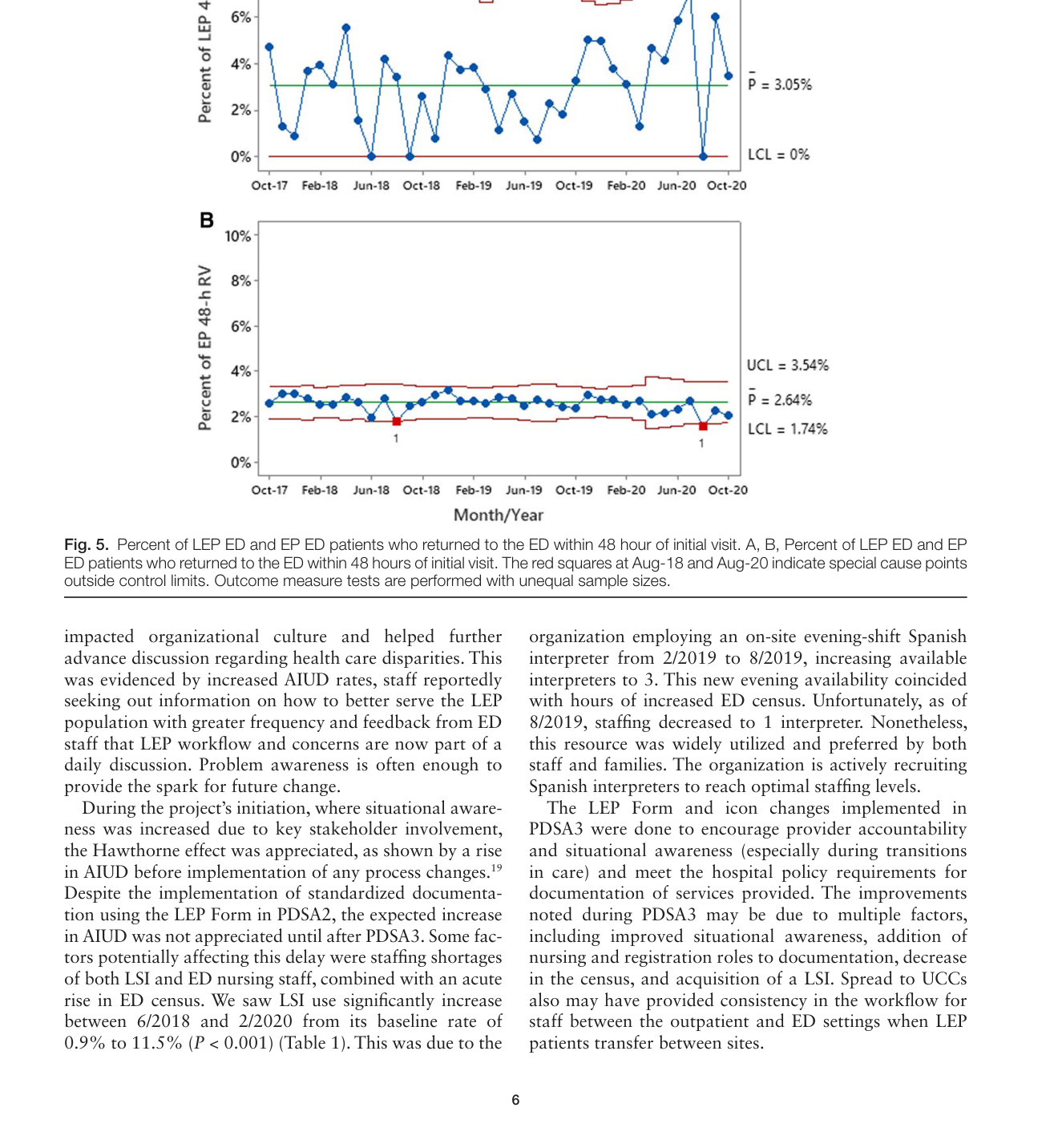
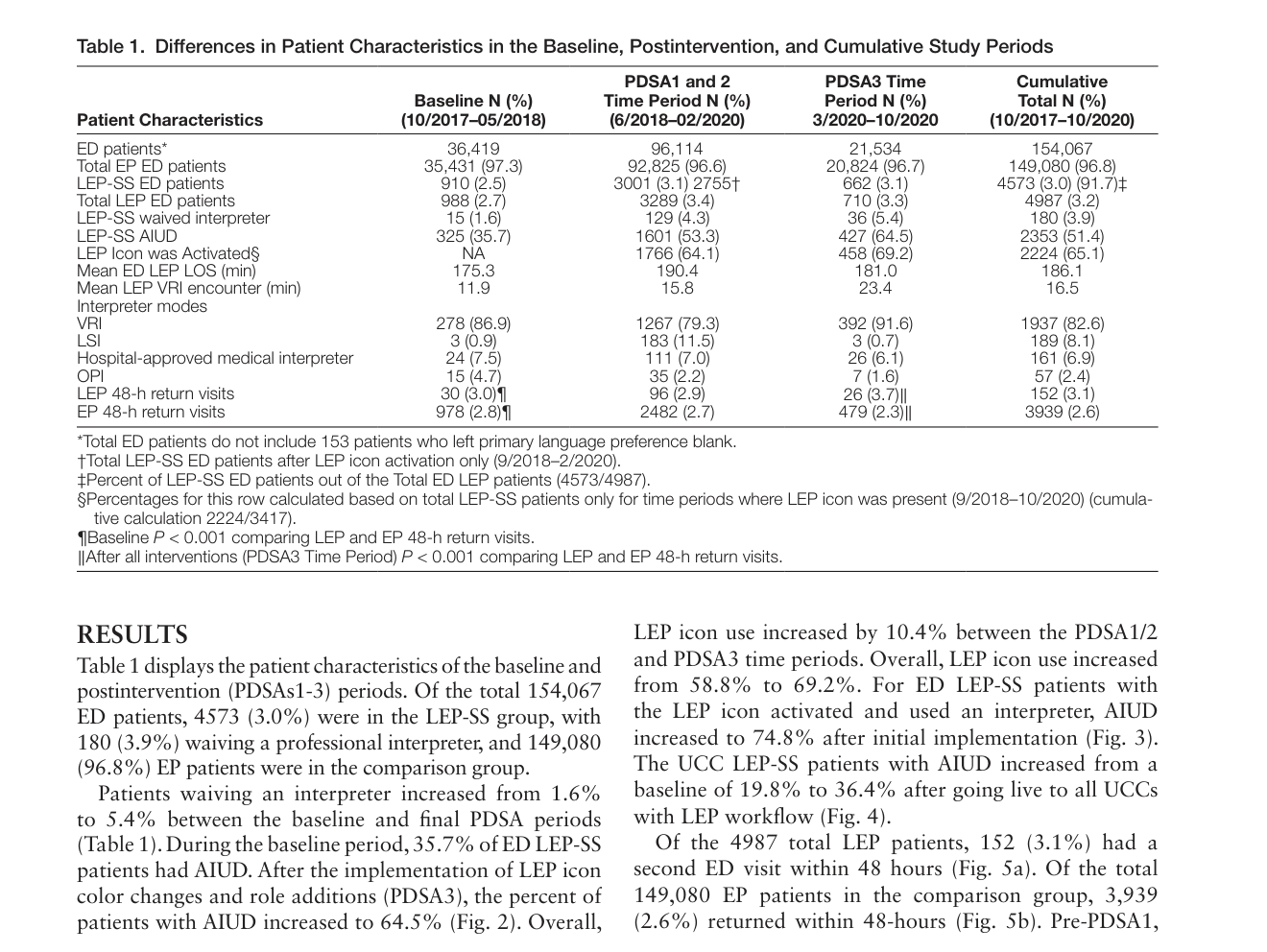
Despite the significant improvement in appropriate interpreter use and documentation, the 48-hour ED return-visit (RV) rate for LEP patients showed no special-cause variation from its baseline of 3.1% across the postintervention period, and the LEP-vs-EP RV gap remained significant (P < 0.001) both before and after all interventions (Fig. 5, Table 1). The authors conclude that improving professional interpreter use by itself had no significant effect on the return-visit rate.
"During the postintervention period (6/1/2018-10/31/2020), no special cause variation was noted from the baseline 48-hour emergency department RV rates for LEP patients (3.1%) or English proficient patients (2.6%)." (Martinez, 2021, p. 1)
"Though professional interpreter use improves patient outcomes such as return visits, by itself, it had no significant effect." (Martinez, 2021, p. 7)
Methods Context #
What? #ⓘ
The observable: the 48-hour ED return-visit (RV) rate — the proportion of patients returning to the ED within 48 hours of an initial visit — tracked separately for the LEP and English-proficient (EP) populations and compared with the 2-proportions test.
"Our primary outcome measure was 48-hour RV for LEP and EP populations, process measures included AIUD and LEP icon activation, and the balancing measures were ED LOS and VRI encounter time." (Martinez, 2021, p. 3)
How? #ⓘ
Pre-post quality-improvement evaluation: return-visit rates were tracked on statistical process control (SPC) charts to detect special-cause variation, with baseline (10/2017–05/2018) compared against the PDSA1–3 postintervention period; LEP-vs-EP differences tested with the 2-proportions test at P < 0.05.
"All data were analyzed using statistical process control (SPC) charts created using Minitab Statistical Software v.19 (Minitab, Inc., State College, Pa.)." (Martinez, 2021, p. 3)
Who? #ⓘ
All LEP ED patients (4987 total) and the EP comparison group (149,080) at a freestanding, urban, academic pediatric ED (Level-1 Pediatric Trauma Center, ~53,000 annual visits), Norfolk, Virginia, over October 2017–October 2020; 152 (3.1%) of LEP and 3939 (2.6%) of EP patients returned within 48 hours.
"Of the 4987 total LEP patients, 152 (3.1%) had a second ED visit within 48 hours (Fig. 5a). Of the total 149,080 EP patients in the comparison group, 3,939 (2.6%) returned within 48-hours (Fig. 5b)." (Martinez, 2021, p. 4)
Other Notes #
The authors hypothesized that improving interpreter use would help decrease LEP 48-hour RV; the null result led them to conclude return visits are multi-factorial and require a holistic approach (discharge process, cultural competency, access to care). They also note that gains may have reflected better documentation rather than a true increase in interpreter use, and that LEP RV showed wider variation (0%–7%) than EP RV (1.5%–3.2%), possibly reflecting the smaller LEP population.
Caveats #
- AIUD measured only documentation, not whether an interpreter was actually used throughout each ED visit The appropriate-interpreter-use-and-documentation (AIUD) measure was based on evidence of documentation (a free-text provider note or completed LEP Form), which does not confirm that an interpreter was actually used for every conversation throughout a visit. The authors themselves note the observed improvement may reflect better documentation more than a true increase in interpreter use, so the measured rise from 35.7% to 64.5% may overstate the change in real interpreter utilization — and could explain why return visits did not fall.