QI bundle raised appropriate interpreter use and documentation for Spanish-speaking LEP ED patients from 35.7% to 64.5%
Source
Martinez (2021). Improving Equity of Care for Patients with Limited English Proficiency Using Quality Improvement Methodology. Pediatric Quality & Safety.
Description #
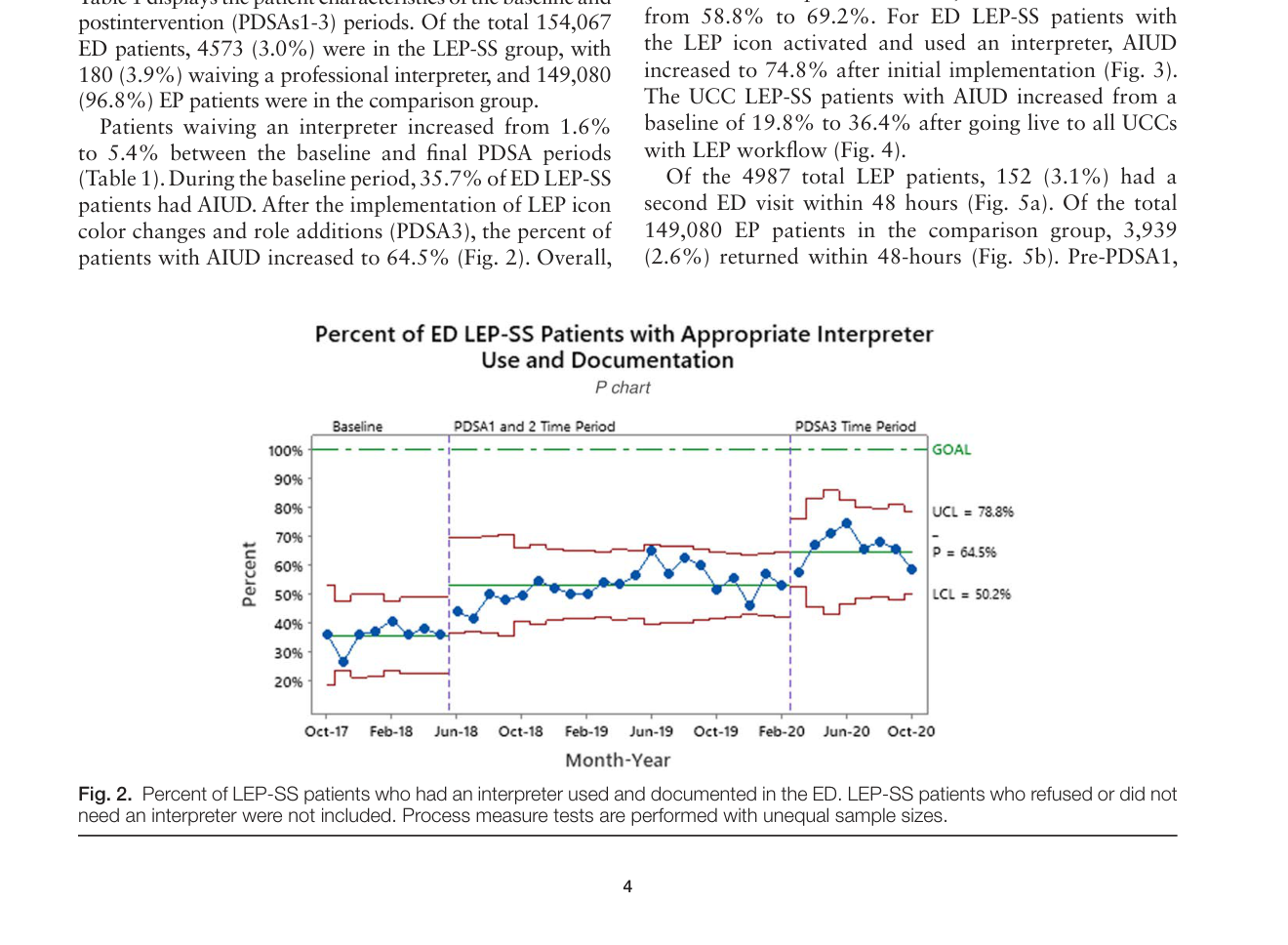
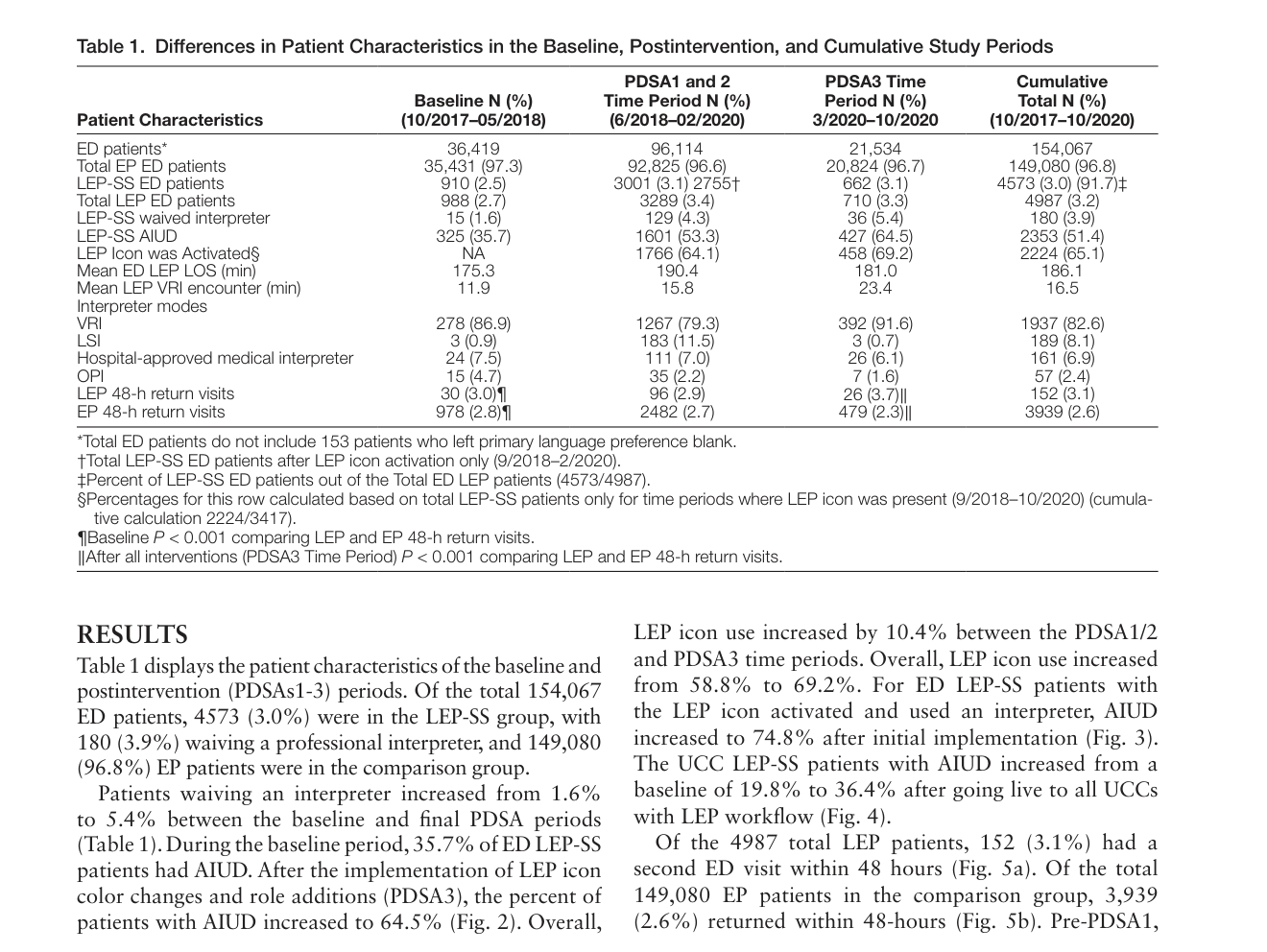
A multi-component quality-improvement bundle in a pediatric emergency department (an electronic tracking-board LEP icon, a standardized 3-click LEP documentation form, and icon color changes for situational awareness, implemented over three PDSA cycles) raised the mean rate of appropriate interpreter use and documentation (AIUD) for Spanish-speaking LEP patients from a 35.7% baseline to 64.5% after the final cycle (Fig. 2, Table 1).
"During the baseline period, 35.7% of ED LEP-SS patients had AIUD. After the implementation of LEP icon color changes and role additions (PDSA3), the percent of patients with AIUD increased to 64.5% (Fig. 2)." (Martinez, 2021, p. 4)
"The mean of LEP-SS patients with AIUD improved from 35.7% to 64.5% without significant changes in balancing measures." (Martinez, 2021, p. 1)
Methods Context #
What? #ⓘ
The observable: the rate of appropriate interpreter use and documentation (AIUD), confirmed by manual chart review for the presence of a free-text provider note or completed LEP Form indicating use of an appropriate professional interpreter (LSI, VRI, hospital-certified medical interpreter, or OPI).
"AIUD during PDSA cycles 1–3 was confirmed by the presence of either a free text notation in the provider's EHR note or completion of the LEP Form." (Martinez, 2021, p. 3)
How? #ⓘ
Quality-improvement project using the Model for Improvement and three sequential Plan-Do-Study-Act cycles, with statistical process control (SPC) charts to detect special-cause variation and centerline shifts; the interventions were a tracking-board LEP icon (PDSA1), a standardized LEP documentation Form (PDSA2), and icon color changes plus added nursing/registration documentation roles (PDSA3).
"Using the Model for Improvement and multiple Plan-Do-Study-Act (PDSA) cycles, a multi-disciplinary team encouraged stakeholder engagement and identified improvement opportunities, implemented an electronic tracking board LEP icon (PDSA1), standardized documentation using an LEP Form linked to the icon (PDSA2), and included color changes to the icon for team situational awareness (PDSA3)." (Martinez, 2021, p. 1)
Who? #ⓘ
Spanish-speaking LEP (LEP-SS) patients in the emergency department of a freestanding, urban, academic children's hospital (Level-1 Pediatric Trauma Center, ~53,000 annual ED volume), Norfolk, Virginia, October 2017–October 2020; LEP-SS were the largest LEP subgroup (91.7%); patients who waived a professional interpreter were excluded from the AIUD rate.
"This project occurred between October 2017 and October 2020 with several interval tests of change performed in the ED of a freestanding, urban, academic children's hospital designated as a Level-1 Pediatric Trauma Center with an annual volume of approximately 53,000 patients." (Martinez, 2021, p. 2)
Other Notes #
A pre-implementation rise in AIUD was attributed by the authors to the Hawthorne effect from stakeholder involvement; the expected gain from standardized documentation (PDSA2) was not seen until after PDSA3, attributed to staffing shortages and an ED census surge. AIUD is a process/documentation measure, not direct confirmation that an interpreter was used for every conversation.
Caveats #
- AIUD measured only documentation, not whether an interpreter was actually used throughout each ED visit The appropriate-interpreter-use-and-documentation (AIUD) measure was based on evidence of documentation (a free-text provider note or completed LEP Form), which does not confirm that an interpreter was actually used for every conversation throughout a visit. The authors themselves note the observed improvement may reflect better documentation more than a true increase in interpreter use, so the measured rise from 35.7% to 64.5% may overstate the change in real interpreter utilization — and could explain why return visits did not fall.
- Inconsistent baseline interpreter-use documentation may have missed patients where interpreters were used Baseline interpreter use was reconstructed from a manual chart review, but documentation of interpreter use was inconsistent before the project, so patients who had an interpreter but no documentation may have been missed. This biases the 35.7% baseline AIUD rate downward and inflates the apparent magnitude of the improvement to 64.5%, since part of the measured gain could be documentation catching up rather than new interpreter use.