Inpatient excellent-satisfaction ratings for understandable nurse explanations rose over seven points post-intervention
Source
Marshall (2016). Creating a Professional Ladder for Interpreters for Improvement of Care. The Joint Commission Journal on Quality and Patient Safety.
Description #
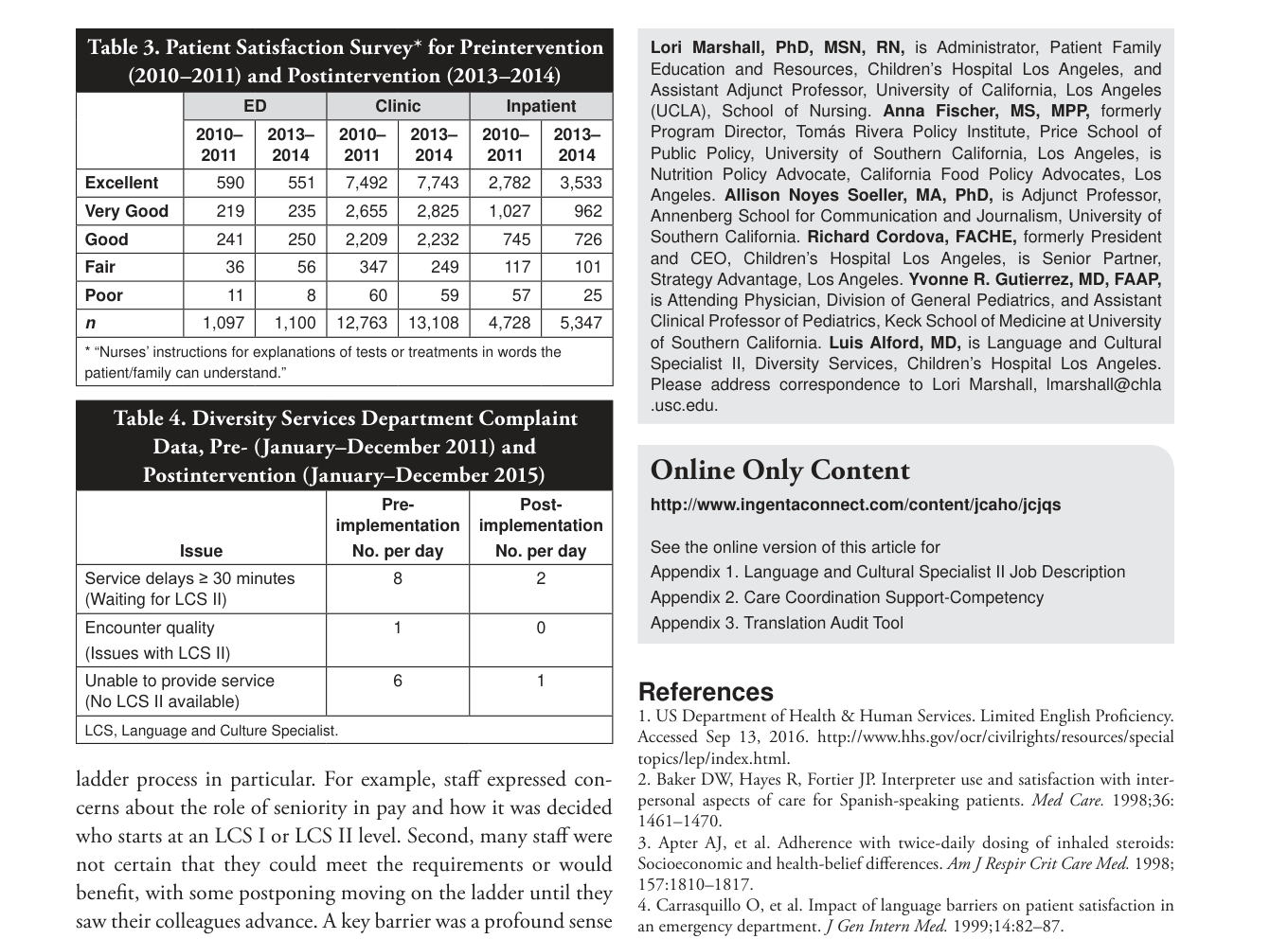
Inpatient patient-satisfaction ratings improved after the career-ladder intervention. The proportion of "excellent" ratings for the survey item "nurses' instructions for explanations of tests or treatments in words the patient/family can understand" increased by more than seven percentage points for the combined 2013–2014 postintervention period compared with the combined 2010–2011 preintervention period (Table 3).
"The inpatient 'excellent' satisfaction ratings for 'nurses' instructions for explanations of tests or treatments in words the patient/family can understand' increased by more than seven percentage points for the combined 2013–2014 postintervention ratings as compared to the combined 2010–2011 preintervention ratings (Table 3, page 472)." (Marshall, 2016, p. 470)
Methods Context #
What? #ⓘ
The observable: percentage of "excellent" responses to a single post-visit patient-satisfaction item on whether nurses explained tests/treatments in understandable words, drawn from the health system's standard satisfaction survey.
"Data from an item, 'nurses instructions or explanations of tests or treatments in words the patient/family can understand,' from the health system's postvisit/postdischarge patient satisfaction survey was used to assess patient satisfaction." (Marshall, 2016, p. 470)
How? #ⓘ
Pre-post comparison of pooled inpatient survey responses (preintervention 2010–2011 vs postintervention 2013–2014); the survey is a standard follow-up conducted by phone one week after visit or hospitalization.
"The survey is part of the health system's standard patient satisfaction follow-up process, conducted via a phone call one week after visit or hospitalization." (Marshall, 2016, p. 470)
Who? #ⓘ
Inpatients (and families) at Children's Hospital Los Angeles responding to the satisfaction survey; the inpatient response pool totaled 4,728 (2010–2011) and 5,347 (2013–2014) respondents (Table 3).
"n … 4,728 … 5,347" (Marshall, 2016, p. 472, Table 3, Inpatient columns)
Other Notes #
The satisfaction item measures perceived understandability of nurse (not specifically interpreter) explanations, and is not LEP-specific; the >7-point change is reported without a significance test. Single-site, uncontrolled pre-post design.
Caveats #
- Uncontrolled single-site pre-post QI design without concurrent control for the CHLA interpreter career ladder This is an uncontrolled, single-site quality-improvement (pre-post) report from one hospital with no concurrent control group, no statistical testing of the pre-post differences, and outcomes measured over a multi-year period of concurrent organizational change (CEO sponsorship, staff turnover, broader restructuring). The reported complaint reductions and satisfaction increase cannot be causally attributed to the career ladder alone, and the percentage reductions derive from very small daily complaint counts (e.g., 8→2, 1→0, 6→1). The authors themselves flag that care outcomes and cost-effectiveness were not yet evaluated, underscoring that these are descriptive QI signals rather than effect estimates.