Interpreter career-ladder restructuring was followed by large reductions in service-delay, encounter-quality, and unable-to-provide complaints
Source
Marshall (2016). Creating a Professional Ladder for Interpreters for Improvement of Care. The Joint Commission Journal on Quality and Patient Safety.
Description #
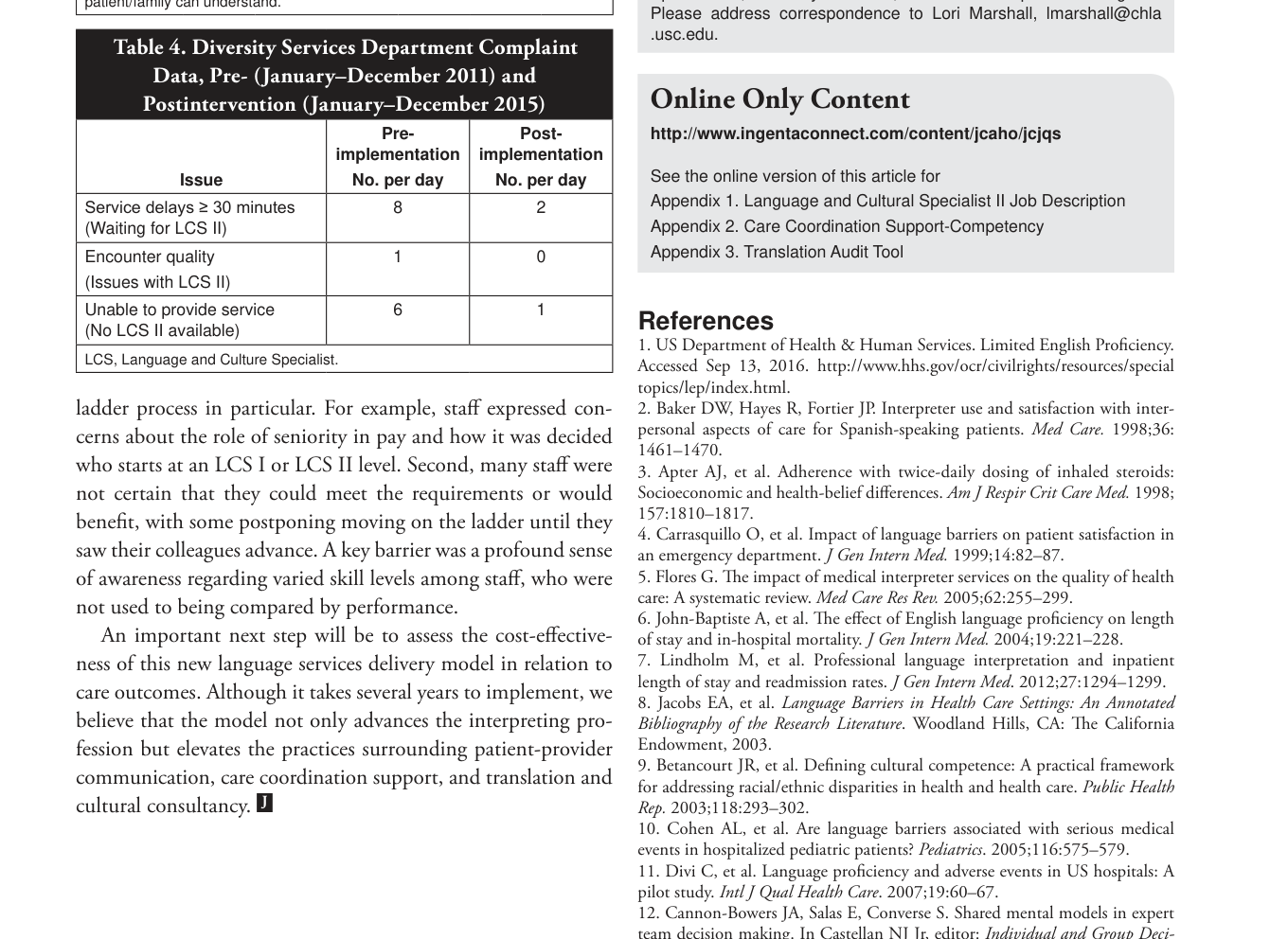
After implementing a four-level professional career ladder for interpreter (Language and Culture Specialist) staff, the Diversity Services Department recorded large pre-post reductions in logged complaints: a 75% reduction in calls for service delays, a 100% reduction in encounter-quality complaints, and an 85% reduction in "unable to provide service" complaints. The supporting table reports daily complaint counts falling from 8 to 2 (service delays ≥30 minutes), 1 to 0 (encounter quality), and 6 to 1 (unable to provide service) (Table 4).
"Postintervention of the professional ladder, there was a 75% reduction in calls for service delays, a 100% reduction in encounter quality complaints, and an 85% reduction in 'unable to provide service' (Table 4, page 472)." (Marshall, 2016, pp. 470–471)
"Service delays ≥ 30 minutes (Waiting for LCS II) … 8 … 2 … Encounter quality (Issues with LCS II) … 1 … 0 … Unable to provide service (No LCS II available) … 6 … 1" (Marshall, 2016, p. 472, Table 4)
Methods Context #
What? #ⓘ
The observable: logged complaints about language services, captured by department phone/e-mail intake and categorized into three groups — service delays, encounter quality, and unable to provide service.
"Complaints were categorized into three groups: service delays, encounter quality, and unable to provide service." (Marshall, 2016, p. 470)
How? #ⓘ
Pre-post quality-improvement comparison of complaint counts before (January–December 2011) versus after (January–December 2015) the professional-ladder restructuring; complaints logged by staff answering phones and via e-mail, reviewed weekly and summarized.
"Data for complaints were captured by staff answering phones in the department who would log complaint calls by callers, location, and issue. Complaints sent by e-mail were logged and accounted for by sender, location, and issue. Data were reviewed weekly and summarized for weekly and month totals." (Marshall, 2016, p. 470)
Who? #ⓘ
Children's Hospital Los Angeles, a 357-bed metropolitan academic pediatric medical center with 33 clinics (>15,682 admissions, 77,673 ED visits, 348,440 outpatient visits in 2015); >60% of patients had limited English proficiency; 24 dedicated department language staff.
"CHLA, a metropolitan academic medical center for pediatric care, has a 357-bed hospital, as well as 33 clinics, for annual totals of more than 15,682 admissions, 77,673 emergency department (ED) visits, and 348,440 outpatient visits (data from 2015)." (Marshall, 2016, p. 466)
Other Notes #
This is an uncontrolled single-site pre-post comparison; the percentage reductions are derived from small daily counts (e.g., the 100% encounter-quality reduction reflects a drop from 1 to 0 per day). See qualifying caveat on design.
Caveats #
- Uncontrolled single-site pre-post QI design without concurrent control for the CHLA interpreter career ladder This is an uncontrolled, single-site quality-improvement (pre-post) report from one hospital with no concurrent control group, no statistical testing of the pre-post differences, and outcomes measured over a multi-year period of concurrent organizational change (CEO sponsorship, staff turnover, broader restructuring). The reported complaint reductions and satisfaction increase cannot be causally attributed to the career ladder alone, and the percentage reductions derive from very small daily complaint counts (e.g., 8→2, 1→0, 6→1). The authors themselves flag that care outcomes and cost-effectiveness were not yet evaluated, underscoring that these are descriptive QI signals rather than effect estimates.