No significant association between interpreter need and 30- or 90-day complication rates after TSA
Source
Kyle Kunze (2023). Association Between Limited English Language Proficiency and Disparities in Length of Stay and Discharge Disposition After Total Shoulder Arthroplasty: A Retrospective Cohort Stud. The Musculoskeletal Journal of Hospital for Special Surgery.
Description #
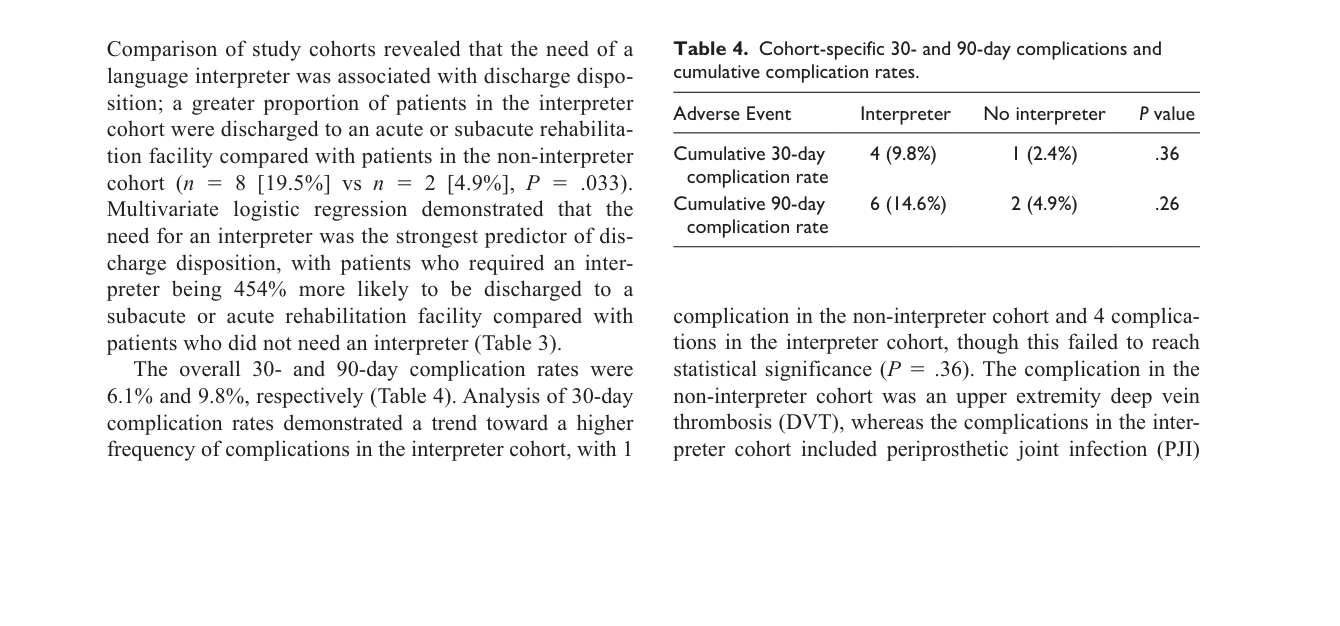
In the matched TSA cohort, short-term complication rates were statistically similar between the interpreter and non-interpreter cohorts. The interpreter cohort had numerically more complications at both 30 days (4 [9.8%] vs 1 [2.4%], P = .36) and 90 days (6 [14.6%] vs 2 [4.9%], P = .26), but neither difference reached statistical significance (Table 4).
"Analysis of 30-day complication rates demonstrated a trend toward a higher frequency of complications in the interpreter cohort, with 1 complication in the non-interpreter cohort and 4 complications in the interpreter cohort, though this failed to reach statistical significance (P = .36)." (Kunze, 2023, p. 88)
"Likewise, no statistically significant association was found between 90-day complication rates and interpreter use, with a total of 6 cumulative complications documented for the interpreter cohort and 2 cumulative complications for the non-interpreter cohort (P = .26)." (Kunze, 2023, p. 89)
Methods Context #
What? #ⓘ
The observable: cumulative 30-day and 90-day postoperative complication rates after TSA (a secondary outcome), counted by cohort.
"Secondary outcomes included discharge disposition and 30- and 90-day complications." (Kunze, 2023, p. 86)
How? #ⓘ
Single-institution retrospective cohort; complication counts compared between matched cohorts using χ2 / Fisher's exact test.
"Categorical or ordinal data were compared using the χ2 test of association or Fisher's exact test." (Kunze, 2023, p. 86)
Who? #ⓘ
41 interpreter-requiring TSA patients matched 1:1 to 41 non-interpreter patients at a single urban institution (Hospital for Special Surgery, NY), January 2016–March 2020.
"The overall 30- and 90-day complication rates were 6.1% and 9.8%, respectively (Table 4)." (Kunze, 2023, p. 88)
Other Notes #
The authors explicitly note the study was not powered to detect differences in complication rates, so the null result should not be read as evidence of no effect (see qualifying caveat). They speculate that difficulty interpreting discharge instructions could plausibly contribute to complications such as DVT or surgical-site infection, while acknowledging this is speculation that the retrospective design cannot establish.
Caveats #
- TSA study was not powered to detect differences in postoperative complication rates The a priori power analysis sized the cohorts (35 minimum per group; 41 enrolled) to detect a length-of-stay difference, not a complication-rate difference. The authors state the study was not powered to detect differences in complication rates and that larger studies may report conflicting data. Consequently the non-significant 30- and 90-day complication results (P = .36 and P = .26) cannot be interpreted as evidence that interpreter need is unrelated to complications — the study was likely underpowered for this secondary outcome, where the interpreter cohort still showed numerically higher complication counts.