Interpreter-cohort TSA patients were 454 percent more likely to be discharged to a rehabilitation facility
Source
Kyle Kunze (2023). Association Between Limited English Language Proficiency and Disparities in Length of Stay and Discharge Disposition After Total Shoulder Arthroplasty: A Retrospective Cohort Stud. The Musculoskeletal Journal of Hospital for Special Surgery.
Description #
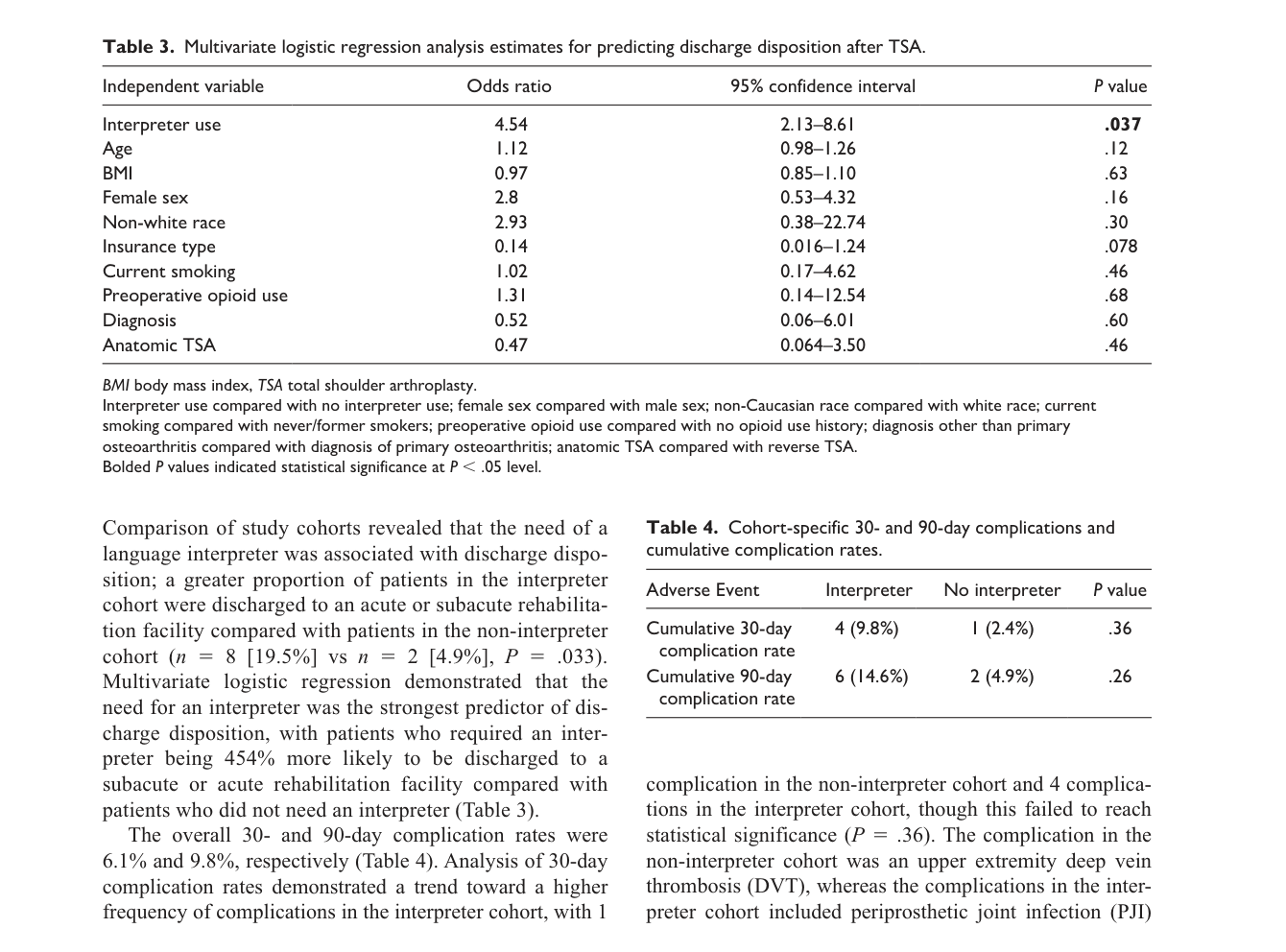
In the matched TSA cohort, a greater proportion of interpreter-requiring patients were discharged to an acute or subacute rehabilitation facility rather than home, compared with non-interpreter patients (n = 8 [19.5%] vs n = 2 [4.9%], P = .033). On multivariate logistic regression, interpreter use was the strongest predictor of discharge disposition: patients who required an interpreter were 454% more likely (odds ratio 4.54, 95% CI 2.13–8.61, P = .037) to be discharged to a subacute or acute rehabilitation facility (Table 3).
"Comparison of study cohorts revealed that the need of a language interpreter was associated with discharge disposition; a greater proportion of patients in the interpreter cohort were discharged to an acute or subacute rehabilitation facility compared with patients in the non-interpreter cohort (n = 8 [19.5%] vs n = 2 [4.9%], P = .033)." (Kunze, 2023, p. 88)
"Multivariate logistic regression demonstrated that the need for an interpreter was the strongest predictor of discharge disposition, with patients who required an interpreter being 454% more likely to be discharged to a subacute or acute rehabilitation facility compared with patients who did not need an interpreter (Table 3)." (Kunze, 2023, p. 88)
Methods Context #
What? #ⓘ
The observable: discharge disposition after TSA, classified as discharge home, to a subacute rehabilitation facility, or to an acute inpatient rehabilitation facility (a secondary outcome).
"Discharge disposition was classified as discharge to the patient's home, to a subacute rehabilitation facility, or to an acute inpatient rehabilitation facility." (Kunze, 2023, p. 86)
How? #ⓘ
Single-institution retrospective cohort; categorical disposition compared between matched cohorts with χ2 / Fisher's exact test, and multivariate logistic regression controlling for confounders to estimate the odds ratio.
"multivariate logistic regression models were constructed to investigate the potential association between interpreter use, discharge disposition, and short-term complication rates." (Kunze, 2023, p. 87)
Who? #ⓘ
41 interpreter-requiring TSA patients matched 1:1 to 41 non-interpreter patients (82 total) at a single urban institution (Hospital for Special Surgery, NY) from a TSA registry of consecutive reverse/anatomic TSA cases, January 2016–March 2020.
"A total of 72 (87.8%) patients were discharged home following TSA, while the remaining 10 patients were discharged to an acute or subacute rehabilitation facility." (Kunze, 2023, p. 87)
Other Notes #
The bivariate proportion (P = .033) and adjusted odds ratio (OR 4.54, P = .037) point the same direction. The authors speculate that communication barriers may prevent patients from expressing readiness for discharge or confidence in postoperative function, raising the likelihood of facility discharge.
Caveats #
- Retrospective TSA cohort could not control for unmeasured confounders (OSA, surgeon LOS thresholds, social factors) affecting LOS and discharge Because the study was a retrospective chart review, several factors plausibly affecting length of stay and discharge disposition could not be measured or controlled, even though cohorts were matched on age, BMI, sex, and procedure. The authors specifically name obstructive sleep apnea (which has LOS implications and was unavailable), surgeon-specific differences in postoperative LOS thresholds and protocols (introduced by pooling a 12-surgeon registry, neither quantified nor studied), day of the week of surgery, and unrecorded social factors (a patient's cultural expectations of hospital stay and home situation affecting safe discharge). These residual confounders mean the observed interpreter–LOS and interpreter–disposition associations may be partly attributable to factors other than the language barrier itself.