Bedside interpreter telephone access had no significant effect on length of stay
Source
Karliner (2017). Convenient Access to Professional Interpreters in the Hospital Decreases Readmission Rates and Estimated Hospital Expenditures for Patients With Limited English Proficiency. Med Care.
Description #
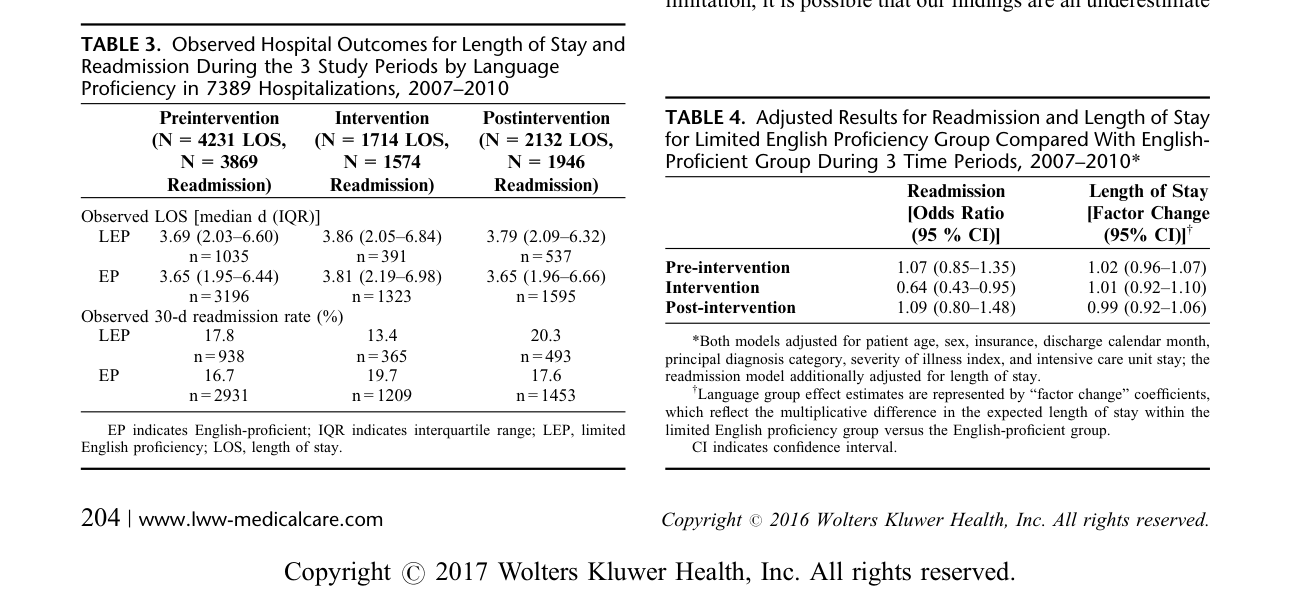
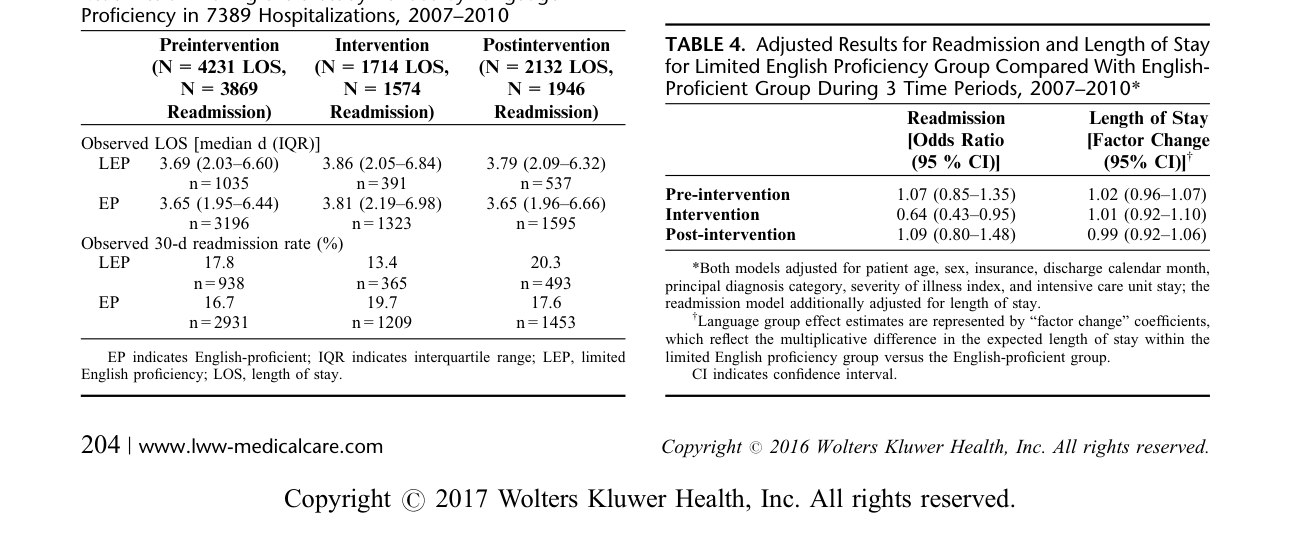
The bedside interpreter telephone intervention had no significant impact on length of stay (LOS) for LEP patients. Unadjusted median LOS was essentially unchanged across the three study periods and did not differ between LEP and EP groups (e.g., LEP intervention median 3.86 days vs EP 3.81; Table 3). In adjusted analyses the period-by-language interaction for LOS was not significant (P=0.818), and the LEP-vs-EP factor-change estimate during intervention was 1.01 (95% CI 0.92–1.10) (Table 4).
"There was no significant impact of the bedside intervention on LOS. The unadjusted median LOS did not differ between LEP and EP groups over the 3 study time periods (Table 3). In adjusted analyses, the effect of intervention intensity on LOS was not significantly modified by patient language (P = 0.818 for test of interaction) (Table 4)." (Karliner, 2017, p. 203)
"There was no significant intervention impact on length of stay in either unadjusted or adjusted analyses." (Karliner, 2017, p. 199)
Methods Context #
What? #ⓘ
The observable: length of stay in days, derived from admission and discharge date/time in the administrative billing database; log-transformed for modeling.
"We defined LOS using the admission and discharge date and time from the administrative billing database. After log-transformation, the LOS outcome was approximately normally distributed ... and was modeled using linear regression." (Karliner, 2017, p. 201)
How? #ⓘ
Natural experiment / quasi-experimental pre–intervention–post design; linear regression on logged LOS with study period, language group, and period-by-language interaction plus covariates (age, sex, insurance, calendar month, principal diagnosis, SOI, ICU stay), fit with GEE; EP group as nonequivalent control.
"Linear (for logged LOS) and logistic (for 30-day readmission) models regressed the outcome onto a categorical indicator of the study periods, patient language group, and the period-by-language interaction, as well as covariates ... All models were fit using generalized estimating equations with exchangeable correlation structure to accommodate repeated hospital stays for individual patients." (Karliner, 2017, p. 201)
Who? #ⓘ
Discharges of patients aged 50 years or older from the 2-unit Medicine floor of an academic medical center, Jan 15 2007–Jan 15 2010; 8077 discharges (1963 LEP, 6114 EP) after exclusions of top-1% LOS, planned chemo/radiation, and missing/unknown language.
"there were 8077 discharges included for patients age 50 years or above (range, 50–108), 1963 (24.3%) for LEP and 6114 for EP patients." (Karliner, 2017, p. 201)
Other Notes #
The authors interpret the LOS null as consistent with mixed prior findings, reasoning that better communication can both shorten LOS (faster diagnosis) and lengthen it (fuller history-taking, discharge preparation), with the net effect near zero.
Caveats #
- Single-institution natural experiment with low baseline interpreter use limits generalizability and causal certainty The study was a single-institution natural experiment with limited baseline interpreter use, and it included only patients aged 50 years and older. As a quasi-experimental design at one hospital, it cannot fully rule out secular trends or unmeasured confounding (the authors note they cannot explain the concurrent rise in EP readmission), and the readmission benefit may not generalize to hospitals serving younger LEP populations or with different baseline interpreter access.