Bedside interpreter telephone access lowered LEP 30-day readmission during intervention (OR 0.64)
Source
Karliner (2017). Convenient Access to Professional Interpreters in the Hospital Decreases Readmission Rates and Estimated Hospital Expenditures for Patients With Limited English Proficiency. Med Care.
Description #
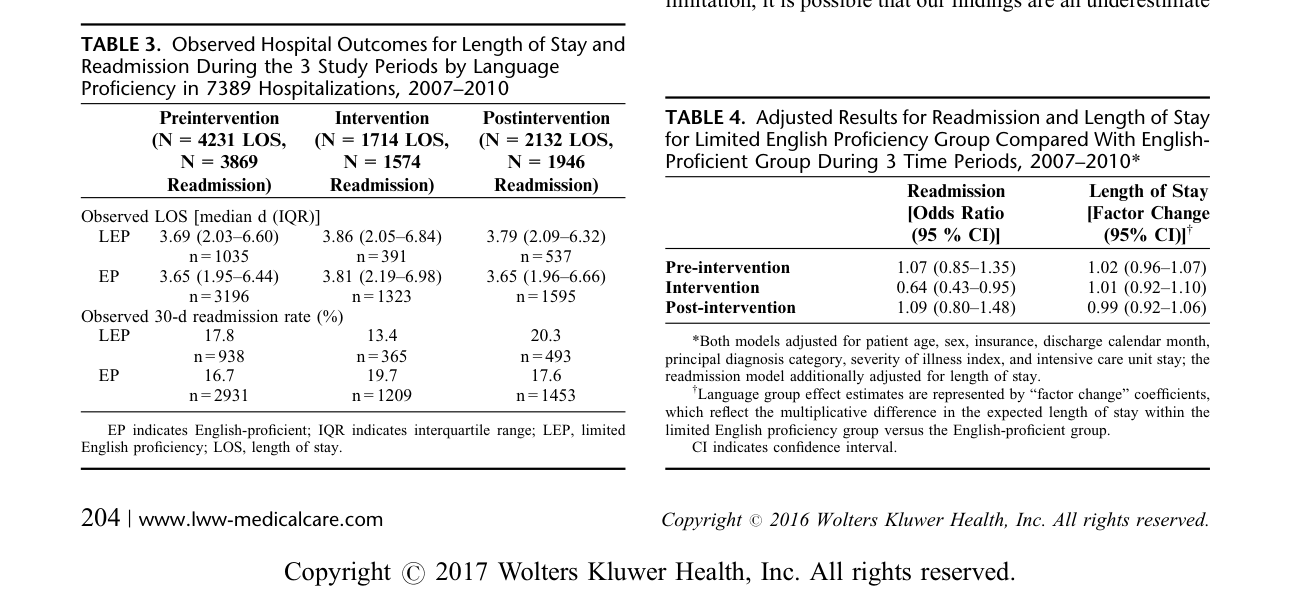
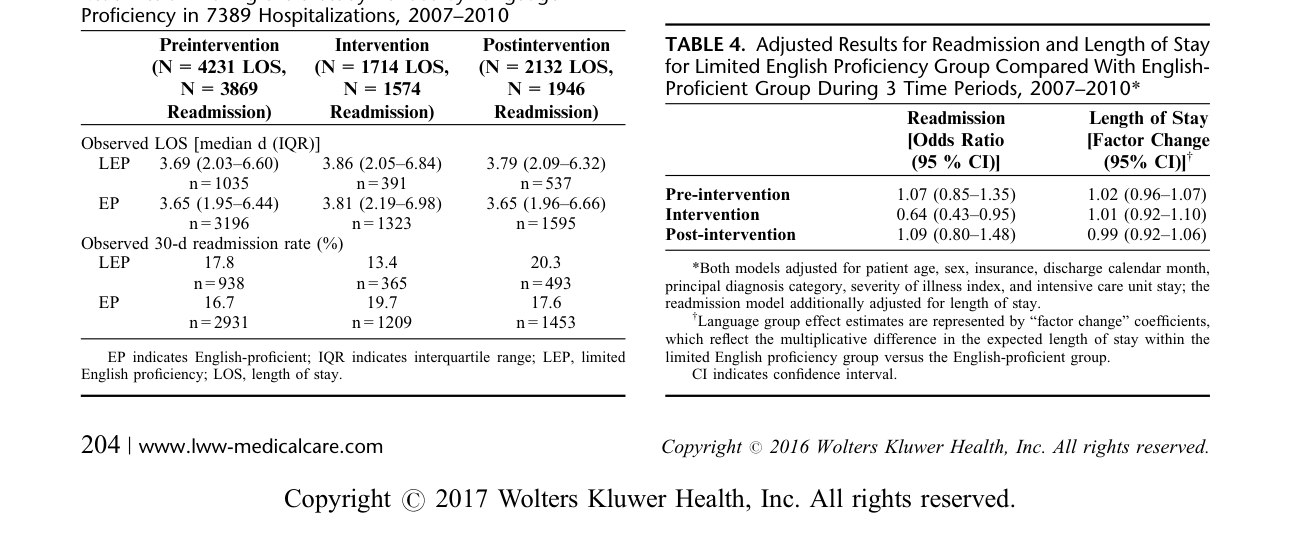
Providing a dual-handset interpreter telephone at every LEP bedside was associated with a significant reduction in 30-day readmissions for the LEP group during the 8-month intervention period. Observed LEP readmission fell from 17.8% preintervention to 13.4% during the intervention, while English-proficient (EP) readmission rose from 16.7% to 19.7% over the same window (Table 3). In adjusted analyses the period-by-language interaction was significant (P=0.040), and the LEP-vs-EP adjusted odds ratio for readmission was 0.64 (95% CI 0.43–0.95) during the intervention versus roughly equivalent pre (1.07) and post (1.09) periods (Table 4). The improvement was not maintained postintervention once the telephones became less accessible.
"In adjusted analyses, the effect of the intervention on readmission rates was significantly modified by patient language group; that is, the effect of the study periods on readmission rates significantly differed across the 2 language groups (P = 0.040 for test of interaction). The odds of readmission for the LEP compared with EP group was lower during the intervention period; while it was roughly equivalent during both the preintervention and postintervention periods (Table 4)." (Karliner, 2017, p. 203)
"There was a significant decrease in observed 30-day readmission rates for the LEP group during the 8-month intervention period compared with 18 months preintervention (17.8% vs. 13.4%); at the same time English proficient readmission rates increased (16.7% vs. 19.7%); results remained significant in adjusted analyses." (Karliner, 2017, p. 199)
Methods Context #
What? #ⓘ
The observable: 30-day readmission, defined as any inpatient admission to any service within 30 days of the index Medicine-floor discharge, drawn from administrative billing data.
"We defined readmission as any inpatient admission to any service occurring r30-days from the time of the index discharge from the Medicine floor." (Karliner, 2017, p. 201)
How? #ⓘ
Natural experiment / quasi-experimental pre–intervention–post design; logistic models regressed 30-day readmission on study period, language group, and the period-by-language interaction, adjusting for age, sex, insurance, calendar month, principal diagnosis, severity of illness, ICU stay, and LOS, fit with GEE. EP group served as nonequivalent control.
"Linear (for logged LOS) and logistic (for 30-day readmission) models regressed the outcome onto a categorical indicator of the study periods, patient language group, and the period-by-language interaction, as well as covariates describing patient age, sex, insurance, discharge calendar month, principal diagnosis category, SOI index, and ICU stay." (Karliner, 2017, p. 201)
Who? #ⓘ
Discharges of patients aged 50 years or older from the 2-unit Medicine floor of an academic medical center, Jan 15 2007–Jan 15 2010; 8077 discharges (1963 LEP, 6114 EP) after exclusions, with 7389 eligible for the readmission analysis.
"there were 8077 discharges included for patients age 50 years or above (range, 50–108), 1963 (24.3%) for LEP and 6114 for EP patients." (Karliner, 2017, p. 201)
Other Notes #
The effect is an interaction (the EP control trended upward while LEP fell), and it was tied to the intervention's accessibility: readmission benefit disappeared in the postintervention period (LEP 20.3%) once phones were removed from bedsides during a floor remodel.
Caveats #
- Single-institution natural experiment with low baseline interpreter use limits generalizability and causal certainty The study was a single-institution natural experiment with limited baseline interpreter use, and it included only patients aged 50 years and older. As a quasi-experimental design at one hospital, it cannot fully rule out secular trends or unmeasured confounding (the authors note they cannot explain the concurrent rise in EP readmission), and the readmission benefit may not generalize to hospitals serving younger LEP populations or with different baseline interpreter access.
- No individual-patient interpreter data, so readmission analysis is intention-to-treat only without per-protocol exposure Interpreter utilization could not be linked to individual patients, so the analysis is essentially intention-to-treat at the floor/period level rather than per-protocol. Some patients may have had many interpreted encounters and others none, and the authors could not test whether patients without interpreted encounters were readmitted more often, leaving the dose–response link between actual interpreter use and the readmission benefit unverified.