Interpreter or bilingual-provider access was offered to only 24% of postpartum couplets at admission and 14% for daily rounds
Source
Jennifer L Jensen (2023). Evaluation of Patient Access to Spanish-Language-Concordant Care on a Postpartum Unit. Clinical Evaluation and improvement.
Description #
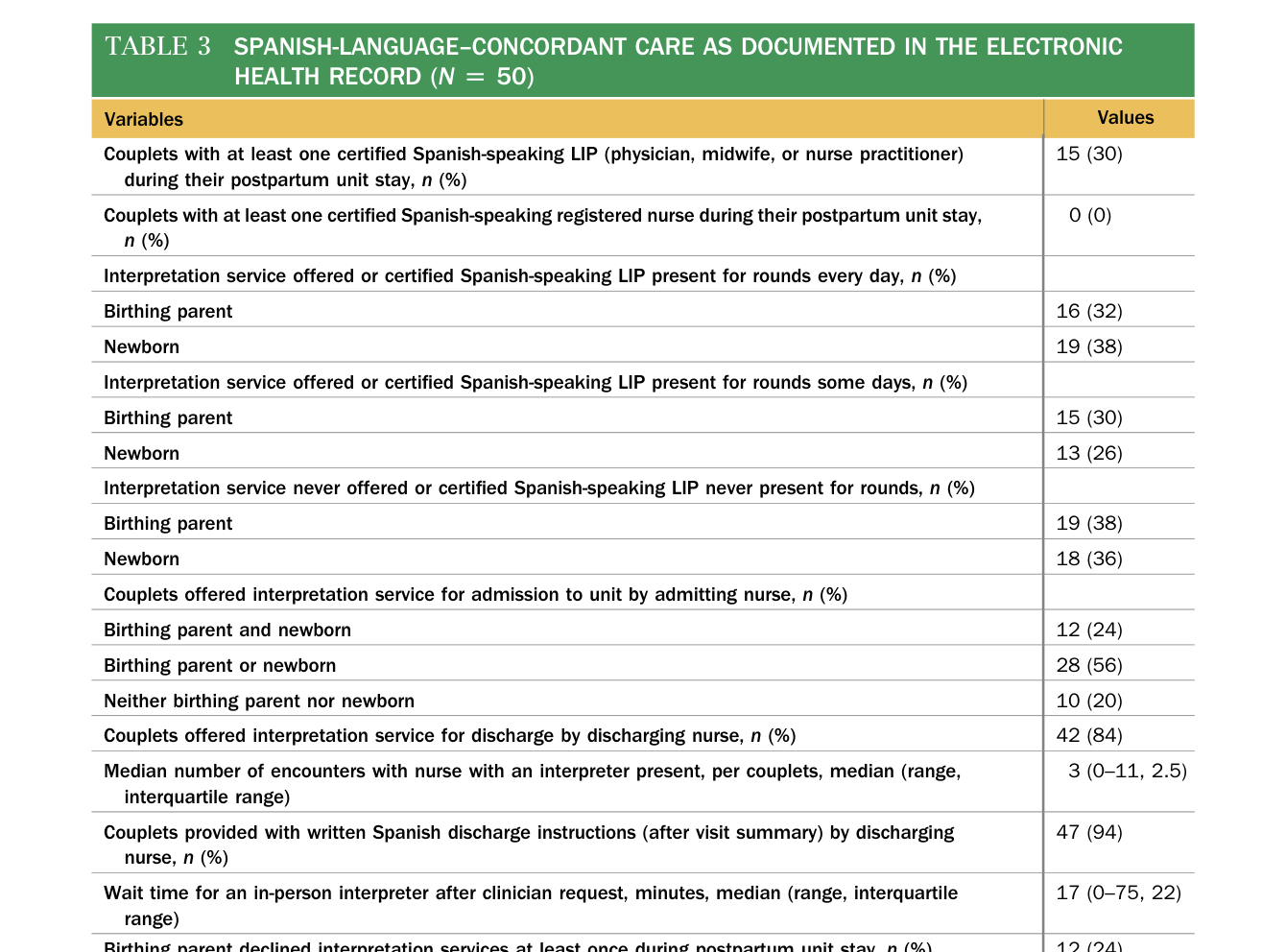
In a chart review of 50 Spanish-preferring postpartum birthing parent–newborn couplets, access to a clinician certified in medical Spanish or to an interpreter was offered to both members of the couplet at only 12 of 50 (24%) admissions and at only 7 of 50 (14%) daily maternal/newborn rounds; a substantial share of couplets never had concordant access during rounds across their stay (birthing parent 38%, newborn 36%) (Table 3). The authors read this as systematic underuse of interpretation services relative to national standards.
"Access to a clinician certified in medical Spanish or an interpreter was offered to 12 of 50 (24%) couplets upon admission to the unit and to 7 of 50 (14%) of couplets for daily maternal and newborn medical rounds." (Jensen, 2023, p. 429)
"Birthing parents and newborns had a bilingual LIP or interpretation service during rounds each day (32% and 38%, respectively); on some days (30% and 26%); or, for a substantial proportion, never during their postpartum hospitalization (38% and 36%)." (Jensen, 2023, p. 434)
Methods Context #
What? #ⓘ
The observable: the proportion of sampled postpartum encounters (admission, daily rounds, discharge) at which interpretation service or a certified Spanish-speaking provider was offered or used, abstracted from the EHR.
"Instances of interpreter use were analyzed as the proportion of sample encounters, including postpartum admission for birthing parent and newborn, daily rounds for birthing parent and newborn, discharge for the couplet, and all nursing encounters inclusive of admission and discharge." (Jensen, 2023, p. 434)
How? #ⓘ
Cross-sectional retrospective chart review: clinician notes and interpreter-service logs in the EHR were reviewed for each couplet to record whether interpretation services were offered, used, or declined per encounter type; analyzed with descriptive statistics in Excel.
"All clinician notes within these 101 charts (50 for birthing parents and 51 for their newborns) were reviewed to evaluate clinician use or patient declines of interpreter services." (Jensen, 2023, p. 433)
Who? #ⓘ
50 randomly selected birthing parent–newborn couplets with a documented Spanish-language preference, admitted Sept–Dec 2019 (pre-COVID) to a postpartum unit at a tertiary academic medical center in the southeastern United States; sampled from 164 eligible couplets, with two replaced for not meeting inclusion criteria.
"There were 164 couplets with documented Spanish language preference in the study time frame, and 50 (30%) were randomly selected using the Microsoft Excel RAND function for this descriptive study." (Jensen, 2023, p. 433)
Other Notes #
By contrast, concordant access was high at discharge (84% of couplets had an interpreter offered/present; 94% received Spanish written discharge instructions), so the underuse was concentrated in admission and daily rounds rather than the formal discharge step.
Caveats #
- EHR-documented Spanish language preference is an imperfect proxy for language-access need The cohort was defined by patients' documented Spanish-language preference in the EHR, which the authors note is an imperfect indicator of actual language-access need. Some flagged patients may have preferred English ("false positives") and some who needed interpreters may have identified as English-speaking ("false negatives") out of fear of bias or embarrassment, so the denominators and the measured proportions of concordant-care provision may be mis-estimated.
- Single-site small sample limited to Spanish-speaking postpartum patients limits generalizability The study drew small samples (50 couplets in the chart review; 14 clinicians interviewed) from a single tertiary academic medical center and restricted attention to Spanish-speaking patients. These descriptive proportions and themes therefore characterize one unit's local practice and may not generalize to other sites, other languages, or other care settings.