Documented interpreter use was not significantly associated with LOS, ED revisits, readmission, or surgical follow-up after cholecystectomy
Source
J Walker Rosenthal (2025). Pilot study of provider adherence to language services for surgical patients with limited English proficiency. American journal of surgery.
Description #
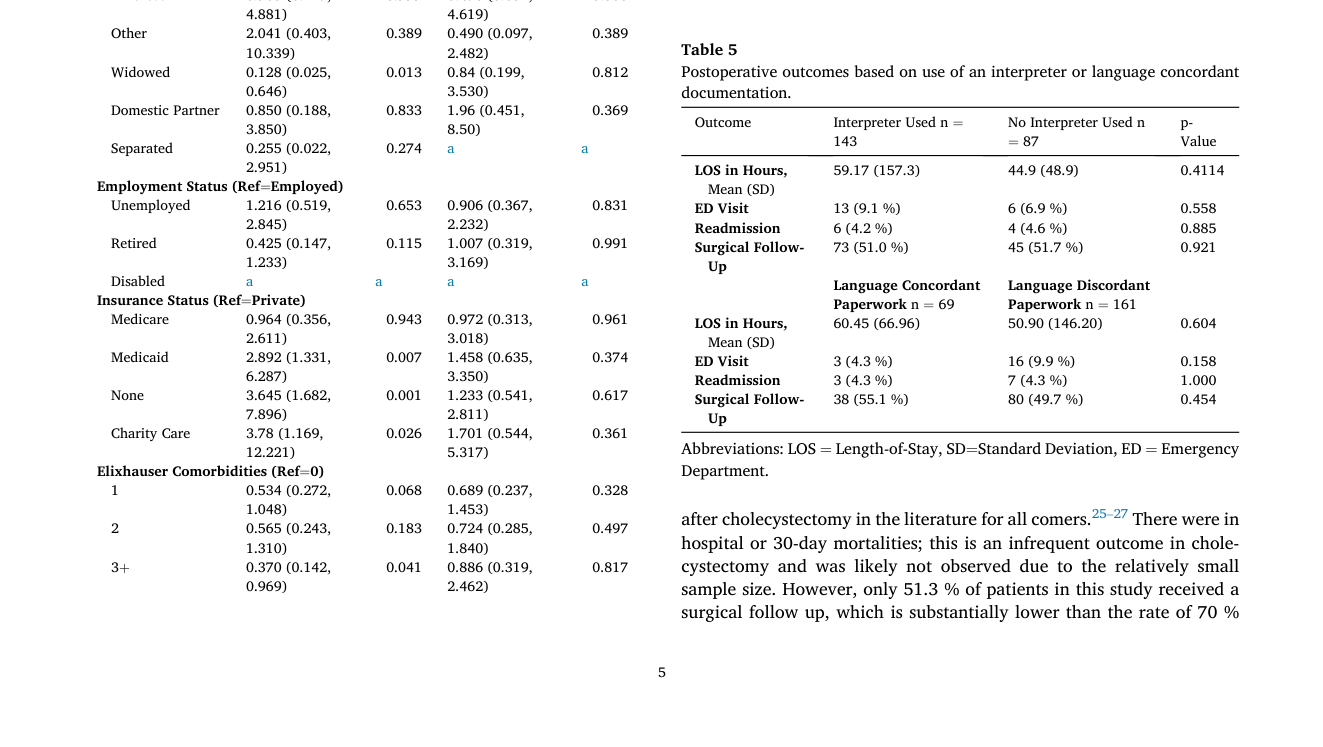
In LEP cholecystectomy patients, documented interpreter use was not significantly associated with any of the four 30-day postoperative outcomes examined: length of stay (LOS 59.17 vs 44.9 hours, p=0.4114), ED revisits (9.1% vs 6.9%, p=0.558), readmission (4.2% vs 4.6%, p=0.885), or surgical follow-up (51.0% vs 51.7%, p=0.921) (Table 5). These are null/non-significant associations in a study the authors describe as likely underpowered for these infrequent clinical outcomes.
"Interpreter service utilization and language concordant documentation were not significantly associated with LOS, ED visits, hospital readmissions, or surgeon follow-up." (Rosenthal, 2025, p. 1)
"There were no statistically significant differences in postoperative outcomes by use of interpreter services or language concordant paperwork (Table 5)." (Rosenthal, 2025, pp. 3–4)
Methods Context #
What? #ⓘ
The observables: 30-day postoperative hospital length-of-stay (hours), ED re-visits, readmissions, and surgical-team follow-up visits, compared between patients with vs without documented interpreter use.
"Clinical outcomes were captured if they occurred within 30 days of the operative encounter, and these outcomes included hospital length-of-stay, emergency department (ED) re-visits, readmissions, follow-up visits with the surgical team, and 30-day mortality." (Rosenthal, 2025, p. 2)
How? #ⓘ
Retrospective cohort with univariate analysis; Chi-square for binary outcomes, two-sample t-tests for time-related outcomes, and univariate regression for associations; significance at p<0.05.
"Univariate analyses were performed using Chi-square analysis for binary outcomes, two-sample t-tests for time-related outcomes, and univariate regression to determine associations. All p values were from 2-sided tests and results were deemed statistically significant at p < 0.05." (Rosenthal, 2025, p. 2)
Who? #ⓘ
228 LEP cholecystectomy patients (143 with documented interpreter use vs 87 without) across five University of Pennsylvania Health System hospitals, Jan 2021–Jan 2024; postoperative outcomes were rare (19 ED visits, 10 readmissions, 0 deaths).
"Of the entire cohort, 118 (51.30 %) patients completed a follow-up visit with the surgical team. Furthermore, 19 (8.26 %) patients presented to the ED postoperatively and 10 (4.35 %) were readmitted. No patients died within 30 days of their operation." (Rosenthal, 2025, p. 3)
Other Notes #
The mean LOS for the operative encounter was 2 d 6 h (±5 d 8 h). The point estimate for LOS was higher in the interpreter-used group (59.17 vs 44.9 hours) but with very large SD (157.3) and not significant.
Caveats #
- Retrospective single-system single-operation design limits generalizability of cholecystectomy language-service findings The study is retrospective and confined to a single health system and a single operation (cholecystectomy), limiting the generalizability of both the utilization rates and the outcome associations. The authors note the multi-hospital, broad-region nature of the system may partly offset this.
- Small sample with rare postoperative events left the cholecystectomy outcome associations underpowered Postoperative events were rare in this relatively small cohort (19 ED visits, 10 readmissions, and 0 deaths among 228 patients), and the authors explicitly attribute the absence of observed mortality to the small sample size. The non-significant associations between language-service use and LOS, ED revisits, readmission, or follow-up therefore cannot be read as evidence of no effect; the study was likely underpowered to detect such differences.