Only 31% of LEP cholecystectomy patients received language-concordant documentation
Source
J Walker Rosenthal (2025). Pilot study of provider adherence to language services for surgical patients with limited English proficiency. American journal of surgery.
Description #
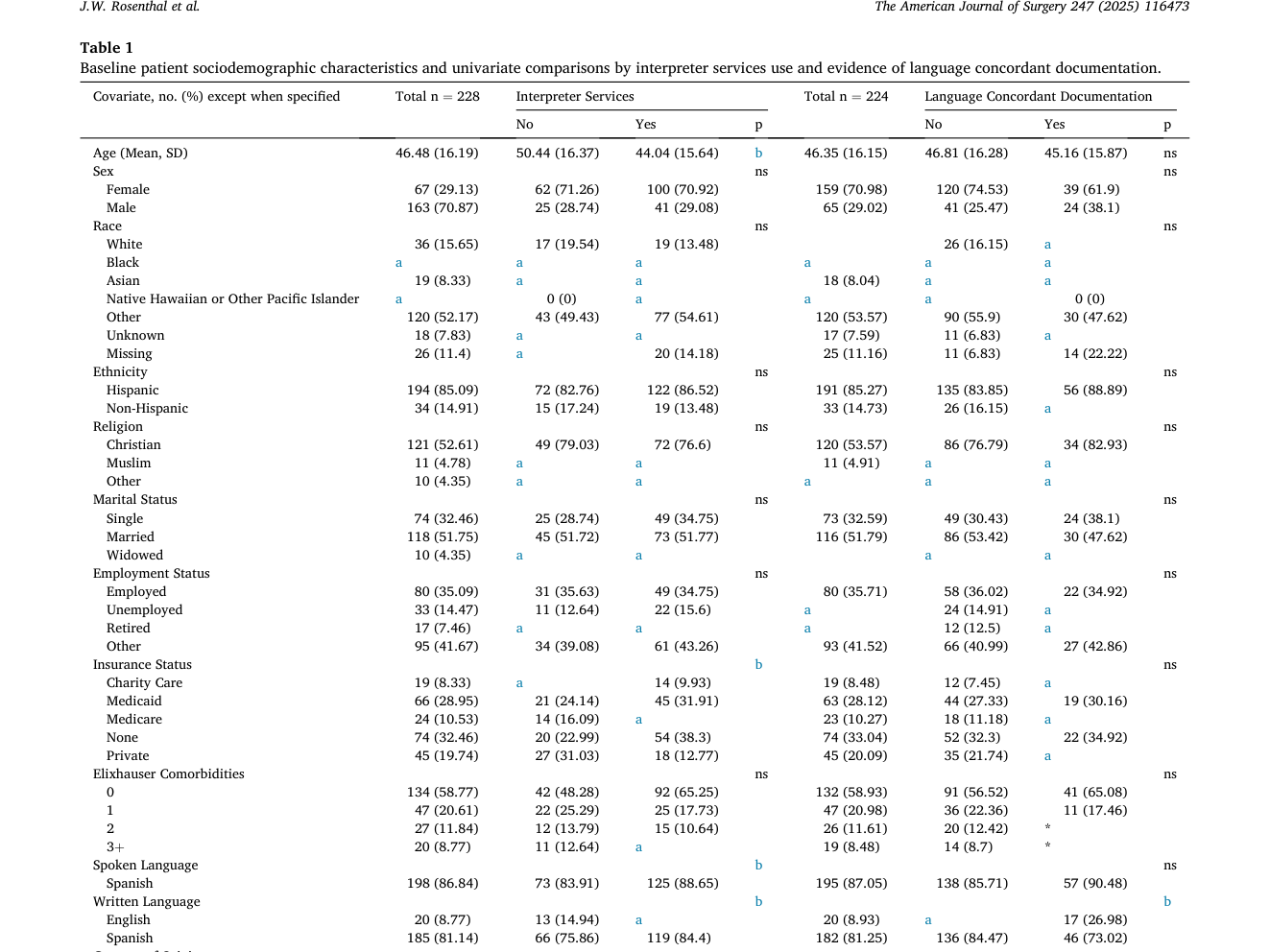
Among LEP patients undergoing cholecystectomy, only 31% (69 of 228) received any language-concordant paperwork (translated consent form and/or discharge documents). Fully language-concordant consent forms were present for only 21% (n=47), and complete language-concordant discharge documents for only 13% (n=28); most patients (75%, n=168) had only partially concordant discharge documents (Supplementary Table 1).
"Of the total cohort, 69 (31 %) patients had language concordant paperwork. Of those patients, all 47 (21 %) had fully language concordant consent forms. Furthermore, 168 (75 %) patients had partially concordant discharge documents. Twenty-eight (13 %) patients had completely concordant discharge documents (Supplementary Table 1)." (Rosenthal, 2025, p. 2)
"Within this single academic institution, 62.17 % of patients had documented the use of an interpreter during the preoperative informed consent process, 20.43 % included language-concordant consent forms, and 12.17 % provided complete language-concordant discharge paperwork." (Rosenthal, 2025, p. 4)
Methods Context #
What? #ⓘ
The observable: presence of translated, language-concordant paperwork for the surgical consent form and/or the discharge documents, abstracted from the EMR; discharge concordance categorized as full, partial (only pre-populated areas), or none.
"Translated, language concordant paperwork for either the surgical consent form and/or the discharge documents. Language concordance on discharge documents was considered ‘partial’ if only pre-populated areas were concordant with written language whereas inputted information was in English." (Rosenthal, 2025, p. 2)
How? #ⓘ
Retrospective cohort study; two independent researchers abstracted documentation of language-concordant paperwork from the EMR (Epic Penn Chart).
"All data were obtained from the electronic medical record (EMR; Epic Penn Chart Systems). Chart review was performed by two independent researchers (E.B and J.R.)" (Rosenthal, 2025, p. 2)
Who? #ⓘ
228 LEP patients aged ≥18 undergoing cholecystectomy across five University of Pennsylvania Health System hospitals (Jan 2021–Jan 2024); predominantly Hispanic (85%) and Spanish-speaking (87%).
"The study population included 228 patients with limited English proficiency who underwent cholecystectomy." (Rosenthal, 2025, p. 2)
Other Notes #
Patients with Spanish or Chinese written-language preference had markedly lower odds of language-concordant paperwork than those with English written language (Spanish OR 0.06, p<0.001; Chinese OR 0.028, p=0.004) (Table 4).
Caveats #
- Retrospective single-system single-operation design limits generalizability of cholecystectomy language-service findings The study is retrospective and confined to a single health system and a single operation (cholecystectomy), limiting the generalizability of both the utilization rates and the outcome associations. The authors note the multi-hospital, broad-region nature of the system may partly offset this.
- Only documented language-service use could be assessed, likely underestimating true utilization Utilization was measured only as documented use in the EMR; actual interpreter and language-concordant-service use that was provided but not documented would be missed, so the reported 62% interpreter-use and 31% concordant-documentation rates likely underestimate true utilization.