Interpreter use was documented for only 62% of LEP cholecystectomy patients despite the Section 1557 mandate
Source
J Walker Rosenthal (2025). Pilot study of provider adherence to language services for surgical patients with limited English proficiency. American journal of surgery.
Description #
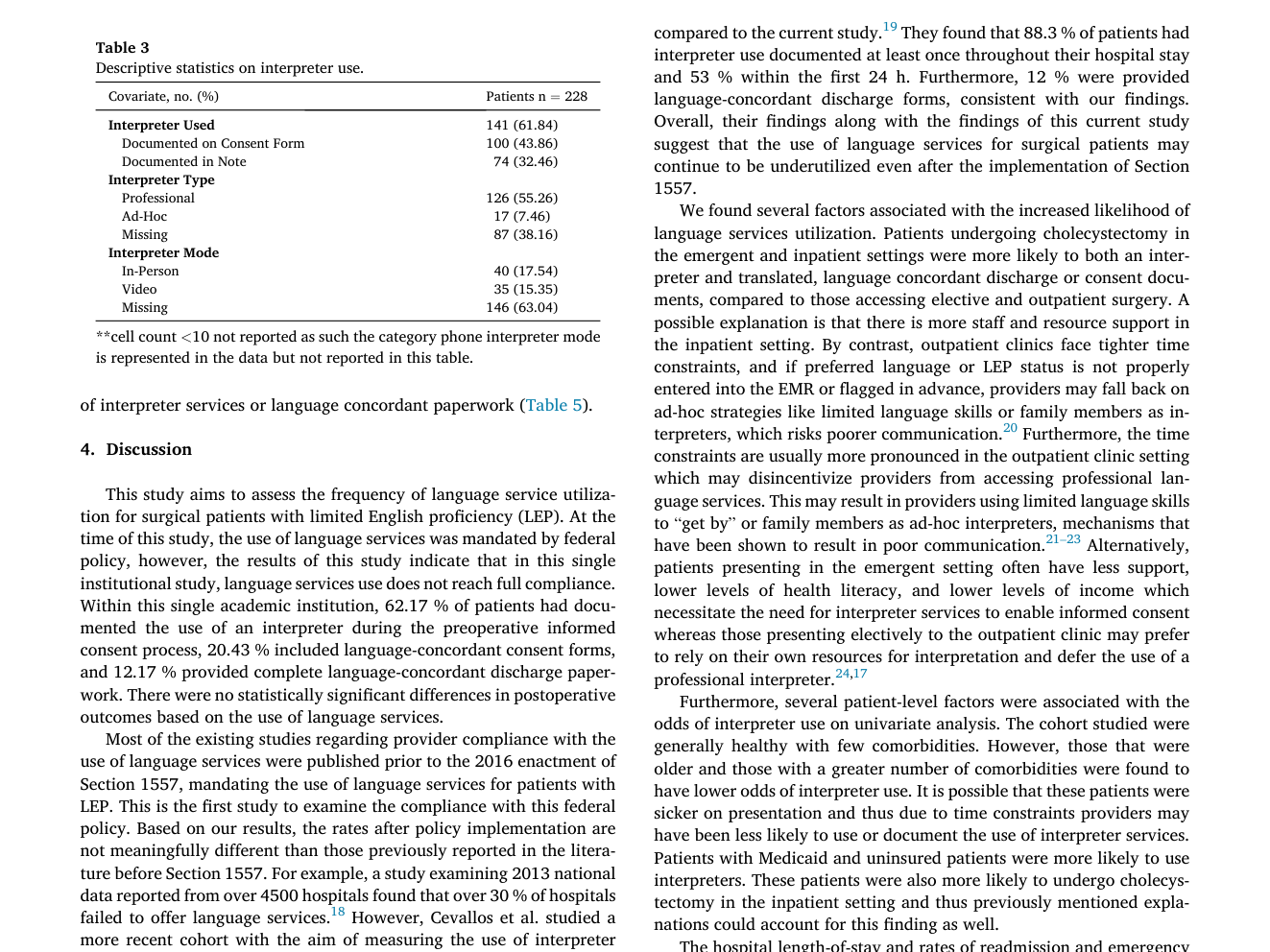
Among LEP patients undergoing cholecystectomy at a single academic health system, documented interpreter use during the preoperative informed-consent process was present for only 62% of patients (141 of 228), well below the full compliance required by Section 1557 of the Affordable Care Act. Of those with documented use, most was by a professional interpreter (n=126, 55%) while 7% used an ad-hoc interpreter (Table 3).
"Of the total cohort, 141 (62 %) patients had some form of documented interpreter use during the informed consent process, and 69 (31 %) patients had language concordant paperwork." (Rosenthal, 2025, p. 2)
"Within this single academic institution, 62.17 % of patients had documented the use of an interpreter during the preoperative informed consent process, 20.43 % included language-concordant consent forms, and 12.17 % provided complete language-concordant discharge paperwork." (Rosenthal, 2025, p. 4)
Methods Context #
What? #ⓘ
The observable: documented use of a language interpreter during the preoperative informed-consent process, abstracted from the physical surgical consent form and/or the preoperative surgical note in the EMR.
"The primary outcome was documented use of language services. This included1 use of an interpreter during the preoperative informed consent process as documented on the physical surgical consent form and/or the preoperative surgical note as a statement stating the use of an interpreter." (Rosenthal, 2025, p. 2)
How? #ⓘ
Retrospective cohort study; two independent researchers performed chart review of the EMR (Epic Penn Chart) to abstract documented interpreter use, with interpreter services categorized as professional, ad-hoc, or missing.
"We conducted a retrospective cohort study of patients with limited English proficiency (LEP) who underwent a cholecystectomy at one of five hospitals affiliated with the University of Pennsylvania Health System (UPHS; Pennsylvania, United States) from January 01, 2021 to 01/31/2024." (Rosenthal, 2025, p. 2)
Who? #ⓘ
228 LEP patients aged ≥18 undergoing cholecystectomy across five University of Pennsylvania Health System hospitals (Jan 2021–Jan 2024); predominantly Hispanic (85%) and Spanish-speaking (87%); excluded those <18, lacking a preoperative written informed consent in the record, or not consenting for themselves.
"The study population included 228 patients with limited English proficiency who underwent cholecystectomy." (Rosenthal, 2025, p. 2)
Other Notes #
The authors note this likely underestimates true utilization because only documented use could be assessed.
Caveats #
- Retrospective single-system single-operation design limits generalizability of cholecystectomy language-service findings The study is retrospective and confined to a single health system and a single operation (cholecystectomy), limiting the generalizability of both the utilization rates and the outcome associations. The authors note the multi-hospital, broad-region nature of the system may partly offset this.
- Only documented language-service use could be assessed, likely underestimating true utilization Utilization was measured only as documented use in the EMR; actual interpreter and language-concordant-service use that was provided but not documented would be missed, so the reported 62% interpreter-use and 31% concordant-documentation rates likely underestimate true utilization.