Adjusted odds of 7-day ED readmission were only 3% higher and non-significant for interpreter-requested pediatric patients
Source
Greenky (2019). A Reversed Trend: Care for Limited English Proficiency Patients in the Pediatric Emergency Department. Emergency Medicine International.
Description #
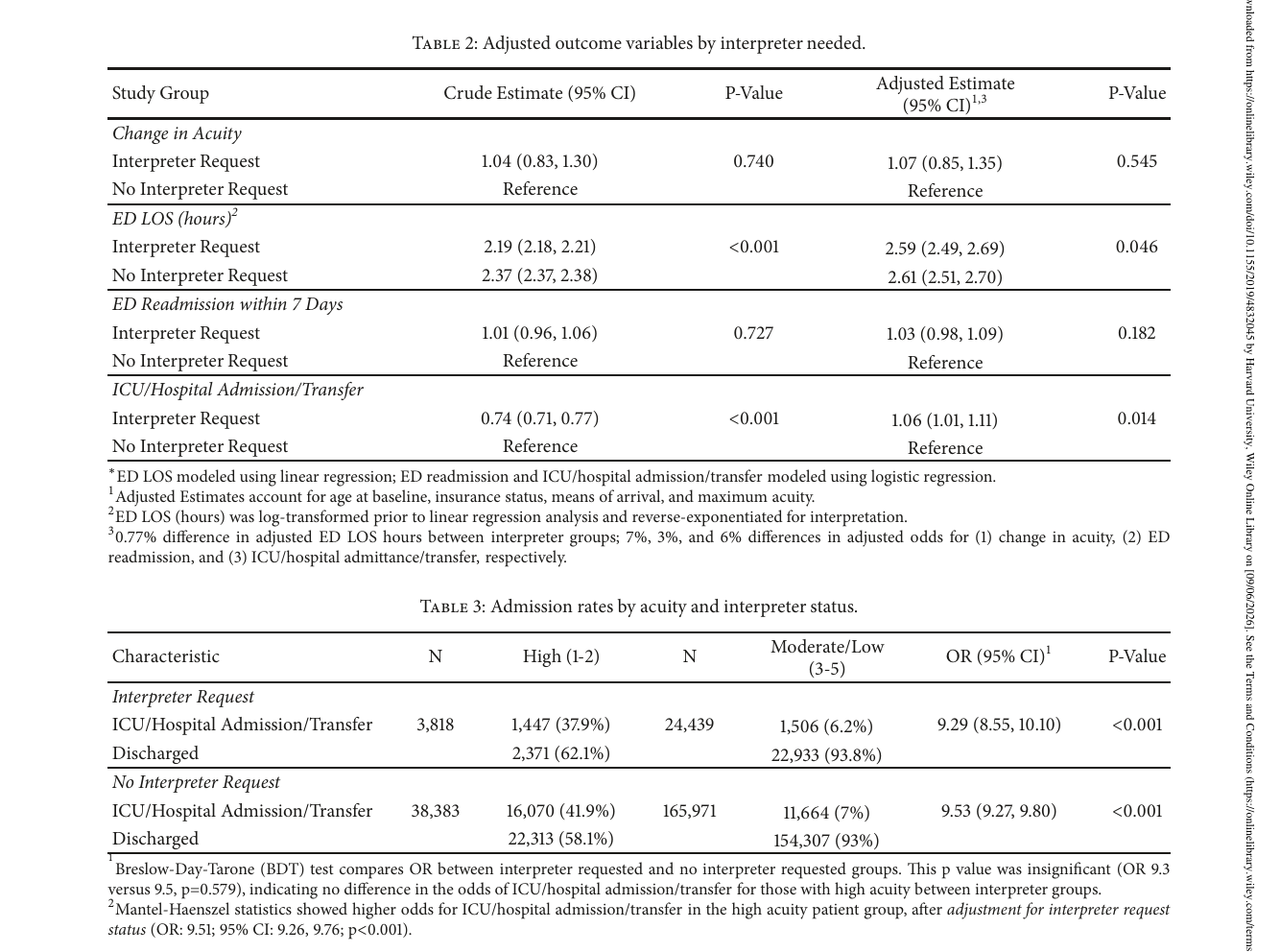
For ED readmission within 7 days, the adjusted odds were only 3.0% higher in the interpreter-requested cohort than in the no-interpreter group (adjusted OR 1.03, 95% CI: 0.98–1.09; p=0.182), a small, non-significant effect (ES < 0.2) (Table 2). This contrasts with prior pediatric-ED studies that reported increased unplanned return rates for LEP patients.
"For ED readmission within 7 days, adjusted odds were 3.0% higher in the interpreter requested cohort (aOR: 1.03, 95% CI: 0.98, 1.09). These ES are considered small and not clinically significant (ES < 0.2)." (Greenky, 2019, p. 4)
Methods Context #
What? #ⓘ
The observable: whether a patient returned to the ED within seven days (ED readmission within 7 days), recorded per encounter from the EPIC EMR.
"Study outcomes were change in triage acuity, ED length of stay (LOS), readmission to the ED within seven days, and hospital disposition." (Greenky, 2019, p. 2)
How? #ⓘ
Retrospective cohort study; ED readmission modeled with logistic regression adjusted for age at baseline, insurance status, means of arrival, and maximum acuity, reported as adjusted odds ratios with 95% CIs. Effect sizes (Cohen's d) prioritized over p-values given the large sample.
"crude and adjusted associations between interpreter categories and the study outcomes were modeled using... logistic regression for change in acuity, ED readmission within 7 days, and hospital disposition." (Greenky, 2019, p. 2)
Who? #ⓘ
All patients aged 0–18 presenting to three CHOA pediatric EDs in 2016 (152,945 patients / 232,787 encounters); LEP defined by an interpreter request during the encounter; dead-on-arrival and unlisted-language patients excluded.
"This was a retrospective cohort study that looked at all patients aged 0-18 years that arrived in the three CHOA EDs (Hughes Spalding Hospital, Egleston Hospital, and Scottish Rite Hospital) between January 1, 2016, and December 31, 2016." (Greenky, 2019, p. 2)
Other Notes #
The 95% CI (0.98–1.09) crosses 1, consistent with the non-significant p-value, and the absolute readmission rate was nearly identical between groups (7.1% interpreter-requested vs 7.0% no-interpreter; Table 1).
Caveats #
- Single highly-resourced academic pediatric system limits generalizability of the reversed-trend findings The study was conducted entirely within a single, highly-resourced academic pediatric system (Children's Healthcare of Atlanta) with a mature, well-staffed interpreter program (37 interpreters, dedicated in-person Spanish service, video/phone backup). The authors caution that centers with fewer language-access resources may not show the same small/null differences between LEP and English-speaking patients, so the "reversed trend" of near-equivalent ED outcomes may not generalize.
- Interpreter-request EMR field is an imperfect proxy for LEP with substantial undocumented ascertainment LEP status and interpreter use were both operationalized from a single EMR "interpreter requested" field, which the authors acknowledge is an imperfect proxy. Only 83.3% of patients with a non-English primary language were documented as having requested an interpreter, leaving 16.7% whose interpreter use is unknown; there is no EMR field confirming an interpreter was actually offered or used, it is unclear who requested the interpreter (patient, family, or provider), and unclear who was LEP (patient, caregiver, or both). Patients who declined an interpreter but would have benefited are also misclassified. This measurement uncertainty could bias the small/null group differences in the ED outcome comparisons.