Adjusted ED length of stay was negligibly different (0.77%, ~1.2 min) between interpreter-requested and English-speaking pediatric patients
Source
Greenky (2019). A Reversed Trend: Care for Limited English Proficiency Patients in the Pediatric Emergency Department. Emergency Medicine International.
Description #
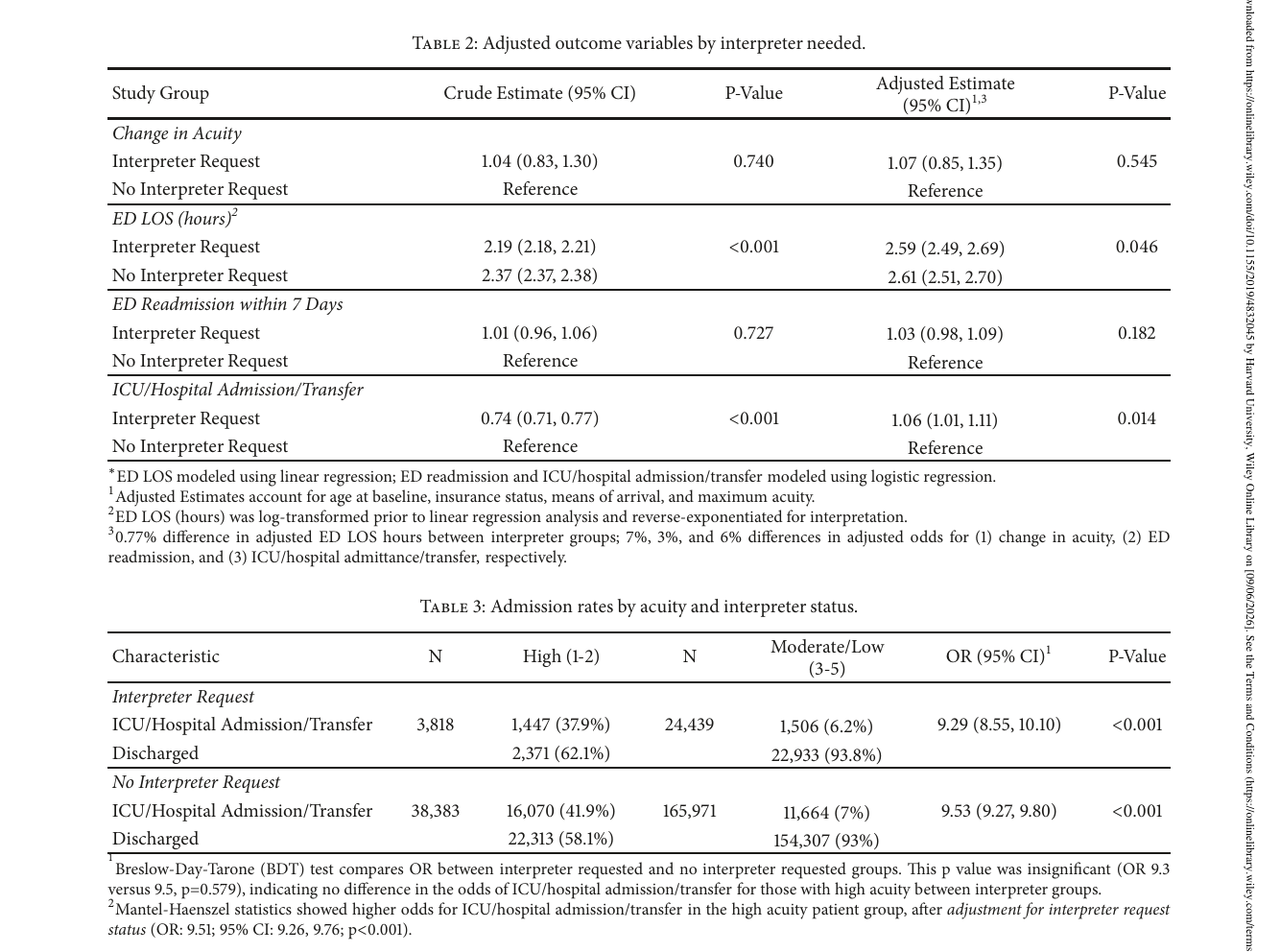
In this large pediatric ED cohort, the model-adjusted difference in ED length of stay (LOS) between patients who requested an interpreter (treated as LEP) and those who did not was only 0.77% — about 1.2 minutes (2.59 vs 2.61 adjusted hours) — a small effect (ES < 0.2) that the authors deemed not clinically significant (Table 2). Notably the direction was reversed from prior literature: LEP/interpreter-requested patients spent slightly less time in the ED than English-speaking patients.
"For ED LOS, a model-adjusted difference of 0.77% (1.2 minutes, 2.59 hours versus 2.61) was found between interpreter groups." (Greenky, 2019, p. 4)
"Interestingly, our data suggested that non-LEP patients spent slightly more time in the ED than LEP patients. This difference was not clinically significant due to the low ES value and amounted to only a 1.2-minute difference." (Greenky, 2019, p. 6)
Methods Context #
What? #ⓘ
The observable: ED length of stay in hours, recorded per encounter from the EPIC electronic medical record and compared between interpreter-requested and no-interpreter-requested groups.
"Study outcomes were change in triage acuity, ED length of stay (LOS), readmission to the ED within seven days, and hospital disposition." (Greenky, 2019, p. 2)
How? #ⓘ
Retrospective cohort study; ED LOS log-transformed and modeled with linear regression, adjusted for age at baseline, insurance status, means of arrival, and maximum acuity, then reverse-exponentiated. Cohen's d effect sizes were prioritized over p-values given the very large sample.
"crude and adjusted associations between interpreter categories and the study outcomes were modeled using linear regression for ED LOS (after normality transformation)... Linear- and logistic-adjusted associations controlled for age at baseline, insurance status, means of arrival, and maximum acuity as confounders." (Greenky, 2019, p. 2)
Who? #ⓘ
All patients aged 0–18 presenting to three Children's Healthcare of Atlanta (CHOA) pediatric EDs in 2016 (152,945 patients / 232,787 encounters); excluded patients dead on arrival/died in ED and those with no language or interpreter status charted. Patients categorized LEP if an interpreter was requested during the encounter.
"This was a retrospective cohort study that looked at all patients aged 0-18 years that arrived in the three CHOA EDs (Hughes Spalding Hospital, Egleston Hospital, and Scottish Rite Hospital) between January 1, 2016, and December 31, 2016." (Greenky, 2019, p. 2)
Other Notes #
The authors frame the overall null/reversed pattern as a "reversed trend" relative to earlier pediatric-ED studies and attribute it (speculatively) to the 2010 Joint Commission communication guidelines and CHOA's expanded interpreter program. The adjusted LOS comparison reached statistical significance (p=0.046, Table 2) but the effect size is trivially small, illustrating the authors' rationale for prioritizing ES over p-values in a 232,787-encounter sample.
Caveats #
- Single highly-resourced academic pediatric system limits generalizability of the reversed-trend findings The study was conducted entirely within a single, highly-resourced academic pediatric system (Children's Healthcare of Atlanta) with a mature, well-staffed interpreter program (37 interpreters, dedicated in-person Spanish service, video/phone backup). The authors caution that centers with fewer language-access resources may not show the same small/null differences between LEP and English-speaking patients, so the "reversed trend" of near-equivalent ED outcomes may not generalize.
- Interpreter-request EMR field is an imperfect proxy for LEP with substantial undocumented ascertainment LEP status and interpreter use were both operationalized from a single EMR "interpreter requested" field, which the authors acknowledge is an imperfect proxy. Only 83.3% of patients with a non-English primary language were documented as having requested an interpreter, leaving 16.7% whose interpreter use is unknown; there is no EMR field confirming an interpreter was actually offered or used, it is unclear who requested the interpreter (patient, family, or provider), and unclear who was LEP (patient, caregiver, or both). Patients who declined an interpreter but would have benefited are also misclassified. This measurement uncertainty could bias the small/null group differences in the ED outcome comparisons.