Most clinicians reported inability to accurately assess hearing loss in LEP patients hindered treatment (93 percent)
Source
Aparna Govindan (2025). Clinician Perspectives on the Management of Hearing Loss in Patients With Limited English Proficiency. official journal of American Academy of Otolaryngology-Head and Neck Surgery.
Description #
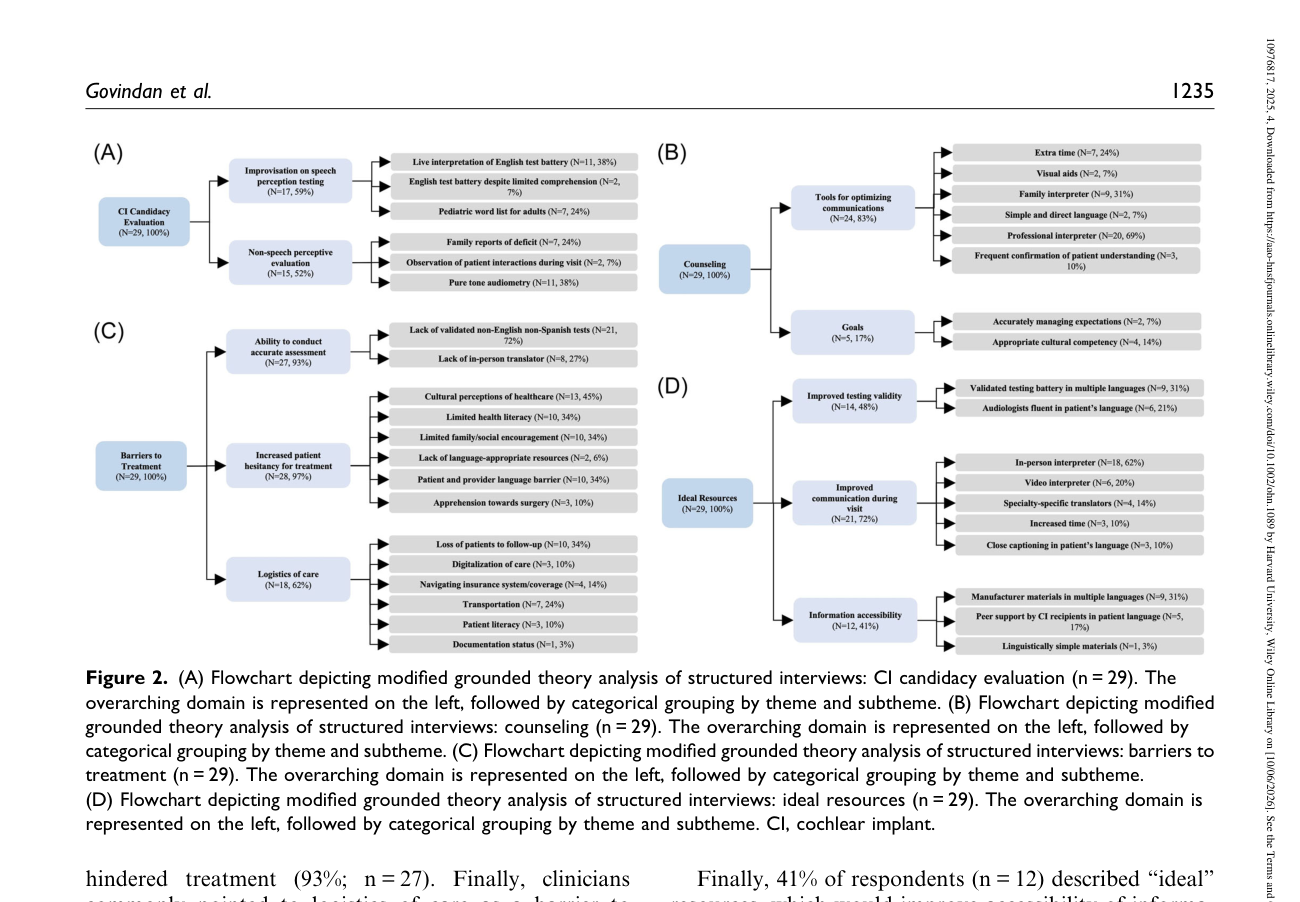
In the qualitative interviews (n = 29), most respondents reported that the inability to perform an accurate assessment of hearing loss in LEP patients hindered treatment (93%; n = 27) (Figure 2C). This is a clinician-reported mechanism linking the language barrier to downstream care: when language-specific testing is unavailable, providers cannot accurately characterize the deficit, which in turn obstructs treatment decisions.
"Most respondents reported that the inability to perform an accurate assessment of HL in LEP patients hindered treatment (93%; n = 27)." (Govindan, 2025, pp. 1234–1235)
Methods Context #
What? #ⓘ
The observable: clinician-reported themes coded from structured interviews, here the frequency with which providers named inaccurate hearing-loss assessment in LEP patients as a barrier to treatment.
"Frequencies of each qualitative response were calculated for themes and subthemes by calculating the frequency of response as a percentage of the number of responses in the respective domain." (Govindan, 2025, p. 1233)
How? #ⓘ
Structured Zoom interviews using an IRB-approved script, analyzed with directed content analysis guided by modified grounded theory (iterative axial coding); two authors coded, a third adjudicated.
"Participant responses were analyzed using directed content analysis guided by modified grounded theory, an iterative axial coding scheme for data distillation in qualitative research." (Govindan, 2025, p. 1233)
Who? #ⓘ
29 US hearing-health clinicians (16 neurotologists/otologists, 13 audiologists) interviewed across 4 regions (South, Northeast, West, Midwest), recruited from 12 cities with the highest immigrant populations.
"Twenty‐nine providers volunteered to participate across 4 American regions (South, Northeast, West, Midwest)." (Govindan, 2025, p. 1233)
Other Notes #
A clinician-perceived mechanism, not a measured accuracy or treatment-rate outcome. Complements the survey-based confidence gap by naming the pathway (inaccurate assessment → hindered treatment).
Caveats #
- Small non-uniform sample skewed to Spanish-Chinese languages and away from the Midwest limits generalizability (Govindan 2025) The survey and interview samples each represent only a fraction of US providers serving LEP hearing-health patients, the geographic distribution is non-uniform (notably few Midwest respondents), and the LEP populations sampled are skewed toward Spanish and Chinese languages. The authors state these factors collectively limit the generalizability of the results — so the confidence, effort, and assessment-practice findings may not transfer to providers or LEP language groups outside the sampled distribution.
- Interview responses subject to recall bias personal bias and self-estimated surgical and LEP volumes (Govindan 2025) The interview-derived findings rest on clinician self-report and are subject to recall bias, the respondents' personal bias or experience with multiculturalism, and self-estimated surgical and LEP patient volumes. The reported frequencies of assessment practices and barriers therefore reflect provider recollection and perception rather than verified clinical behavior, which the authors flag explicitly.