Providers reported significantly greater effort treating non-English non-Spanish speakers than Spanish speakers
Source
Aparna Govindan (2025). Clinician Perspectives on the Management of Hearing Loss in Patients With Limited English Proficiency. official journal of American Academy of Otolaryngology-Head and Neck Surgery.
Description #
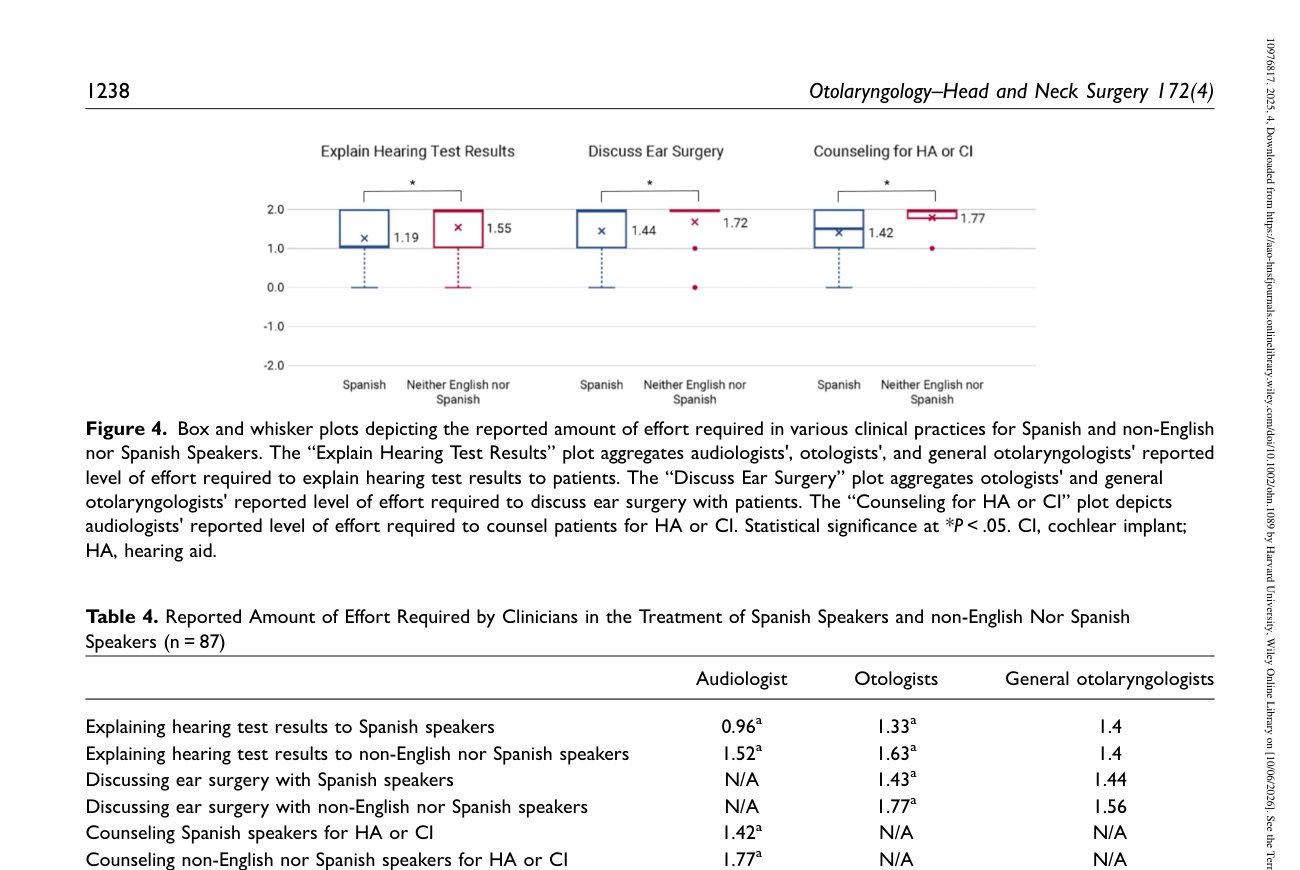
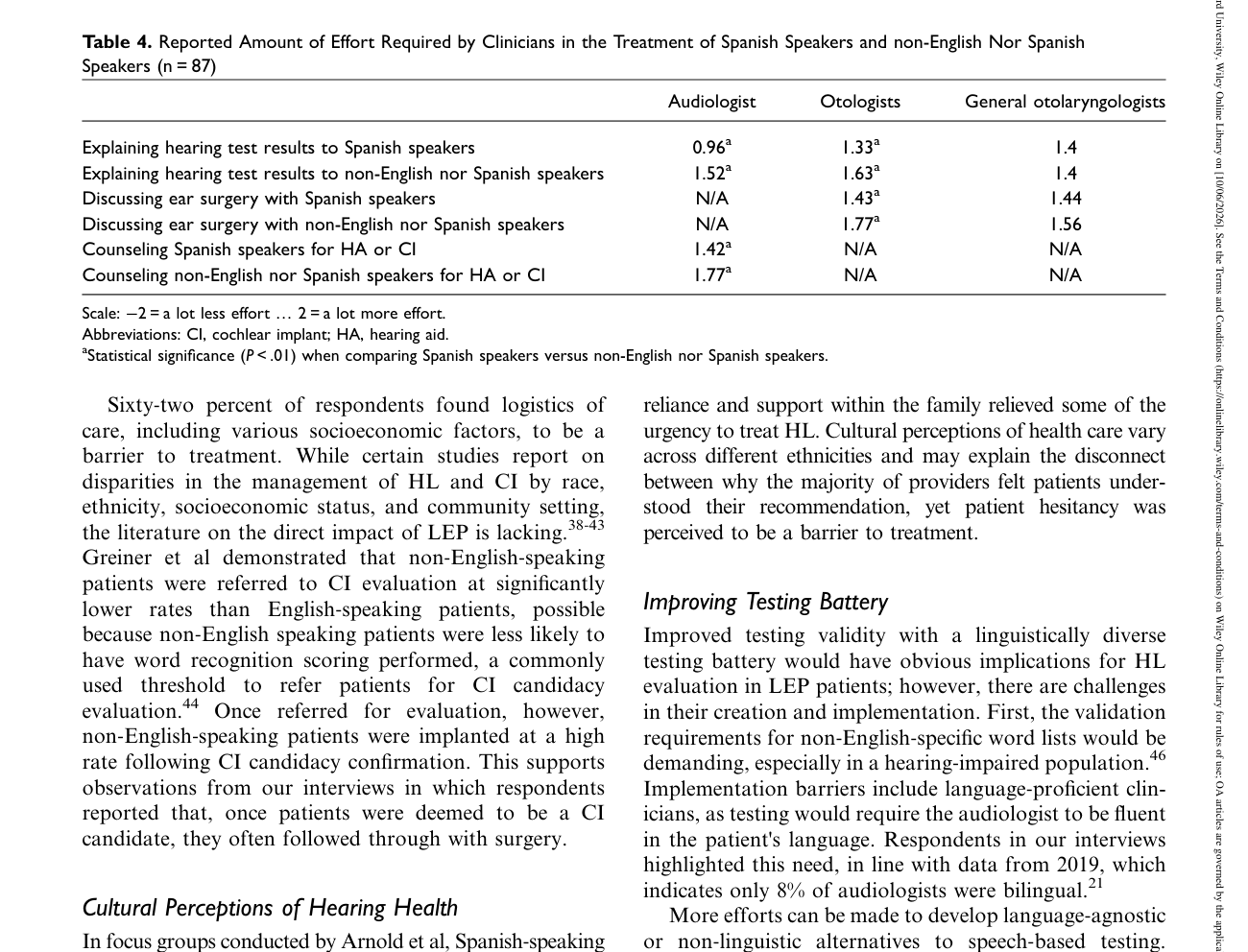
In the national survey (n = 87), providers rated the amount of effort required across clinical tasks on a −2 (a lot less effort) to +2 (a lot more effort) scale, and all provider types reported significantly greater effort treating non-English, non-Spanish speakers than Spanish speakers (P < .01) (Figure 4, Table 4). For example, audiologists rated explaining hearing-test results as 0.96 for Spanish speakers versus 1.52 for non-English/non-Spanish speakers, and otologists rated discussing ear surgery as 1.43 versus 1.77 across the same comparison (Table 4).
"All providers reported a significantly greater amount of effort required to treat non‐English, non‐Spanish speakers compared to Spanish speakers (Figure 4, Table 4)." (Govindan, 2025, p. 1236)
"Explaining hearing test results to Spanish speakers / 0.96a / 1.33a / 1.4 … Explaining hearing test results to non-English nor Spanish speakers / 1.52a / 1.63a / 1.4" (Govindan, 2025, p. 1238)
Methods Context #
What? #ⓘ
The observable: provider self-rated amount of effort (Likert −2 = a lot less effort … +2 = a lot more effort) required for clinical tasks (explaining test results, discussing surgery, counseling), compared across patient language groups.
"Scale: −2 = a lot less effort … 2 = a lot more effort." (Govindan, 2025, p. 1238)
How? #ⓘ
Cross-sectional online (Qualtrics) survey using Likert-scale effort measures; comparisons between Spanish vs non-English/non-Spanish speakers evaluated for statistical significance (P < .01).
"The survey assessed provider years of experience, practice setting, distribution of LEP and non‐LEP patients seen, and quantitative analysis of provider confidence and effort in evaluation, counseling, and management using Likert scale measures (Supplemental Digital Content 2, available online)." (Govindan, 2025, p. 1233)
Who? #ⓘ
87 US providers (35 audiologists, 36 otologists, 16 general otolaryngologists); 72% English-only; predominantly urban academic centers across 20 states.
"Eighty‐seven providers (35 audiologists, 36 otologists, 16 general otolaryngologists) completed the survey." (Govindan, 2025, p. 1235)
Other Notes #
Provider-reported effort burden, a self-report rather than a measured time outcome. Effort rises monotonically with linguistic distance from concordant care (Spanish < non-English/non-Spanish), consistent with the confidence gradient in the same survey.
Caveats #
- Small non-uniform sample skewed to Spanish-Chinese languages and away from the Midwest limits generalizability (Govindan 2025) The survey and interview samples each represent only a fraction of US providers serving LEP hearing-health patients, the geographic distribution is non-uniform (notably few Midwest respondents), and the LEP populations sampled are skewed toward Spanish and Chinese languages. The authors state these factors collectively limit the generalizability of the results — so the confidence, effort, and assessment-practice findings may not transfer to providers or LEP language groups outside the sampled distribution.