Collaborative co-construction among interpreter, provider, and patient achieved mutual understanding (intersubjectivity)
Source
Estrada (2015). A conversation analysis of verbal interactions and social processes in interpreter-mediated primary care encounters. Research in Nursing & Health.
Description #
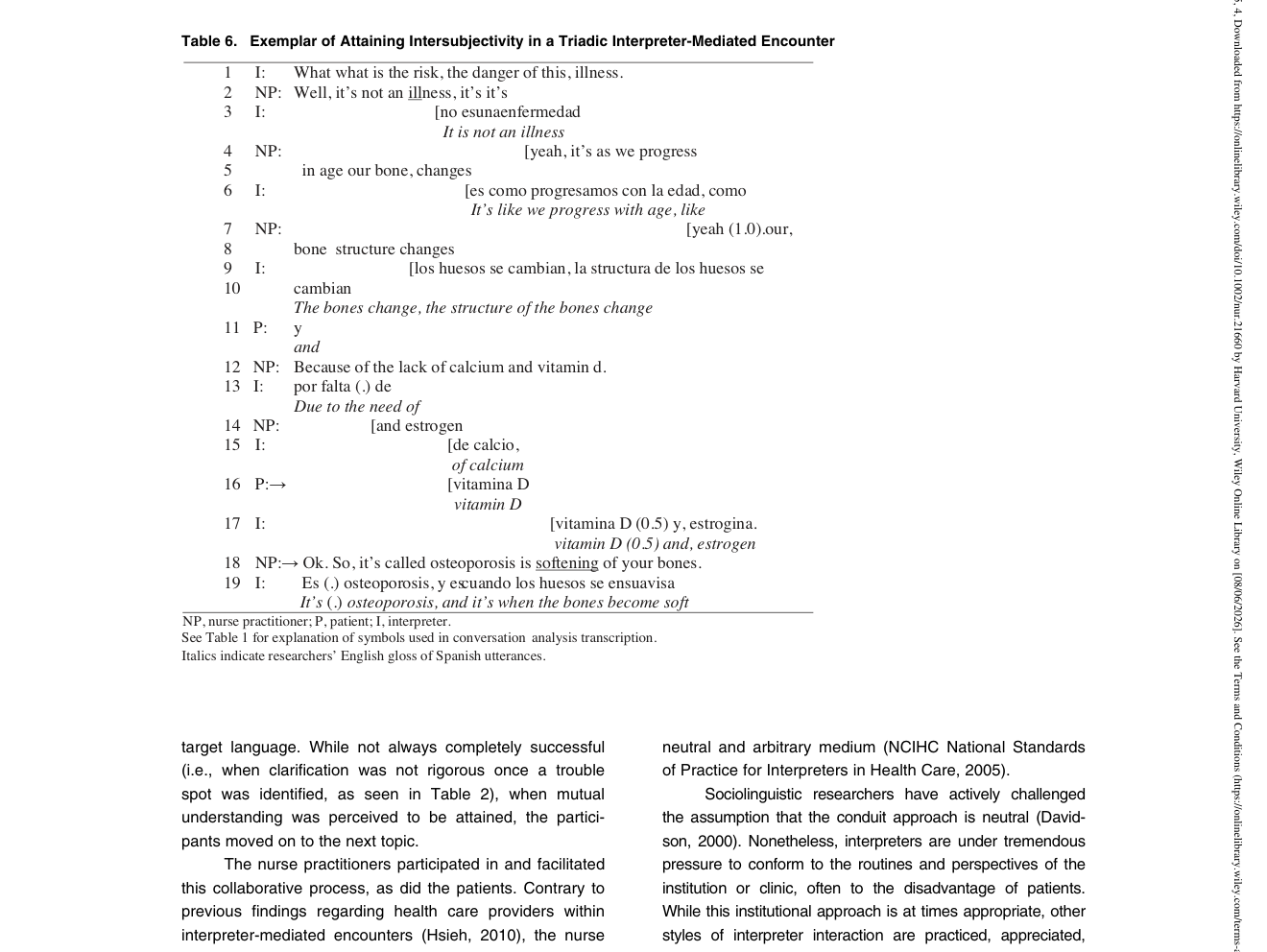
The "Attaining Intersubjectivity" exemplar (Table 6) presented a positive case in which the interpreter, nurse practitioner, and a Salvadoran patient collaboratively co-constructed mutual understanding of osteopenia/osteoporosis — at one point the patient herself contributed "vitamina D" to the definition before the interpreter could relay it, and the NP closed with a summation signaling attainment of intersubjectivity. This demonstrates that language-discordant parties can successfully participate in triadic communication without sacrificing ease or accuracy when all three act as co-contributors.
"At line 16, the patient, indicating understanding of the subject matter and demonstrating her ability to be an active and contributing participant to crafting the definition of 'osteoporosis,' added 'vitamina D' to the list of issues that might lead to softening of the bones, prior to interpretation on the part of the interpreter." (Estrada, 2015, p. 287)
"This excerpt suggests that there are many ways to manage multiparty exchanges without compromising compromise ease or accuracy, in which the role of interpreter can be as active as the other roles, and the patient and NP are also understood to be co-contributors to the management of intersubjective understanding, leading to an encounter where every participant's contribution is valued." (Estrada, 2015, p. 287)
Methods Context #
What? #ⓘ
The observable: a successfully co-constructed triadic exchange culminating in shared understanding (intersubjectivity), evidenced by overlapping "musical round" turns and the patient pre-empting the interpreter, in the verbatim transcript.
"Facilitated by the interpreter, all three interactants participated in a collaborative co-constructive process that resulted in mutual understanding." (Estrada, 2015, p. 287)
How? #ⓘ
Conversation analysis of the verbatim transcript, attending to turn design, overlapping/echoing turns, and the NP's closing summation as the marker of attained intersubjectivity.
"in this encounter some interactions almost resembled a musical round, with the participants echoing each other as they confirmed the ideas expressed." (Estrada, 2015, p. 287)
Who? #ⓘ
One triadic family-practice encounter discussing osteopenia/osteoporosis, among a family-practice nurse practitioner, a female patient from El Salvador, and the clinic-based interpreter, in the North Carolina primary care clinics.
"In this interchange among a family practice nurse practitioner, a female patient from El Salvador, and the clinic-based interpreter, the discussion focused on the implications of non-treatment for the patient's osteopenia, namely the potential development of osteoporosis." (Estrada, 2015, p. 287)
Other Notes #
A positive-case mechanism complementing the trouble-spot exemplars: collaborative, co-constructive interpreting can yield mutual understanding and active patient participation.
Caveats #
- Findings rest on five illustrative (non-prototypical) encounters, limiting generalizability The findings derive from only five interpreter-mediated encounters, and the authors explicitly present the exemplars not as prototypical or representative cases but as illustrations of interactional dynamics. The trouble-spot and intersubjectivity mechanisms are therefore demonstrations of what can occur in such encounters, not claims about how frequently or generally they occur; they cannot be read as estimates of prevalence or effect.