Provider's use of a colloquialism (blood thinner) created interpretation confusion rather than aiding comprehension
Source
Estrada (2015). A conversation analysis of verbal interactions and social processes in interpreter-mediated primary care encounters. Research in Nursing & Health.
Description #
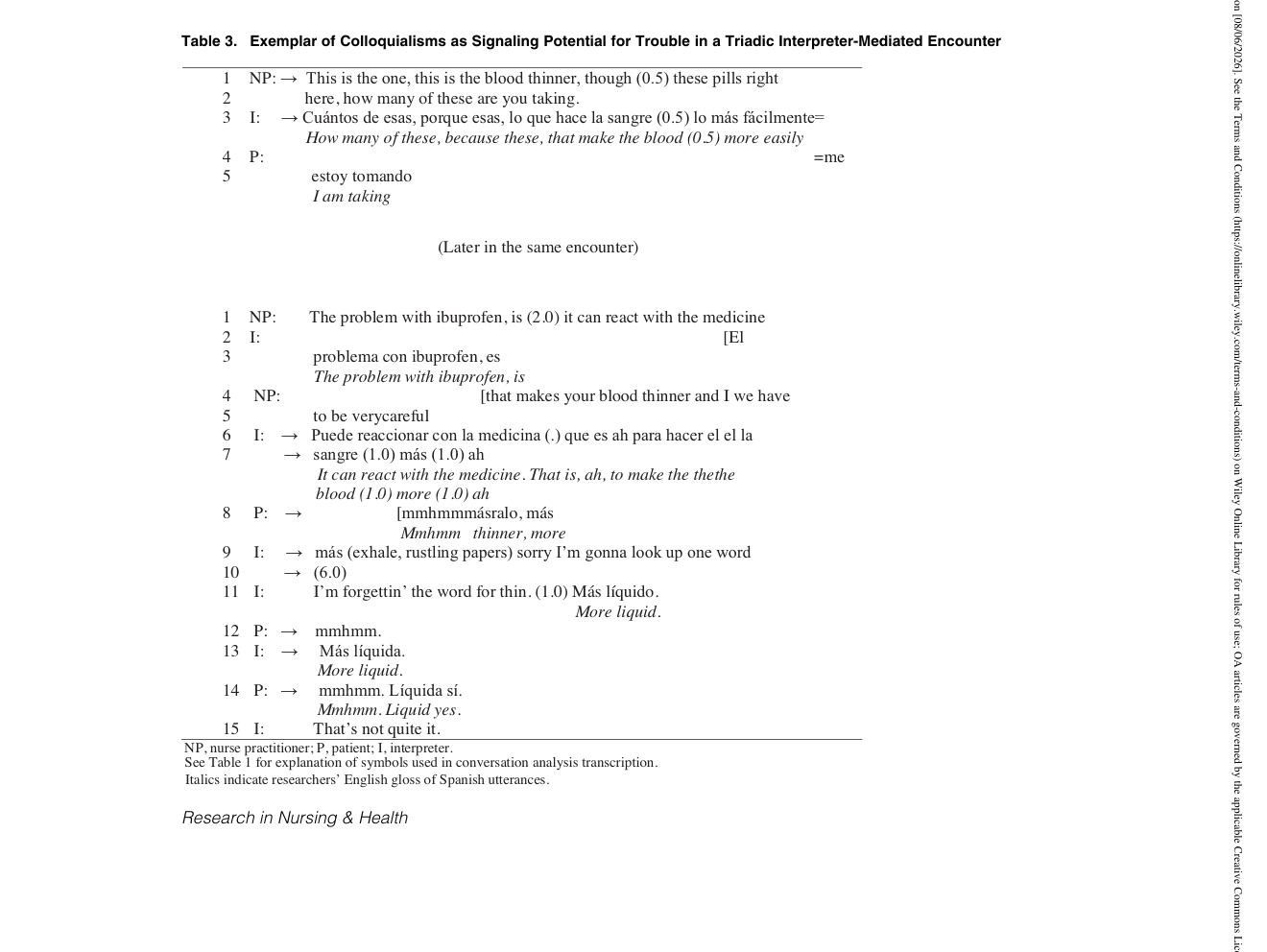
In the "Colloquialisms as Signaling Potential for Trouble" exemplar (Table 3), the nurse practitioner used the colloquial term "blood thinner" instead of the technical term "anticoagulant." Contrary to the plain-language recommendation that colloquialisms aid comprehension, the colloquial term created interpretation trouble: the interpreter struggled to render it in Spanish (hesitations, long silences, "sorry I'm gonna look up one word"), whereas the technical term would have had a direct Spanish cognate (anticoagulante). Distracted by accuracy, the interpreter also missed that the patient had already supplied an adequate rendering ("mas ralo," more thin).
"Interestingly, the trouble spots shown in Table 3 revealed how this approach actually created more confusion. In this instance, the nurse practitioner used the colloquial term, 'blood thinner' (first part line 1), to signify the technical term 'anticoagulant.'" (Estrada, 2015, p. 283)
Interpreter (line 9): "más (exhale, rustling papers) sorry I'm gonna look up one word" (Estrada, 2015, p. 283)
"had the nurse practitioner used the technical term in English (i.e., anticoagulant), the interpreter might have more readily referenced the corresponding Spanish cognate (i.e., anticoagulante)." (Estrada, 2015, p. 283)
Methods Context #
What? #ⓘ
The observable: an interpretation trouble spot triggered by a colloquial English term, evidenced by the interpreter's hesitations, silences, and explicit word-search in the verbatim transcript.
"The interpreter wrestled to find a way to express this colloquialism in Spanish, as evidence by her brief hesitancy between uttering 'sangre' (blood) and the following phrase (line 3), followed later by the longer silences (second part lines 6–10)." (Estrada, 2015, p. 283)
How? #ⓘ
Conversation analysis of the verbatim triadic transcript, attending to hesitancy and silence as real-time indicators of an interpretation issue.
"In real-time conversation, hesitancy may be an indication of an interpretation issue that if addressed immediately within the context, could improve mutual understanding." (Estrada, 2015, p. 283)
Who? #ⓘ
One triadic primary care encounter (anticoagulation/medication discussion) with a Spanish-speaking LEP patient, an English-monolingual nurse practitioner, and a clinic-based interpreter, in the two North Carolina clinics.
"because the interpreter was so concerned about providing an accurate interpretation, she did not notice how the patient had been tracking her trouble and that he had actually provided an appropriate interpretation, 'mas ralo,' (second part, line 8), which signifies 'more thin.'" (Estrada, 2015, p. 283)
Other Notes #
A counter-intuitive mechanism: the standard plain-language recommendation (use colloquial terms) can backfire in interpreter-mediated encounters when the colloquialism lacks a clean target-language equivalent. New healthOutcome slug communicationQuality used (see notes).
Caveats #
- Findings rest on five illustrative (non-prototypical) encounters, limiting generalizability The findings derive from only five interpreter-mediated encounters, and the authors explicitly present the exemplars not as prototypical or representative cases but as illustrations of interactional dynamics. The trouble-spot and intersubjectivity mechanisms are therefore demonstrations of what can occur in such encounters, not claims about how frequently or generally they occur; they cannot be read as estimates of prevalence or effect.