Interpreter's unstated assumption created an unrepaired misinterpretation of who served as informal interpreter
Source
Estrada (2015). A conversation analysis of verbal interactions and social processes in interpreter-mediated primary care encounters. Research in Nursing & Health.
Description #
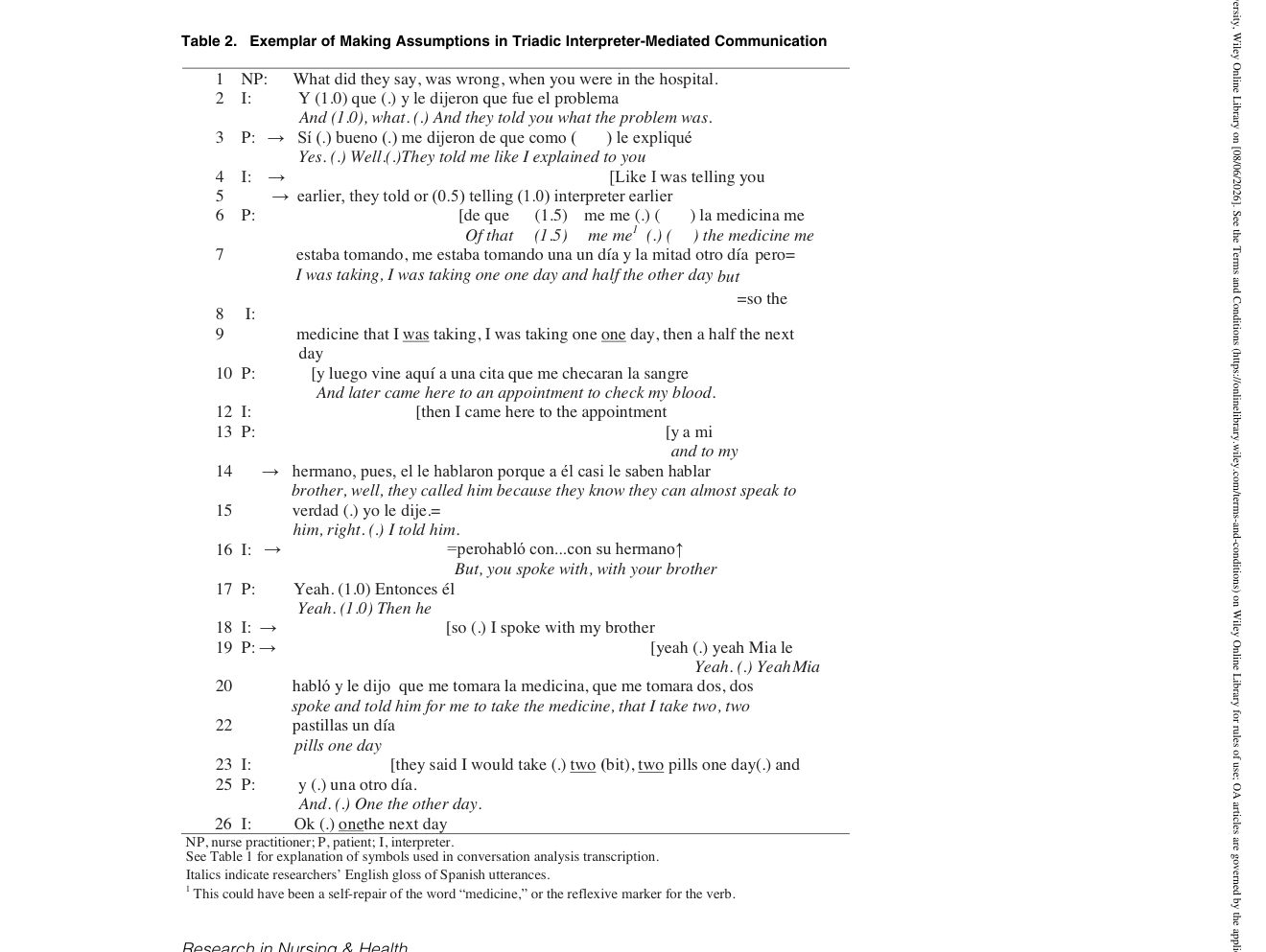
In the "Making Assumptions" exemplar (Table 2), the interpreter inferred — without asking the patient to clarify — that the "they" the patient referenced included or was the interpreter, when the patient was actually describing his brother acting as an informal interpreter. Because the trouble spot was never directly repaired, both the interpreter and the nurse practitioner missed the patient's point that he was conforming to the expectation that patients be engaged participants in their care. This illustrates how an interpreter's institutional assumption can produce a misinterpretation that goes uncorrected.
"Thus, the actual trouble spot of this interpretation occurred in line 5 after the one-second pause, when the interpreter initiated a self-repair that infers that 'they' of the patient's utterance in line 3 included or was the interpreter, as she did not ask the patient to clarify the identify of 'they.' Thus both interpreter and nurse practitioner missed the patient's attempt to underscore how he was conforming to the expectation that patients should be engaged participants in the health care interaction in order to optimize health outcomes" (Estrada, 2015, p. 282)
Patient (line 13-15): "[y a mi hermano, pues, el le hablaron porque a él casi le saben hablar verdad (.) yo le dije." — gloss: "and to my brother, well, they called him because they know they can almost speak to him, right. (.) I told him." (Estrada, 2015, p. 282)
Methods Context #
What? #ⓘ
The observable: a single turn-by-turn interpretation error (a "trouble spot") and the absence of a clarifying repair, traced through the conversation-analytic transcript of one encounter.
"where exactly did this trouble begin? Returning to line 5, the interpreter responded to the patient's prior turn with an implied inference that an interpreter must have been present in the prior interaction, although the patient did not state this." (Estrada, 2015, p. 282)
How? #ⓘ
Conversation analysis of the verbatim transcript: close turn-by-turn examination identifying where the trouble source arose, who initiated (or failed to initiate) repair, and the high-pitch cue signaling the trouble.
"Instead, the trouble happened elsewhere, when the interpreter revealed to the patient that she had misunderstood something and sought clarification in the utterance 'but you spoke with… with your brother' (line 16). Her high pitch on 'brother' indicated that this was the trouble source in her understanding." (Estrada, 2015, p. 282)
Who? #ⓘ
One triadic encounter with a Hispanic male patient presenting with blood in his urine, an English-monolingual nurse practitioner, and a clinic-based interpreter, within the same two North Carolina primary care clinics.
"This Hispanic male patient came to the clinic with a complaint of blood in his urine, a problem which had been previously addressed by other providers." (Estrada, 2015, p. 282)
Other Notes #
The authors note this particular error had "no untoward effect on the outcome," but use it to argue providers should be attentive to how institutional assumptions play out in interpreted communication. A negative-case mechanism for how interpreting can degrade communication accuracy.
Caveats #
- Findings rest on five illustrative (non-prototypical) encounters, limiting generalizability The findings derive from only five interpreter-mediated encounters, and the authors explicitly present the exemplars not as prototypical or representative cases but as illustrations of interactional dynamics. The trouble-spot and intersubjectivity mechanisms are therefore demonstrations of what can occur in such encounters, not claims about how frequently or generally they occur; they cannot be read as estimates of prevalence or effect.