No significant difference in one-year readmission after bariatric surgery between LEP and EP patients (adjusted OR 0.94)
Source
Allan E Stolarski (2022). The impact of English proficiency on outcomes after bariatric surgery. Surgical Endoscopy.
Description #
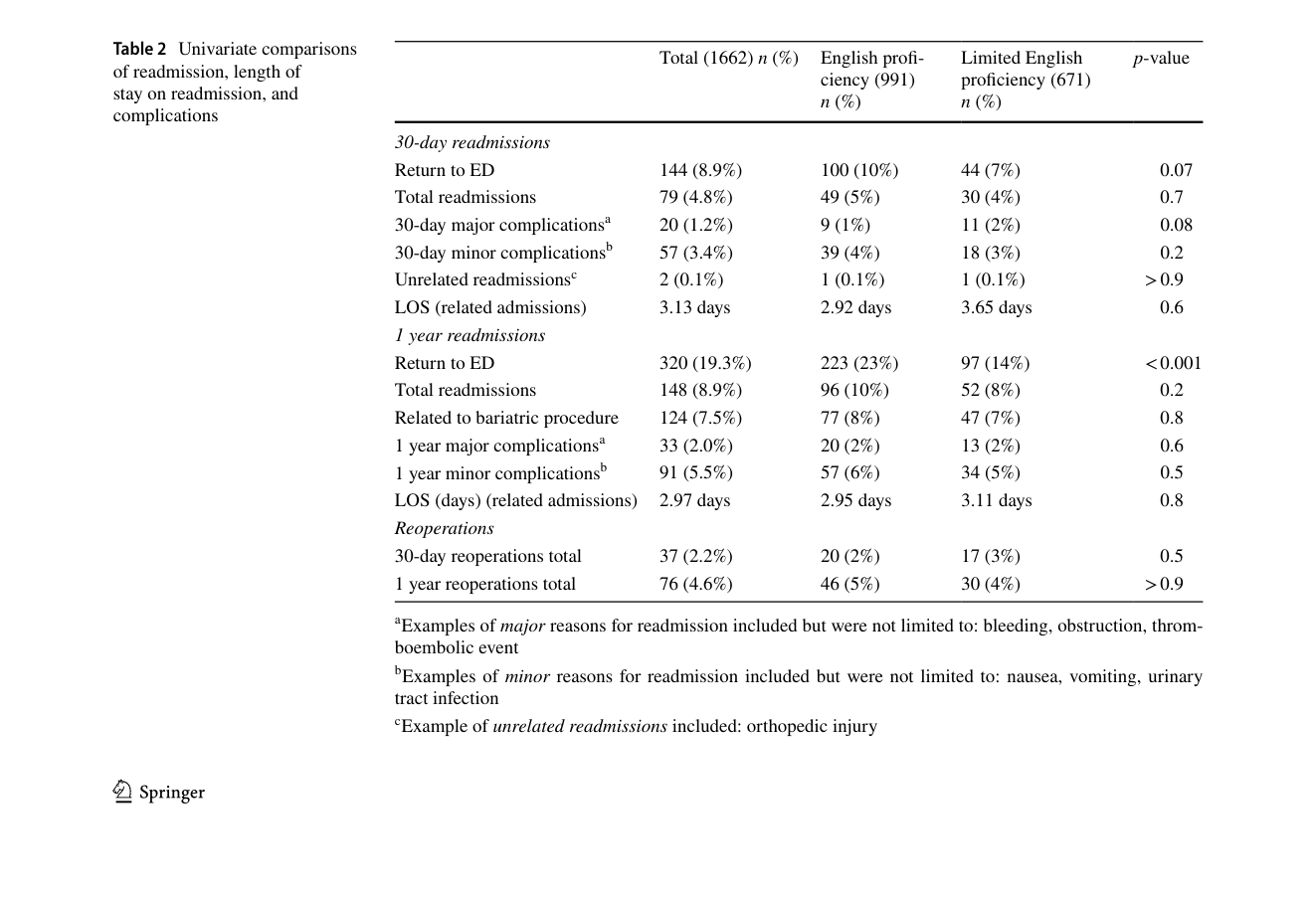
Despite more frequent ED visits by EP patients, there was no significant difference in hospital readmission within one year of bariatric surgery between LEP and EP patients (adjusted OR = 0.94, 95% CI 0.56–1.55; p = 0.50). At 30 days, readmission was likewise not different (EP 5% vs LEP 4%, p = 0.7; adjusted OR 1.01, 95% CI 0.58–1.71; p > 0.90) (Table 2).
"However, despite more frequent ED visits by EP patients, there was no significant difference in readmission within one year; adjusted OR = 0.94 (95% CI 0.56–1.55; p = 0.50)." (Stolarski, 2022, p. 7387)
"There was no difference in presentation to the ED within 30 days (EP 10% vs. LEP 7%; p = 0.07) or readmission within 30 days (EP 5% vs. LEP 4%, p = 0.7). After multivariable logistic regression, the odds of 30-day readmission were no different for LEP versus EP patients, with an adjusted OR of 1.01 (95% CI 0.58–1.71; p > 0.90)." (Stolarski, 2022, p. 7387)
Methods Context #
What? #ⓘ
The observable: all-cause hospital readmission within 30 days and within one year of the index bariatric operation, abstracted from the EMR and compared between LEP and EP groups.
"Outcomes of interest included 30-day and one year all cause visits to the emergency department (ED), 30-day and one year readmission, length of stay (LOS) from index operation" (Stolarski, 2022, p. 7386)
How? #ⓘ
Retrospective chart review; readmission (a dichotomous outcome) compared univariately with chi-square and adjusted with multivariable logistic regression using a priori confounders (age, sex, race, insurance status, ASA class, smoking status, year of operation, sleeve gastrectomy).
"Multivariable logistic regression was used to evaluate dichotomous outcomes including revisit to the ED, readmission, and 30-day complications." (Stolarski, 2022, p. 7386)
Who? #ⓘ
1662 patients aged 18+ undergoing laparoscopic sleeve gastrectomy or gastric bypass at one high-volume, culturally diverse academic bariatric center (Boston Medical Center), Jan 2013–Dec 2017; 671 (40%) LEP.
"Over the 5-year study period, 1662 patients underwent SG or LGBP at our bariatric center (Fig. 1). 671 patients were categorized as LEP (40%) (Table 1)." (Stolarski, 2022, p. 7386)
Other Notes #
The authors emphasize that the EP excess in ED visits "does not translate to increased admissions" (p. 7389). This null readmission finding supports a claim of equivalent post-bariatric readmission outcomes by language proficiency in a well-resourced setting.
Caveats #
- Retrospective chart review could not capture care delivered at outside institutions or follow-up rates by group As a retrospective chart review confined to the institution's own EMR network, the study could not capture ED visits or readmissions that occurred at outside hospitals, and follow-up rates for the LEP and EP groups were not accounted for. Differential out-of-network utilization between groups could bias the observed ED and readmission comparisons (including the finding that LEP patients visited the ED less often).
- Single high-volume center with substantial interpreter infrastructure limits generalizability of equivalent bariatric outcomes The equivalent outcomes were observed at a single, high-volume academic center with substantial interpreter infrastructure (nearly 1.4 million interpreter requests over five years, in-person interpreters in 13+ languages, 24-hour voice/video access, multilingual surgeons, and educational/discharge materials printed in English, Spanish, and Portuguese). The authors caution that the findings may not transfer to institutions with fewer such resources, so the null/equivalence results cannot be read as evidence that LEP carries no risk in lower-resourced settings.