Standardized translated document libraries and EHR templates were the main strategy but were limited to common languages and could not be personalized
Source
Davis (2019). Translating Discharge Instructions for Limited English-Proficient Families: Strategies and Barriers. Hospital Pediatrics.
Description #
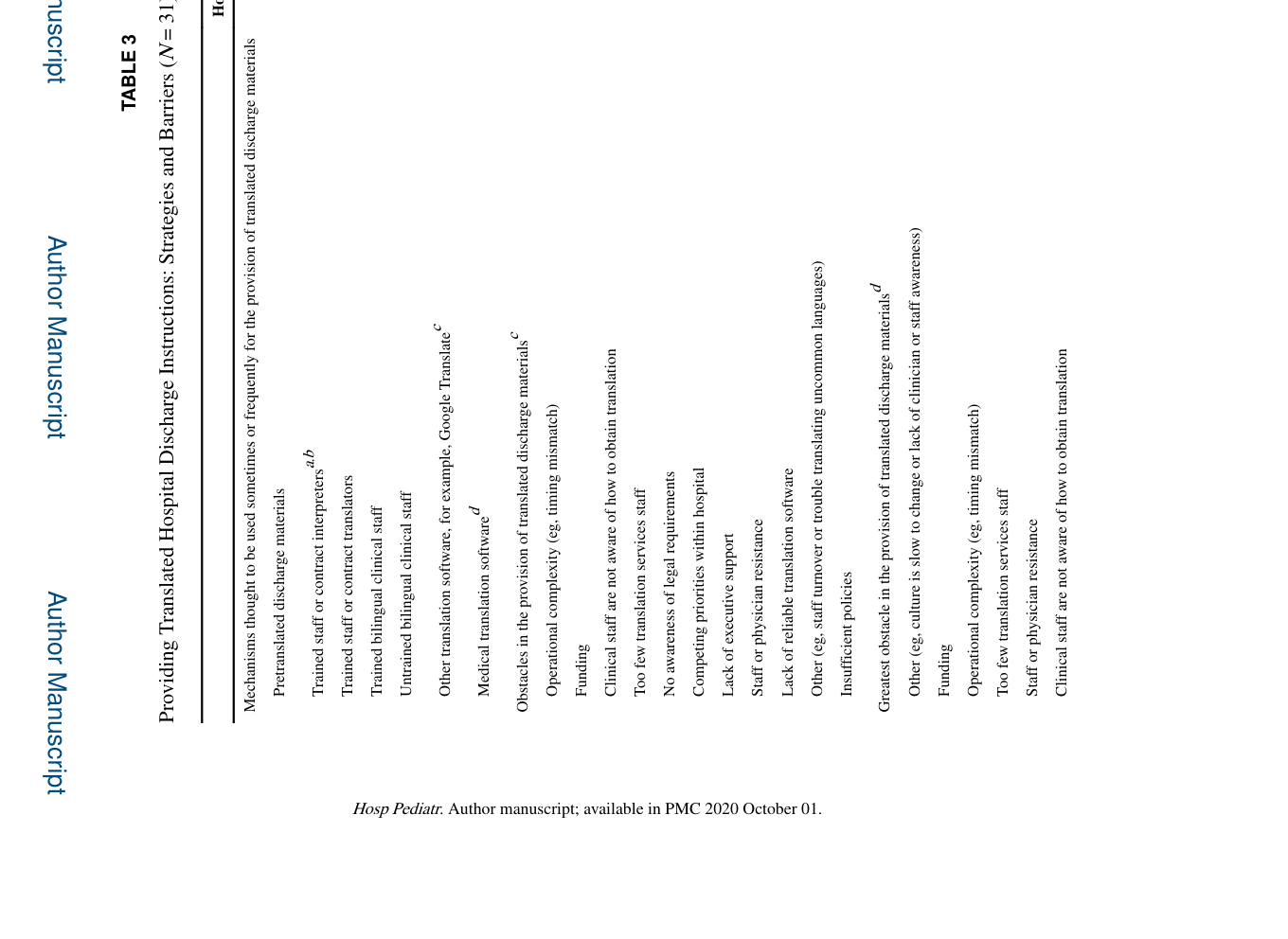
The dominant reported strategy for providing translated discharge instructions was streamlining the translation of standardized documents — building libraries of pretranslated care instructions and incorporating translated standardized templates into the EHR (pretranslated materials were the most-used mechanism, 87%; Table 3). However, both survey respondents and policies noted these standardized assets were typically available only in Spanish or other locally common languages and could not be personalized to an individual patient, so they left speakers of less-common languages and patients needing tailored instructions with unequal access — a mechanism limiting how far this strategy extended concordance.
"Most strategies involved streamlining processes for translating standardized documents. Some respondents cited progress in developing libraries of translated standardized documents (eg, care instructions)... Other respondents described incorporating translated standardized templates into the EHR. Often, however, translated standardized documents are only available in Spanish or other common languages." (Davis, 2019, p. 5)
"Although these approaches may improve access to standardized instructions for a few languages, they do not allow for personalization and may not benefit individuals who speak less-common non-English languages. Notably, LEP individuals in the US speak over 200 different languages." (Davis, 2019, p. 7)
Methods Context #
What? #ⓘ
The observable: reported strategies hospitals felt were successful for translating discharge instructions, captured as open-ended survey responses (Table 4) and as policy content (e.g., translated document libraries).
"Most, although not all, respondents described 1 or more strategies that they felt had been successful in providing translation services at the time of hospital discharge (Table 4)." (Davis, 2019, p. 5)
How? #ⓘ
Inductive content analysis of open-ended survey responses and of 22 written translation policies; themes identified independently then reconciled by the project team; one such theme was maintaining translated standardized document libraries.
"Translated Document Libraries—Almost every institutional policy that mentioned translation services described maintaining a library of translated, standardized documents that could be used multiple times." (Davis, 2019, p. 7)
Who? #ⓘ
Language-services contacts at 31 acute-care CHA children's hospitals and 22 institutional policies; reported strategies reflect institutional/director-level accounts rather than measured patient access.
"Most strategies involved streamlining processes for translating standardized documents." (Davis, 2019, p. 5)
Other Notes #
This is the optimization/delivery side of the corpus's sub-questions: the field's main lever (standardized pretranslation) trades personalization and breadth of language coverage for speed and reusability. It is a described strategy and its stated limitation, not an evaluated outcome — the authors note "lack of formal evaluation of the various approaches."
Caveats #
- Data on clinician use of translation strategies are self-reported by language-services directors as institutional proxies and are subjective Language-services directors answered as proxies for their whole institution, and the authors note that data about how clinicians actually use the various translation strategies are subjective and should be interpreted with caution. Reported barrier rankings and strategy-use frequencies reflect directors' perceptions rather than direct observation of bedside practice, so the mechanisms (e.g., timing mismatch, interpreters-as-translators) are perceived organizational accounts, not measured behaviors.
- Low survey response rate (46%) likely biases the sample toward hospitals with greater language-services resources or interest Most CHA institutions had no available language-services contact, and among those that did the survey response rate was only 46%. The authors caution the sample may be biased toward institutions with greater resources directed at language services or respondents with greater interest in language services. The reported translation-coverage rates (e.g., 74% translating discharge instructions) and strategy frequencies may therefore overstate practice across children's hospitals generally.