Every institutional policy mentioning machine translation forbade using it alone, calling it inaccurate and unsafe
Source
Davis (2019). Translating Discharge Instructions for Limited English-Proficient Families: Strategies and Barriers. Hospital Pediatrics.
Description #
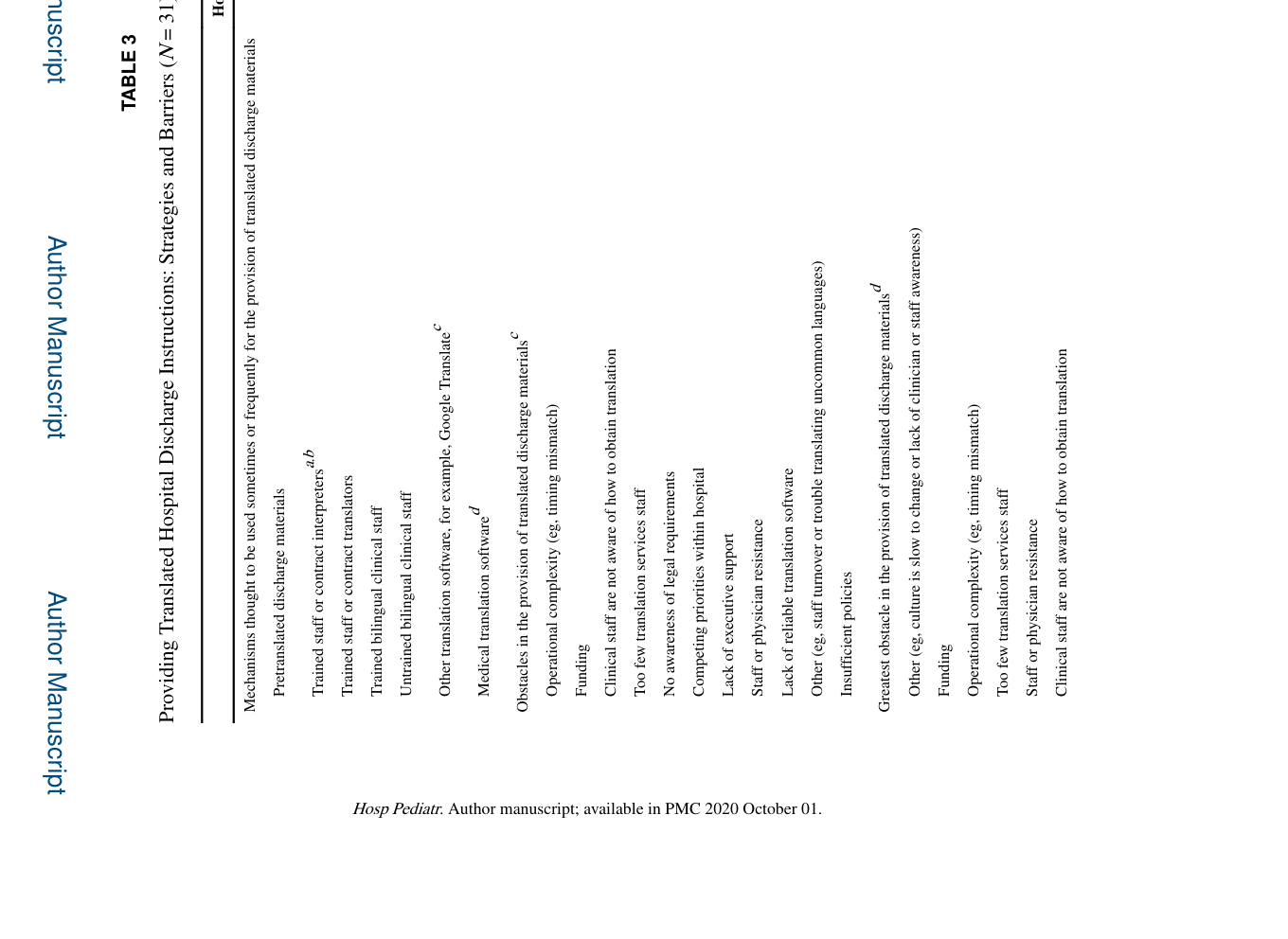
Across the 22 institutional policies analyzed, every policy that mentioned machine translation or translation software (5 of 22) forbade its use alone, characterizing such tools as inaccurate, unreliable, and unsafe. Consistent with this, only 2 of 31 surveyed hospitals (7%) reported "sometimes" or "frequently" using medical translation software for discharge instructions (Table 3), and respondents agreed machine translation should not be used alone. This documents a near-uniform policy stance against standalone machine translation of discharge instructions.
"Every policy that mentioned machine translation or translation software (n = 5 out of 22) forbade its use alone. Typically, these policies explained that such translation mechanisms were 'inaccurate,' 'unreliable,' and 'unsafe.'" (Davis, 2019, p. 6)
"Only 2 institutions reported that providers 'sometimes' or 'frequently' use medical translation software to translate hospital discharge instructions (Table 3)." (Davis, 2019, p. 5)
Methods Context #
What? #ⓘ
The observable: policy provisions regarding machine translation (from content analysis of written policies) and the closed-ended reported frequency of using translation software for discharge instructions (survey, Table 3).
"Machine Translation—Every policy that mentioned machine translation or translation software (n = 5 out of 22) forbade its use alone." (Davis, 2019, p. 6)
How? #ⓘ
Inductive content analysis of 22 institutions' written interpretation/translation policies (consensus-coded by the project team), complemented by descriptive statistics on the survey item about translation-software use.
"Open-ended survey responses and translation policies were coded and analyzed by the project team using inductive content analysis." (Davis, 2019, p. 4)
Who? #ⓘ
22 acute-care CHA children's hospitals whose dated, downloadable interpretation/translation policies were obtained via a November 2017 environmental scan of language-services landing pages (7 of which also completed the survey); among these only 5 policies addressed machine translation at all.
"In November 2017, we conducted an online environmental scan of the 200 acute CHA hospital language services landing pages to find publicly available interpretation and translation policies. Only dated, downloadable files were included... (n = 22, 7 of which were obtained through the survey)." (Davis, 2019, p. 4)
Other Notes #
The denominator is small: only 5 of 22 policies mentioned machine translation, but among those that did the prohibition on standalone use was unanimous. The discussion notes an emerging alternative — a public-health two-step process of high-quality machine translation followed by human review — as a candidate for clinical adaptation.