Hospitals rely on interpreters to act as translators despite differing training, limited to short or simple documents
Source
Davis (2019). Translating Discharge Instructions for Limited English-Proficient Families: Strategies and Barriers. Hospital Pediatrics.
Description #
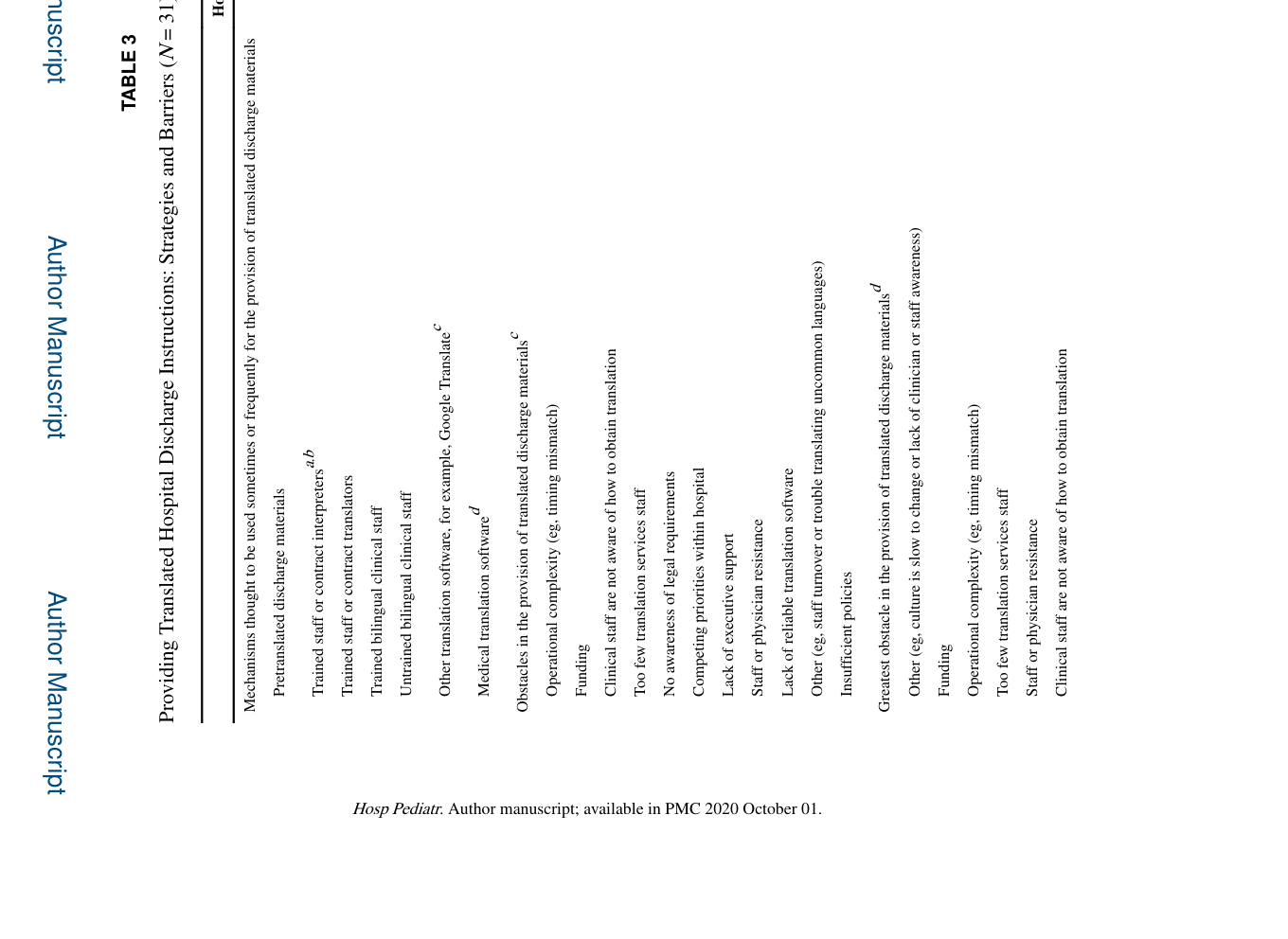
To produce written discharge instructions, hospitals frequently fall back on interpreters (trained for verbal communication) acting as translators (84% reported using trained staff or contract interpreters "sometimes" or "frequently"; Table 3), even though interpreters and translators have different training and certification. Both survey responses and written policies restrict this practice to short, simple, or individualized documents and prohibit interpreters from translating complex materials — a staffing/quality mechanism that shapes which discharge content can be made concordant.
"As noted above, some institutional protocols allowed interpreters (who specialize in facilitating verbal communication between 2 individuals who do not speak the same language) to serve as translators or sight translators of written materials, although interpreters and translators generally have different training and certification. Many constraints for sight translation also applied for interpreters providing written translations. Several institutions permitted interpreters to prepare written translations of only short, individualized documents and prohibited interpreters from translating more-complex materials." (Davis, 2019, p. 6)
"We need to hired [sic] a dedicated translator. We have interpreters, but not all are good translators. We need to do lots of coaching or create internal memory banks to assure quality." (Davis, 2019, p. 19)
Methods Context #
What? #ⓘ
The observable: reported mechanisms used to provide translated discharge materials (closed-ended, Table 3) and policy provisions governing whether interpreters may translate written documents (content analysis of policies).
"When asked about clinicians' approaches for translating hospital discharge instructions, respondents reported that pretranslated materials (87%), professional interpreters (84%), and professional translators (71%) are all used 'sometimes' or 'frequently' (Table 3)." (Davis, 2019, p. 4)
How? #ⓘ
Triangulated mixed methods: closed-ended survey items summarized descriptively, plus inductive content analysis of 22 institutions' written interpretation/translation policies (three readers developed a coding scheme; one coded each policy, two reviewed; disagreements resolved by consensus).
"Three members of the project team read the interpretation and translation policies independently and developed a coding scheme. One team member coded each policy, and 2 additional members reviewed the coding. Disagreements were resolved by consensus." (Davis, 2019, p. 4)
Who? #ⓘ
31 surveyed acute-care CHA children's hospitals plus 22 institutions whose downloadable, dated translation policies were obtained via an environmental scan of CHA hospital language-services pages (7 overlapping with the survey).
"We collected policies from 22 different institutions, 7 of which also completed the survey." (Davis, 2019, p. 6)
Other Notes #
This documents a delivery mechanism (using the available interpreter workforce to fill a translator gap) and its self-imposed scope limit, rather than measuring its effect on patient comprehension or errors.
Caveats #
- Data on clinician use of translation strategies are self-reported by language-services directors as institutional proxies and are subjective Language-services directors answered as proxies for their whole institution, and the authors note that data about how clinicians actually use the various translation strategies are subjective and should be interpreted with caution. Reported barrier rankings and strategy-use frequencies reflect directors' perceptions rather than direct observation of bedside practice, so the mechanisms (e.g., timing mismatch, interpreters-as-translators) are perceived organizational accounts, not measured behaviors.