Operational complexity from mismatched discharge and translation time frames was the most cited barrier to translating discharge instructions
Source
Davis (2019). Translating Discharge Instructions for Limited English-Proficient Families: Strategies and Barriers. Hospital Pediatrics.
Description #
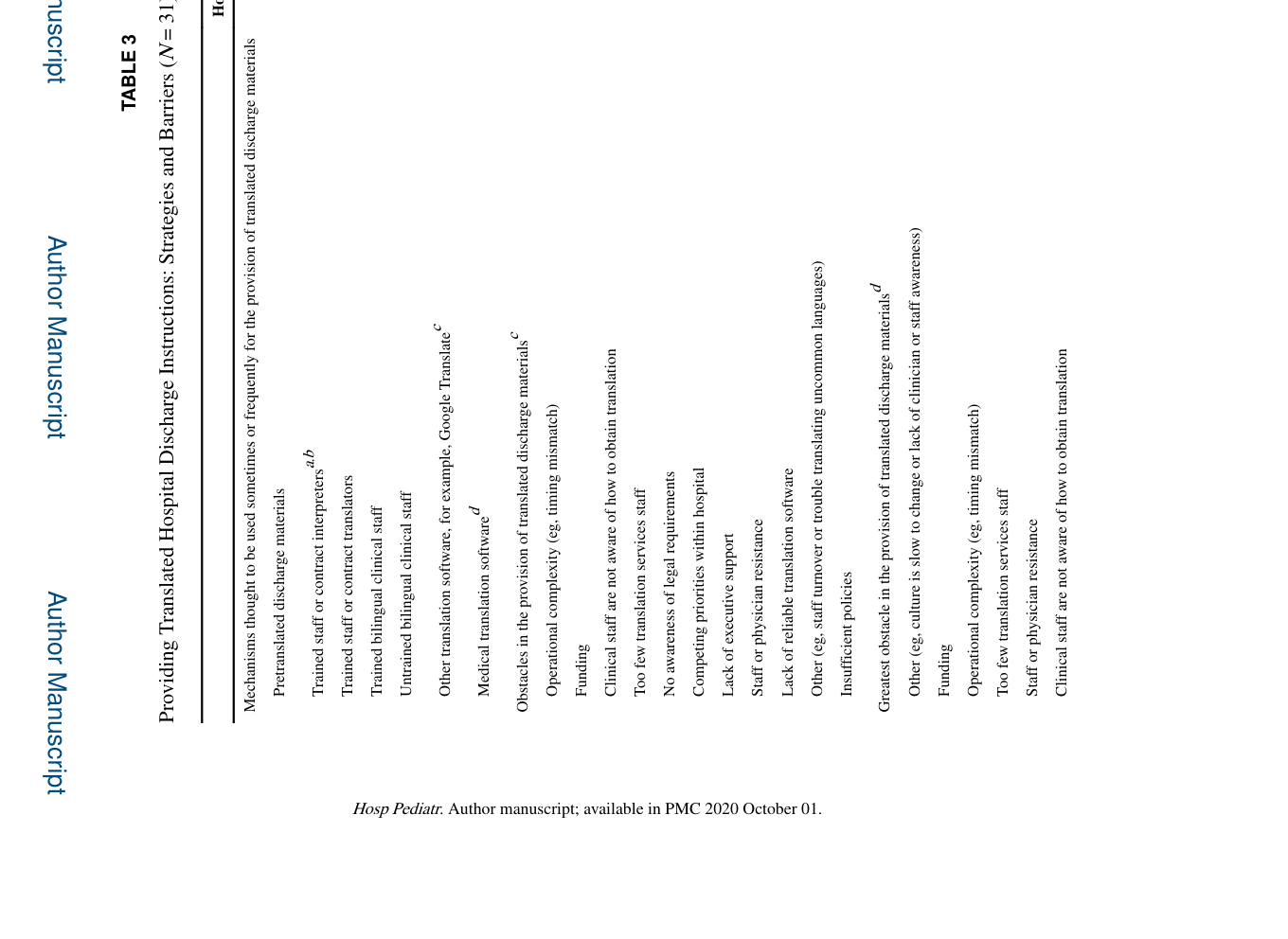
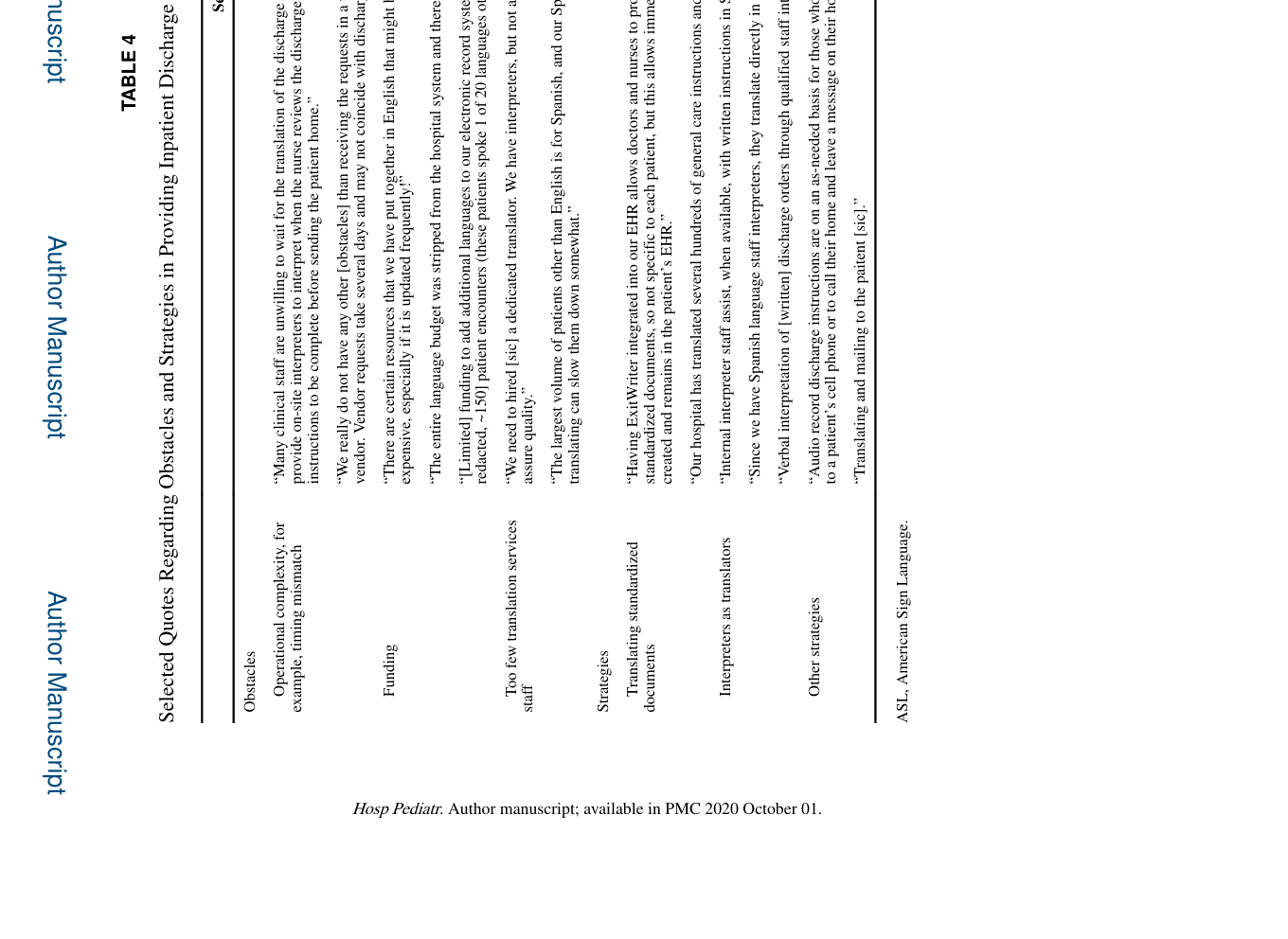
The most commonly cited barrier to providing translated inpatient discharge instructions was "operational complexity" (69%, 20 of 29; Table 3), which respondents described concretely as a timing mismatch: discharge instructions are finalized at the last minute while professional translation takes hours to days, so clinical staff discharge patients before the written translation is ready (Table 4). This is a workflow mechanism by which the time/effort cost of translation causes either delayed discharge or patients leaving without language-concordant written instructions.
"When asked 'What obstacles does your children's hospital face in providing discharge translation services in the inpatient setting?' the most commonly cited barrier was 'operational complexity' (69%; Table 3)." (Davis, 2019, p. 5)
"Many clinical staff are unwilling to wait for the translation of the discharge instructions and end up discharging the patient before the translation is complete. We provide on-site interpreters to interpret when the nurse reviews the discharge instructions with the patient, but clinical staff don't want to wait for the written instructions to be complete before sending the patient home." (Davis, 2019, p. 19)
Methods Context #
What? #ⓘ
The observable: respondents' selection of obstacles from a closed-ended list (Table 3) plus open-ended descriptions of their greatest challenge (Table 4), recording perceived barriers to translating discharge instructions.
"Open- and closed-ended questions were focused on both the institution's overall organization of language services and, more specifically, on the translation of inpatient discharge instructions into languages other than English." (Davis, 2019, p. 3)
How? #ⓘ
Closed-ended barrier responses summarized with descriptive statistics; open-ended responses about the greatest challenge analyzed by the project team with inductive content analysis (independent theme identification then group discussion).
"Open-ended survey responses and translation policies were coded and analyzed by the project team using inductive content analysis. The project team independently examined open-ended responses for themes and then discussed themes together." (Davis, 2019, p. 4)
Who? #ⓘ
Language-services contacts at 31 (closed barrier items: n = 29) acute-care CHA children's hospitals, large and well resourced (median 248 beds, 71% teaching hospitals); responses are the directors' institutional perspective, not direct patient or bedside-clinician observation.
"Respondents (n = 31) completed a deidentified online survey with 25 questions regarding translation services for pediatric inpatients." (Davis, 2019, p. 3)
Other Notes #
When asked for the single "greatest" obstacle, operational complexity, too few translation staff, and funding were each chosen by an equal number (5, 17% each; Table 3) — i.e., the timing mechanism is the most frequently present barrier but not uniquely the worst. This is a perceived/organizational mechanism, not a measured length-of-stay or delay outcome.
Caveats #
- Data on clinician use of translation strategies are self-reported by language-services directors as institutional proxies and are subjective Language-services directors answered as proxies for their whole institution, and the authors note that data about how clinicians actually use the various translation strategies are subjective and should be interpreted with caution. Reported barrier rankings and strategy-use frequencies reflect directors' perceptions rather than direct observation of bedside practice, so the mechanisms (e.g., timing mismatch, interpreters-as-translators) are perceived organizational accounts, not measured behaviors.
- Low survey response rate (46%) likely biases the sample toward hospitals with greater language-services resources or interest Most CHA institutions had no available language-services contact, and among those that did the survey response rate was only 46%. The authors caution the sample may be biased toward institutions with greater resources directed at language services or respondents with greater interest in language services. The reported translation-coverage rates (e.g., 74% translating discharge instructions) and strategy frequencies may therefore overstate practice across children's hospitals generally.