Telephone-based interpreters faced challenges completing communicative tasks versus in-person interpreters due to lost information and lack of visual cues
Source
Benda (2022). The active role of interpreters in medical discourse - An observational study in emergency medicine. Patient Education and Counseling.
Description #
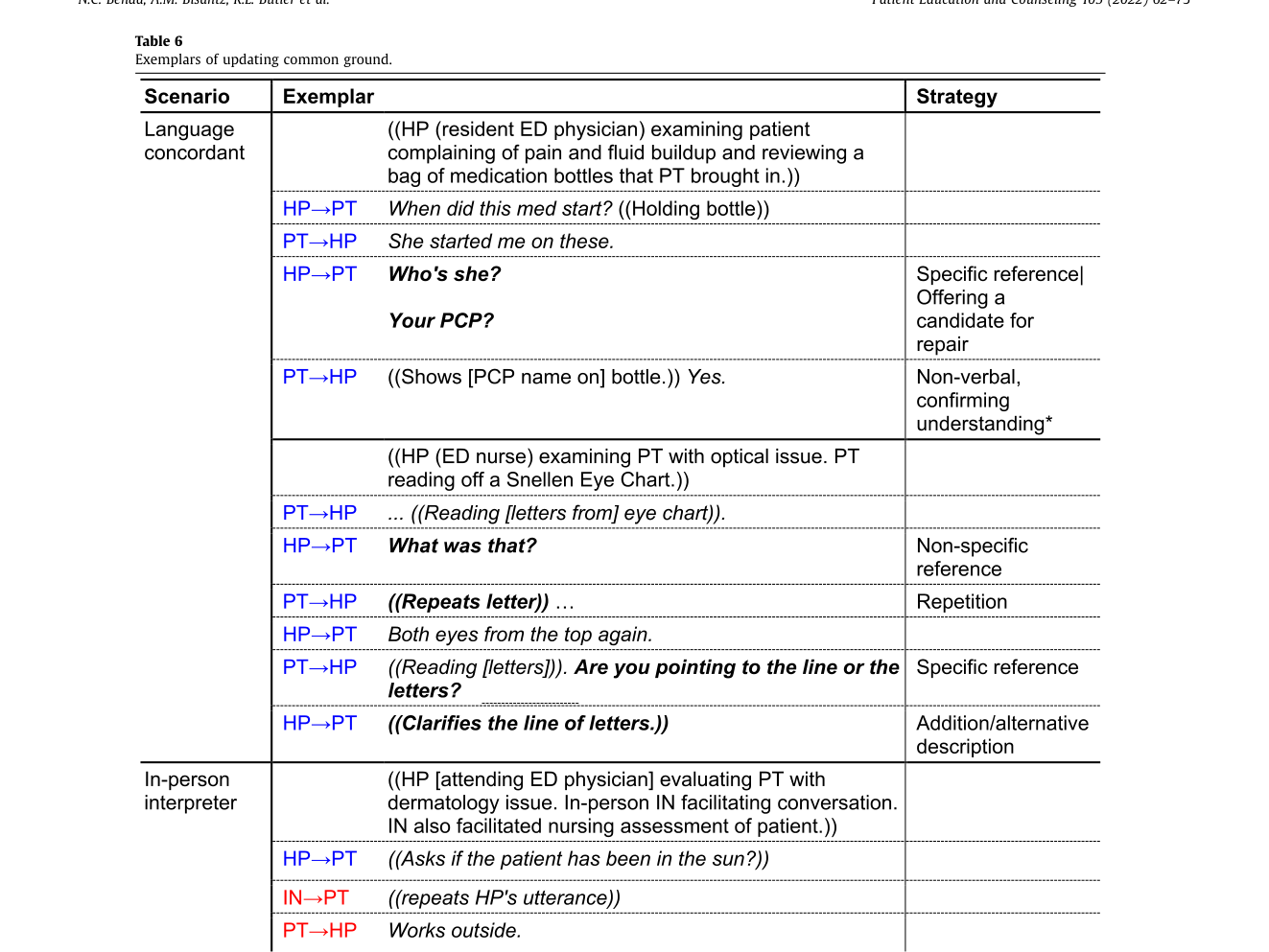
Comparing transcripts of in-person versus telephone-based interpreting in the ED, telephone-based interpreters faced distinctive challenges in completing common-ground tasks: difficulty hearing, information lost in interpretation, and inability to use or access visual cues and locally situated context (e.g., a local clinic name lost in interpretation, or not seeing that an answer was being looked up on a phone). In one repair scenario no party noticed the trouble, so the lost information was never recovered. This identifies a mechanism by which the medium of professional interpretation moderates the quality of language-discordant communication.
"Telephone-based interpreters faced challenges in facilitating communicative tasks based on thematic comparisons with in-person interpreters, including issues hearing and lost information due to the lack of visual cues." (Benda, 2022, p. 62)
"Table 6 also highlights that certain local context (e.g. names of clinics) may be challenging for telephone, and presumably video-based interpreters, who may be located in other domestic or international areas." (Benda, 2022, p. 68)
"In this case, there was no strategy for repair, as none of the parties noticed that trouble had occurred (i.e. the information of the clinic name had been lost in interpretation)." (Benda, 2022, p. 66)
Methods Context #
What? #ⓘ
The observable: scenario-by-scenario thematic comparison of how completely each common-ground task was executed under in-person versus telephone-based interpretation, drawn from the coded transcript exemplars (Tables 3–6).
"Comparisons between transcripts of in person and telephone-based interpreters indicate that telephone-based interpretation presents unique challenges that may require additional strategies or training." (Benda, 2022, p. 71)
How? #ⓘ
In-situ pen-and-paper observation of ED conversations coded turn-by-turn, with representative exemplars collated into three scenarios (language-concordant, in-person interpreter, telephone-based interpreter) and compared thematically; findings vetted through member-checking interviews with providers, nurses, and interpreters.
"At the conclusion of the initial analysis, representative data involving each of the four high-level tasks described and related strategies were collated (similar to the tables presented in the results) based on three different scenarios: 1) language concordant - conversation where patient and hospital staff speak the same language, 2) in-person interpreter - language discordant conversation mediated by an in-person interpreter, and 3) telephone based interpreter - language discordant conversation mediated by a telephone-based interpreter." (Benda, 2022, p. 64)
Who? #ⓘ
Conversations involving ~19 telephone-based interpreters and 3 in-person interpreters across 9 Spanish-speaking LEP patients (of 15 total patients) in a single urban tertiary-care academic ED in the Eastern US; the site used only in-person and telephone-based interpreting (no video).
"Observations involved 3 in-person interpreters, approximately 92 other health professionals, and approximately 19 telephone-based interpreters." (Benda, 2022, p. 64)
"At the time of the observations, the ED data collection sites only used in-person and telephone-based interpreters, therefore our results do not include the increasingly common medium of video-based interpretation." (Benda, 2022, p. 69)
Other Notes #
A qualitative, mechanism-level comparison of interpreting media, not a quantified effect. The authors note this implies a need for medium-specific interpreter training and for health professionals to verbalize visual context to telephone-based interpreters.
Caveats #
- Single integrated network and Spanish-only sample may not generalize to other settings or languages Data came from two hospitals in a single integrated healthcare delivery network in the Eastern US, and patient participants spoke only English and Spanish. The authors caution that the results may not generalize to other care settings or to interpretation in languages other than Spanish, which may involve different communicative themes and challenges. The "active role" and telephone-interpreter findings therefore have bounded external validity.
- Small qualitative ED sample (15 patients) supports thematic but not statistical differences The study observed only 15 unique patients. Although shadowing them throughout their ED stay yielded 63 h of data and themes reached qualitative saturation, the authors state this sample supports thematic/qualitative differences (including the in-person vs. telephone interpreter comparison) but is not sufficient to establish statistical differences. The findings should therefore be read as qualitative mechanisms, not quantified effects.