Three-quarters of surveyed children's hospitals (74%) reported translating discharge instructions
Source
Davis (2019). Translating Discharge Instructions for Limited English-Proficient Families: Strategies and Barriers. Hospital Pediatrics.
Description #
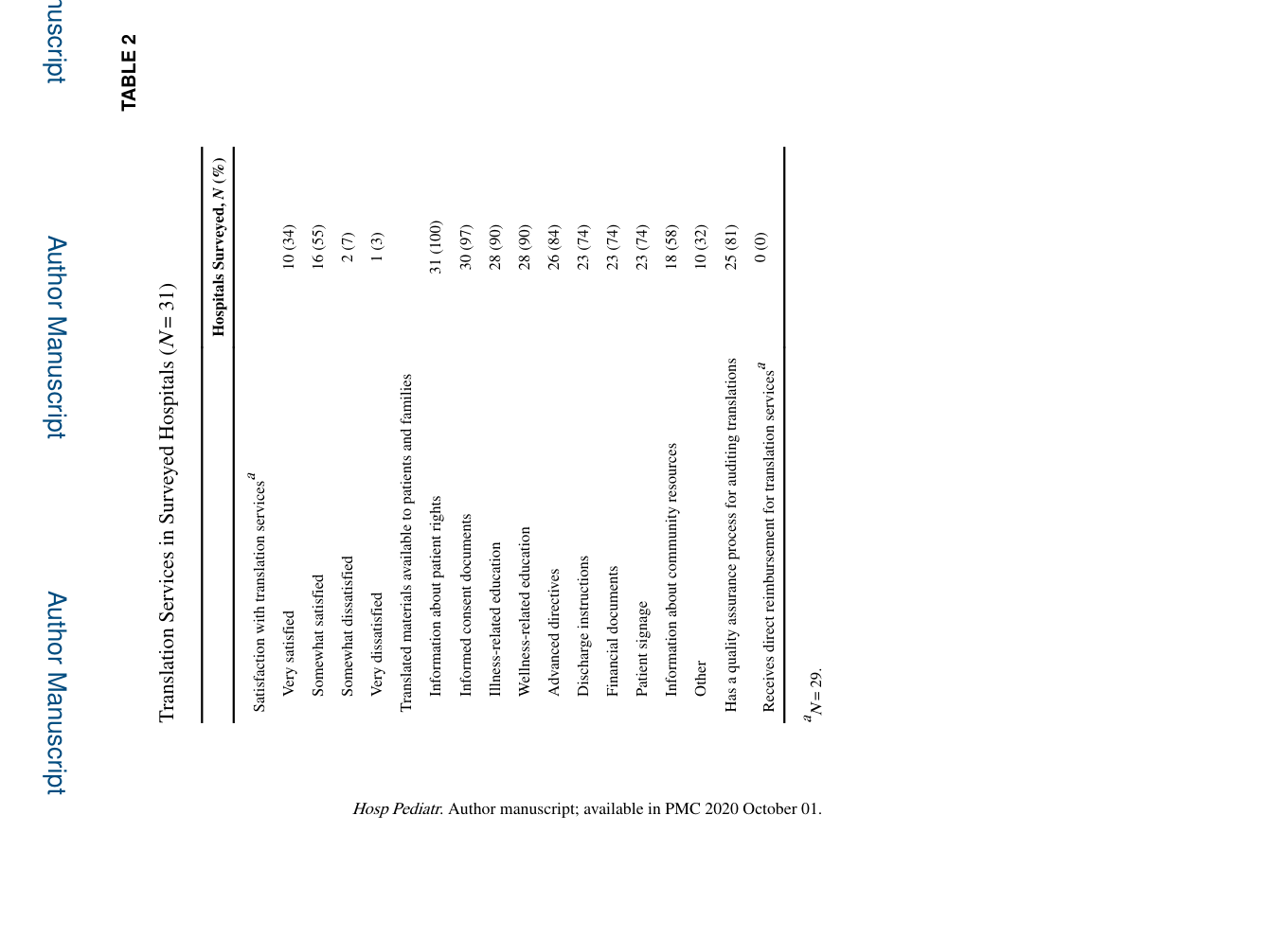
In a survey of 31 children's hospital language-services contacts, all respondents reported translating a subset of hospital documents (e.g., patient-rights handouts at 100%, consent documents at 97%), but only three-quarters (74%, 23 of 31) reported translating discharge instructions (Table 2). Written discharge instructions thus lag behind legal/consent documents in being made language-concordant, even though they are the materials patients take home.
"All respondents reported that their institution translates handouts pertaining to patient rights, nearly all reported translating consent documents (97%), and three-quarters (74%) reported translating hospital discharge instructions (Table 2)." (Davis, 2019, p. 4)
"Discharge instructions / 23 (74)" (Davis, 2019, p. 16)
Methods Context #
What? #ⓘ
The observable: the self-reported proportion of surveyed hospitals that translate each category of written document, including discharge instructions, recorded as closed-ended survey responses.
"Respondents (n = 31) completed a deidentified online survey with 25 questions regarding translation services for pediatric inpatients, including a request for copies of extant translation policies." (Davis, 2019, p. 3)
How? #ⓘ
Mixed-methods design: an online closed- and open-ended survey to Children's Hospital Association language-services contacts, analyzed with descriptive statistics; questions adapted from prior hospital language-access surveys and piloted with language-services professionals.
"We conducted a mixed-methods, multimodal analysis. Data comprised closed- and open-ended responses to an online survey sent to Children's Hospital Association language services contacts (n = 31), an online environmental scan of Children's Hospital Association translation policies (n = 22), and county-level census data." (Davis, 2019, p. 1)
Who? #ⓘ
31 respondents (mostly language or interpreter services directors) from acute-care Children's Hospital Association member hospitals contacted Feb–Aug 2017; 68 of 200 CHA hospitals had a designated contact who was emailed, of whom 31 responded (46% response rate); hospitals were large (median 248 beds) and well resourced.
"We obtained e-mail addresses for 68 individuals who were e-mailed an online survey with up to 2 reminders." (Davis, 2019, p. 3)
Other Notes #
This is a measurement of service availability (whether translated discharge instructions exist), not an outcome on patients. The ~26% of hospitals not translating discharge instructions, plus the federal backdrop that "nearly half of hospitals do not translate discharge instructions" cited in the introduction, frames discharge-instruction translation as an underprovided concordance service.
Caveats #
- Low survey response rate (46%) likely biases the sample toward hospitals with greater language-services resources or interest Most CHA institutions had no available language-services contact, and among those that did the survey response rate was only 46%. The authors caution the sample may be biased toward institutions with greater resources directed at language services or respondents with greater interest in language services. The reported translation-coverage rates (e.g., 74% translating discharge instructions) and strategy frequencies may therefore overstate practice across children's hospitals generally.