Median psychiatric inpatient length of stay was higher for LEP patients (12 vs 8 days) but not statistically significant
Source
Daly (2019). The effect of limited English proficiency and interpreter service use on clinical outcomes in psychiatric inpatient units. Australias Psychiatry.
Description #
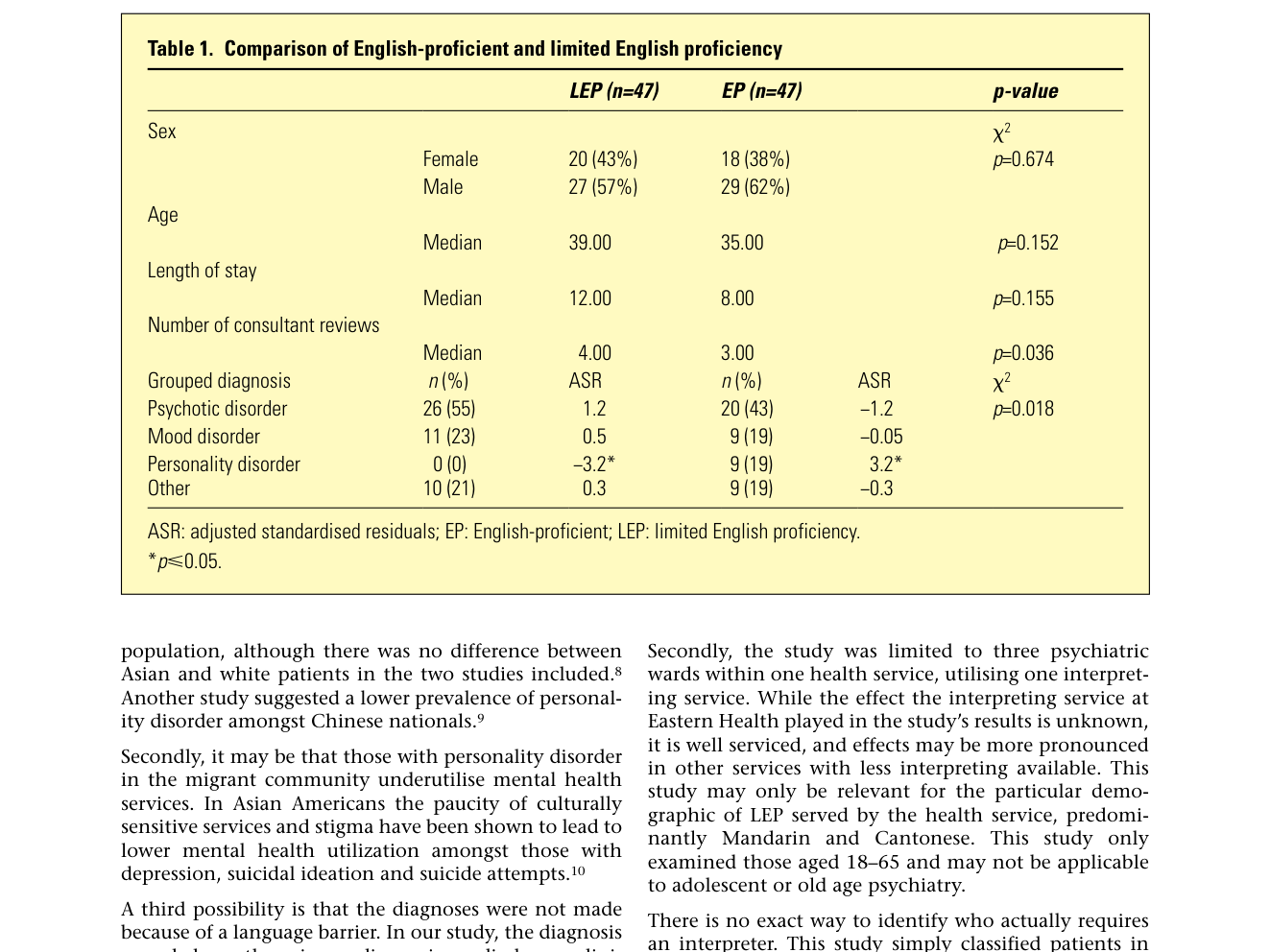
Across three adult psychiatric inpatient units, the median length of stay was higher for patients with limited English proficiency (LEP) than for English-proficient (EP) patients — 12 vs 8 days — but the difference was not statistically significant (p=0.155) (Table 1).
"Though the median length of stay appeared higher in the LEP group (12 vs 8 days), this was not statistically significant." (Daly, 2019, p. 466)
Methods Context #
What? #ⓘ
The observable: hospital length of stay (admission length in days) recorded from electronic records and compared between the LEP and EP groups.
"Length of stay, number of consultant reviews and discharge diagnosis were recorded and compared." (Daly, 2019, p. 465)
How? #ⓘ
Retrospective matched case-comparison: 47 LEP patients (defined by requiring a professional interpreter during admission) compared with 47 EP patients (the next admitted patient not requiring an interpreter); length of stay compared with t-test / Mann–Whitney.
"Forty-seven patients with limited English proficiency (LEP) were retrospectively identified and compared with 47 patients with proficient English." (Daly, 2019, p. 465)
Who? #ⓘ
Adult inpatients aged 18–65 admitted Jan 2017–Aug 2018 across three adult psychiatric units (75 acute beds, two hospital sites) of Eastern Health, a large metropolitan public service in Melbourne, Australia; LEP cohort predominantly Mandarin/Cantonese-speaking.
"There are three adult inpatient units servicing patients aged 18–65 years with a total of 75 acute adult beds across two hospital sites." (Daly, 2019, p. 466)
Other Notes #
The point estimate (median 12 vs 8 days, a 4-day difference) is in the hypothesized direction; the non-significant p-value should be read against the study's explicitly limited power (see qualifying caveat).
Caveats #
- LEP exposure was proxied by interpreter use, leaving ad hoc interpretation and true interpreter need unmeasured The LEP/EP grouping was defined solely by whether a professional interpreter was used during the admission, with no independent measure of who actually needed one. Ad hoc interpretation by family or staff was neither captured nor controlled. This exposure misclassification could bias every between-group comparison (length of stay, consultant reviews, discharge diagnosis) in an unknown direction.
- Small retrospective exploratory psychiatric sample (n=47 per group) was underpowered to detect a length-of-stay difference This was a retrospective, exploratory study with 47 patients per group. The authors note the limited number of cases reduces statistical power, so the non-significant length-of-stay difference (median 12 vs 8 days, p=0.155) cannot be read as evidence of no effect — the study was likely underpowered to detect the difference it was designed to find.