No LEP psychiatric inpatients received a personality disorder diagnosis versus 19% of English-proficient patients
Source
Daly (2019). The effect of limited English proficiency and interpreter service use on clinical outcomes in psychiatric inpatient units. Australias Psychiatry.
Description #
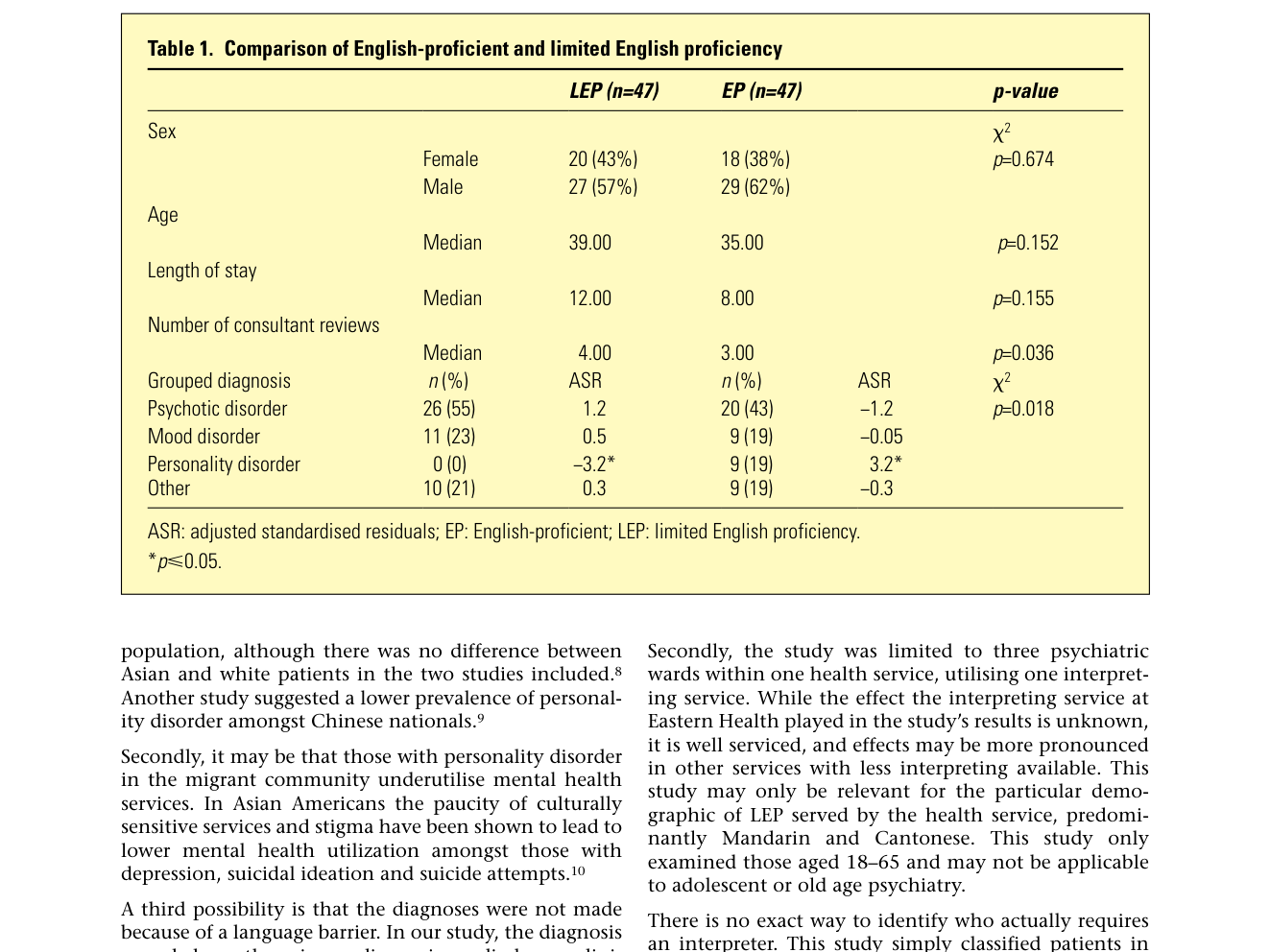
Discharge diagnoses differed significantly between groups (p=0.018): none of the 47 LEP patients received a primary discharge diagnosis of personality disorder, versus 9 of 47 (19%) English-proficient patients, with adjusted standardised residuals (±3.2) flagging the personality-disorder cell as the driver (Table 1). The authors raise a language barrier during assessment as one candidate explanation for the absent diagnoses.
"The ASRs indicate a greater proportion of EP (9 patients) were diagnosed with personality disorders when compared to LEP, of whom none received such a diagnosis (p<0.05)." (Daly, 2019, p. 466)
Methods Context #
What? #ⓘ
The observable: primary discharge diagnosis, clinically determined by psychiatrists and grouped into four categories (psychotic, mood, personality, other).
"Discharge diagnoses were grouped into four categories for analysis: psychotic disorders (including schizoaffective disorder and substance-induced psychosis), mood disorders (depression and bipolar affective disorder), personality disorders (antisocial personality disorder and borderline personality disorder) and other (adjustment disorder, situational crisis, autism, intellectual disability)." (Daly, 2019, p. 466)
How? #ⓘ
Retrospective matched case-comparison (47 LEP vs 47 EP); categorical discharge-diagnosis distribution compared with Fisher's exact test and adjusted standardised residuals (ASR) to locate driving cells.
"For categorical outcomes, Fisher's exact test and the adjusted standardised residual (ASR) were used." (Daly, 2019, p. 466)
Who? #ⓘ
Adult psychiatric inpatients aged 18–65 at Eastern Health, Melbourne; diagnoses were clinician-assigned primary discharge diagnoses rather than structured-instrument diagnoses.
"In our study, the diagnosis recorded was the primary diagnosis on discharge, clinically determined by psychiatrists rather than from validated measures." (Daly, 2019, p. 467)
Other Notes #
This is an observed difference in the distribution of recorded diagnoses, not a validated measure of diagnostic accuracy; the authors offer competing explanations (true prevalence differences, service under-utilisation, and language-barrier-driven under-detection).
Caveats #
- LEP exposure was proxied by interpreter use, leaving ad hoc interpretation and true interpreter need unmeasured The LEP/EP grouping was defined solely by whether a professional interpreter was used during the admission, with no independent measure of who actually needed one. Ad hoc interpretation by family or staff was neither captured nor controlled. This exposure misclassification could bias every between-group comparison (length of stay, consultant reviews, discharge diagnosis) in an unknown direction.