Patients with LEP had the highest proportion receiving behavioral pain tools, suggesting interpreter underutilization
Source
Aksharananda Rambachan (2023). Pain Assessment Disparities by Race, Ethnicity, and Language in Adult Hospitalized Patients. Pain Management Nursing.
Description #
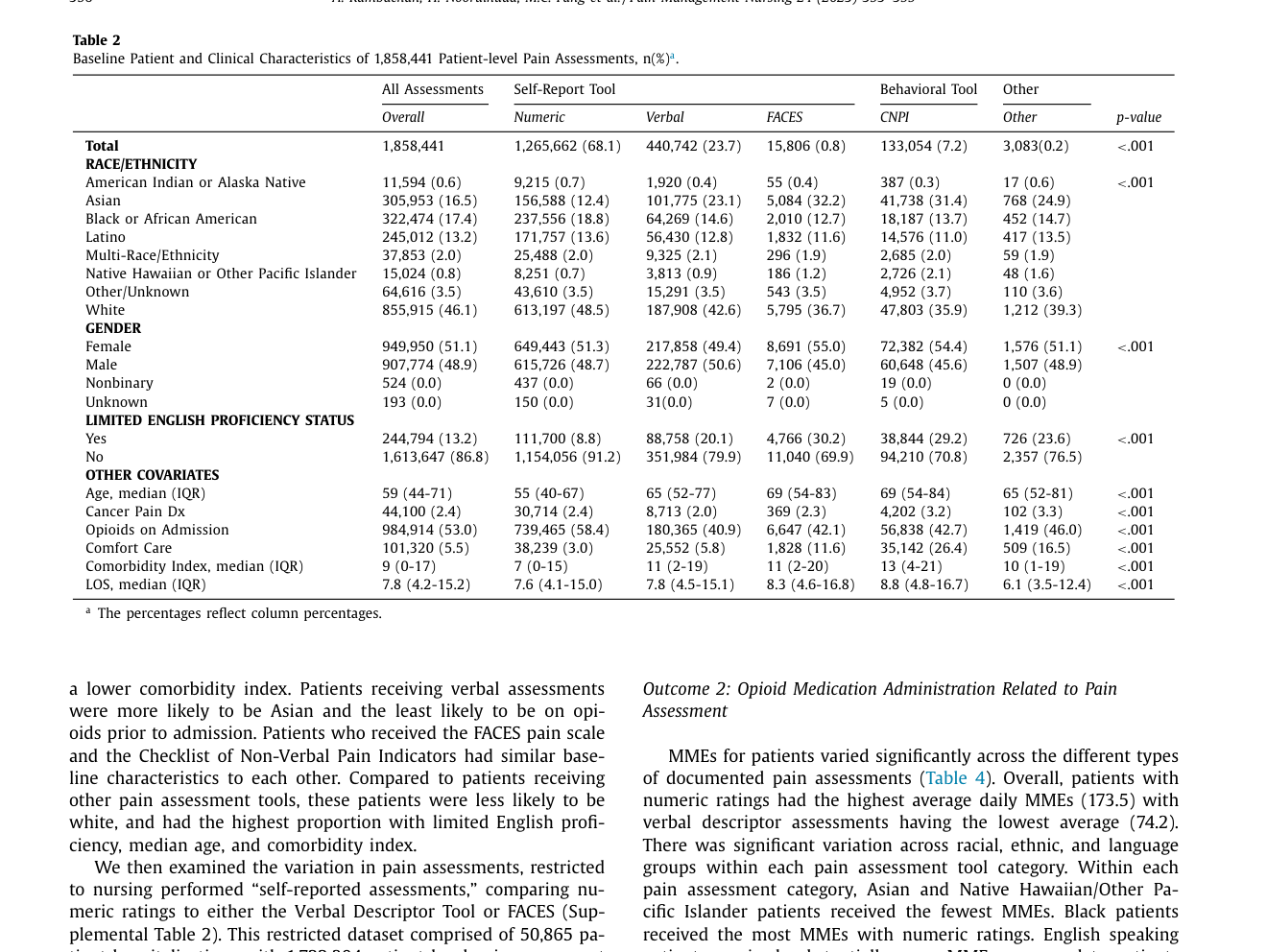
Patients receiving the FACES pain scale and the Checklist of Nonverbal Pain Indicators (behavioral tools, used when a patient cannot self-report) had the highest proportion of limited English proficiency among all assessment-tool groups. The authors interpret this elevated reliance on behavioral tools for patients with LEP as probable underutilization of interpreters by nurses — supported by institutional data showing video interpreters were used for fewer than 30% of hospital days for LEP patients during a 2018 sample period — offering a mechanism for the numeric-rating disparity (Table 2).
"Patients who received the FACES pain scale and the Checklist of Non-Verbal Pain Indicators had similar baseline characteristics to each other. Compared to patients receiving other pain assessment tools, these patients were less likely to be white, and had the highest proportion with limited English proficiency, median age, and comorbidity index." (Aksharananda, 2023)
"Evidenced by the higher use of behavioral tools for patients with LEP, it is probable that interpreters were underutilized by nurses. For example, internal data from our institution during a one-month period in 2018 indicated that video interpreters were used for less than 30% of hospital days for LEP patients (Eniasivam, Malevanchik, Khoong, Lau, & Fernández, 2020)." (Aksharananda, 2023)
Methods Context #
Methods details (with associated screenshots/quotes + page numbers) that contextualize how the evidence was produced that help us to understand/evaluate/use it.
What? #ⓘ
The observable was the distribution of documented pain-assessment-tool types (Numeric Rating Scale, Verbal Descriptor Scale, FACES, Checklist of Nonverbal Pain Indicators, Other) and the baseline patient characteristics — including LEP proportion — associated with each tool category.
"The first outcome was the type of pain assessment tool utilized by nursing. Options included self-reported pain tools: Numeric Rating Scale, Verbal Descriptor Scale, FACES pain scale, or behavioral tools, including the Checklist of Nonverbal Pain Indicators (Table 1), or “Other,”" (Aksharananda, 2023)
How? #ⓘ
Descriptive stratification of EHR-documented pain assessments by tool type, with baseline demographic, hospitalization, and comorbidity variables compared across tool categories using chi-squared or ANOVA tests; the interpreter-underutilization interpretation is the authors' inference triangulated against separately published institutional interpreter-use data.
"Baseline demographic, hospitalization-related, and comorbidity indices were stratified by pain assessment tool with comparisons using chi-squared or ANOVA tests." (Aksharananda, 2023)
Who? #ⓘ
Adult general medicine inpatients at UCSF Helen Diller Medical Center, 2013–2021 (51,602 hospitalizations, 13.2% LEP), with the behavioral-tool categories (FACES and Checklist of Nonverbal Pain Indicators) together comprising the smaller fraction of the 1,858,441 assessments (FACES 0.8%, CNPI 7.2%).
"Overall, the Numeric Rating Scale was the most common tool used, comprising 68.1% of total assessments, followed by the Verbal Descriptor Tool (23.7%), the Checklist of Nonverbal Pain Indicators (7.2%), and the FACES pain scale (0.8%)." (Aksharananda, 2023)
Other Notes #
Caveats #
- Single-institution EHR study without interpreter-usage data cannot confirm interpreter underutilization as the cause of LEP pain-assessment disparities This is a single-institution retrospective cohort drawn entirely from EHR data, and the authors did not have access to interpreter-usage data — so they could not directly characterize the association between interpreter use and pain-assessment type, leaving the proposed "interpreter underutilization" mechanism inferential rather than demonstrated. The analysis was also limited to complete cases where a pain-assessment tool was linked to a value (excluding the many switches between tools), and the identity of the nurse performing each assessment was unavailable, so nurse-level variation and bias could not be modeled. The authors further note ongoing debate about the validity and cross-group comparability of pain scales themselves, which complicates interpreting the numeric-rating disparity. Being single-site (one urban academic medical center), generalizability to other settings is uncertain.