English-speaking patients received substantially more daily opioids (MMEs) than patients with LEP across all pain assessments
Source
Aksharananda Rambachan (2023). Pain Assessment Disparities by Race, Ethnicity, and Language in Adult Hospitalized Patients. Pain Management Nursing.
Description #
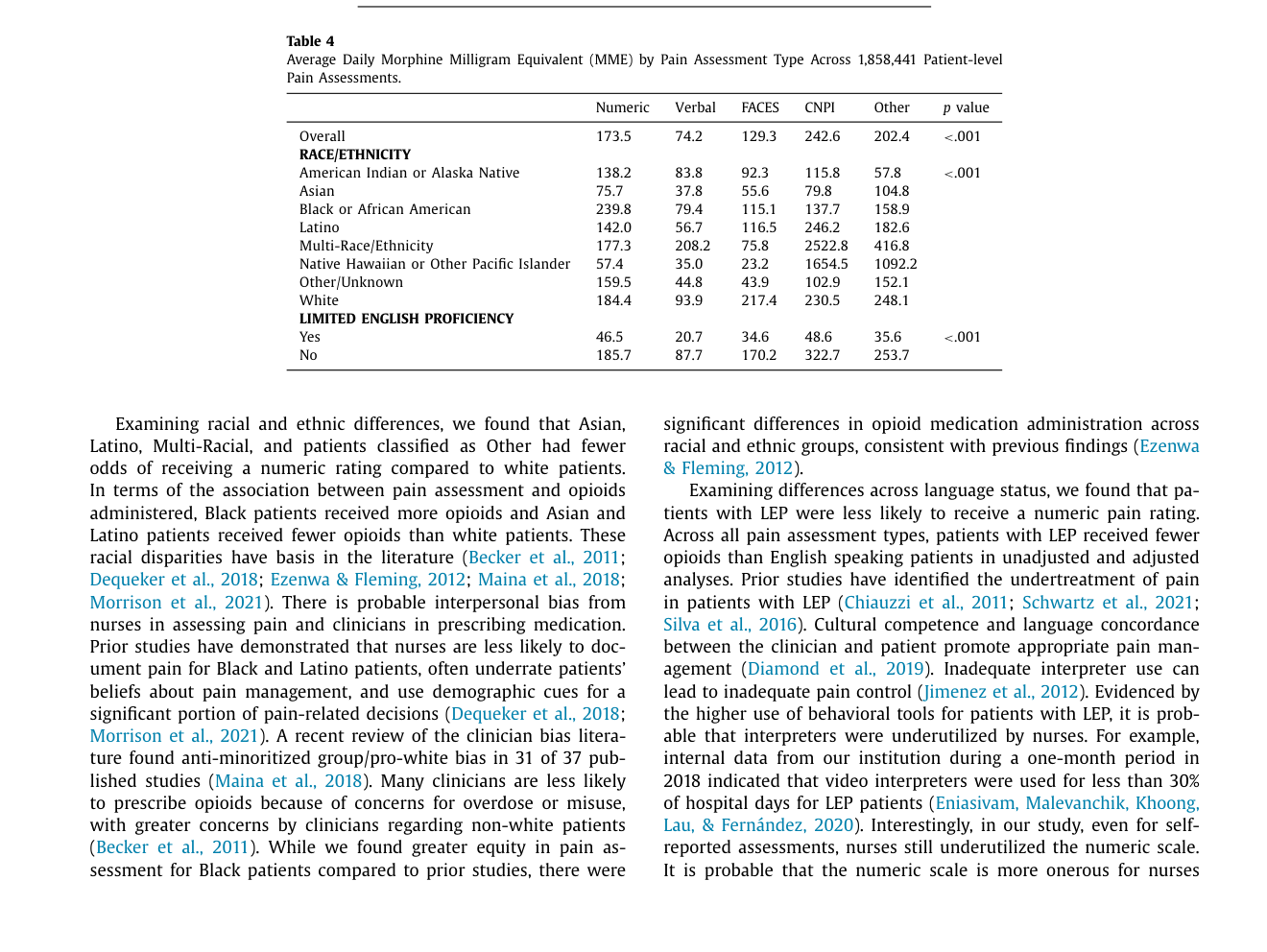
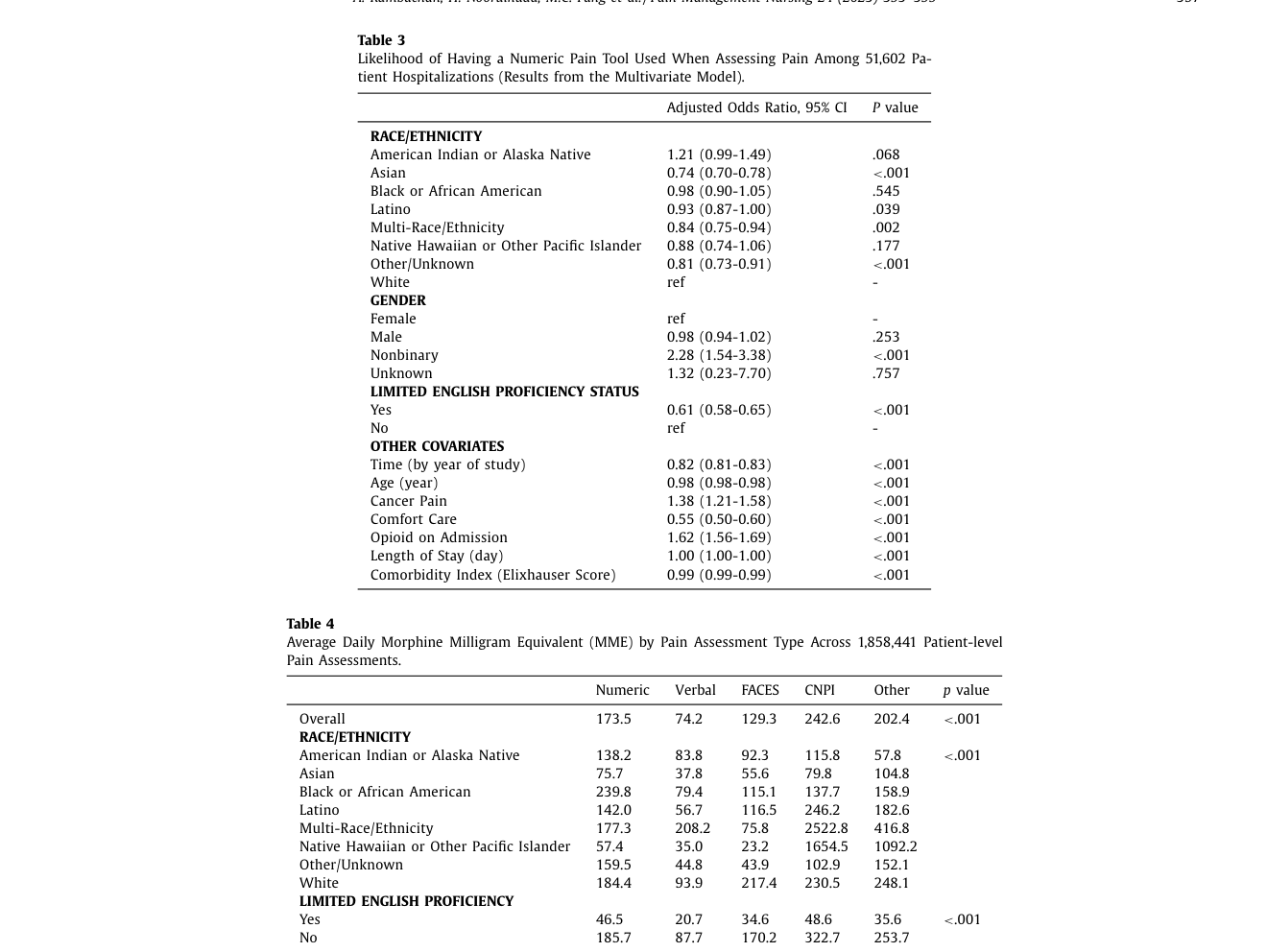
Examining the second primary outcome — average daily opioid administration (morphine milligram equivalents, MME) by pain assessment category — English-speaking patients received substantially more daily opioids than patients with LEP within every pain-assessment category. Restricting to nurse self-report assessments only, patients with LEP (along with Asian and Native Hawaiian/Other Pacific Islander patients) received the fewest MMEs across pain assessment categories (Table 4; Supplemental Table 3).
"English speaking patients received substantially more MMEs compared to patients with LEP across all pain assessments. When focusing upon nursing performed self-report assessments only, there was a similar pattern to the overall data, where Asian and Native Hawaiian/Other Pacific Islander patients, and patients with LEP, received the fewest MMEs across pain assessment categories (Supplemental Table 3)." (Aksharananda, 2023)
Methods Context #
Methods details (with associated screenshots/quotes + page numbers) that contextualize how the evidence was produced that help us to understand/evaluate/use it.
What? #ⓘ
The observable was the quantity of opioid pain medication administered, operationalized as the average morphine milligram equivalent (MME) per patient per day, tabulated within each documented pain-assessment-tool category.
"The second outcome was the number of opioids associated with each patient assessment type, calculated as the average morphine milligram equivalent (MME) per patient/per day. We examined this outcome across (i) all pain assessment types, including all self-reported and behavioral assessments and (ii) restricted to only self-reported assessments, comparing the Numeric Rating Scale to the Verbal Descriptor Scale/FACES pain scale." (Aksharananda, 2023)
How? #ⓘ
Time-stamped medication administration records from the Epic EHR (Clarity) were used to compute per-patient/per-day MME, then stratified across pain-assessment categories and across racial, ethnic, and language groups within each category, with the same MME average applied to each assessment row for a given patient.
"MMEs for patients varied significantly across the different types of documented pain assessments (Table 4). [...] There was significant variation across racial, ethnic, and language groups within each pain assessment tool category." (Aksharananda, 2023)
"As the level of analysis was each documented pain assessment, many patients had multiple rows of data included in this analysis. The same MME average was used for each row of data for each individual patient." (Aksharananda, 2023)
Who? #ⓘ
Adult general medicine inpatients at UCSF Helen Diller Medical Center (urban academic center), 2013–2021, excluding ICU stays; the overall cohort was 51,602 patient hospitalizations with 1,858,441 patient-level pain assessment values, of whom 13.2% were patients with LEP.
"we included 51,602 patient hospitalizations and 1,858,441 patient-level pain assessment values. [...] The majority, 86.8%, were English speaking and 13.2% were patients with LEP." (Aksharananda, 2023)
Other Notes #
Caveats #
- Single-institution EHR study without interpreter-usage data cannot confirm interpreter underutilization as the cause of LEP pain-assessment disparities This is a single-institution retrospective cohort drawn entirely from EHR data, and the authors did not have access to interpreter-usage data — so they could not directly characterize the association between interpreter use and pain-assessment type, leaving the proposed "interpreter underutilization" mechanism inferential rather than demonstrated. The analysis was also limited to complete cases where a pain-assessment tool was linked to a value (excluding the many switches between tools), and the identity of the nurse performing each assessment was unavailable, so nurse-level variation and bias could not be modeled. The authors further note ongoing debate about the validity and cross-group comparability of pain scales themselves, which complicates interpreting the numeric-rating disparity. Being single-site (one urban academic medical center), generalizability to other settings is uncertain.