Patients with LEP had the lowest adjusted odds of numeric pain ratings (OR 0.61, 95% CI 0.58-0.65)
Source
Aksharananda Rambachan (2023). Pain Assessment Disparities by Race, Ethnicity, and Language in Adult Hospitalized Patients. Pain Management Nursing.
Description #
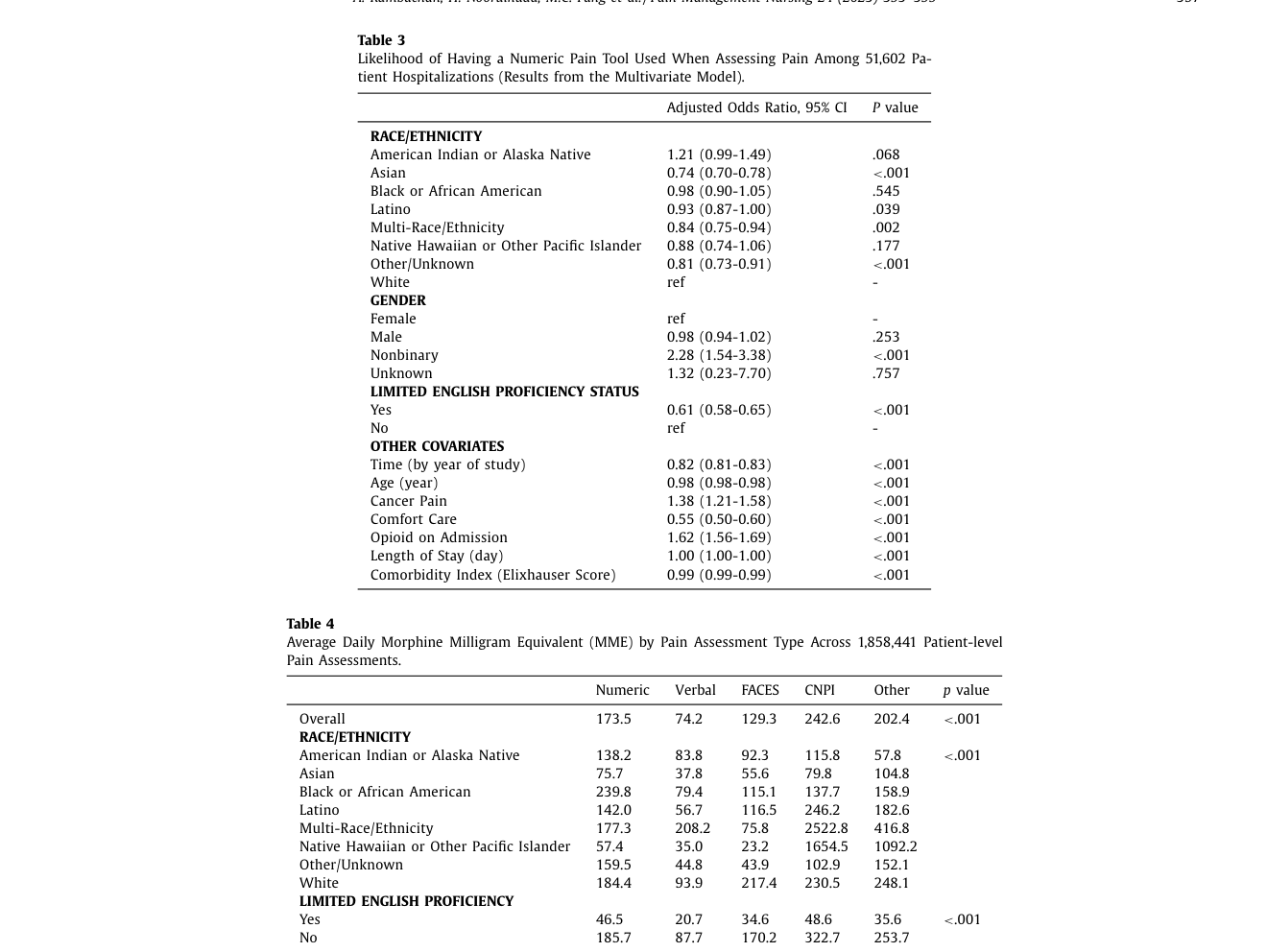
In a multivariable logistic regression restricted to nurse-performed self-report pain tools, patients with limited English proficiency (LEP) had the lowest adjusted odds of receiving a numeric (Numeric Rating Scale) pain assessment versus another self-report tool, compared with English-speaking patients (OR 0.61, 95% CI 0.58–0.65). This was the largest reduction in odds of any subgroup examined, exceeding even the Asian-patient effect (OR 0.74) (Table 3).
"Using multivariable logistic regression to model the relationship between race/ethnicity, LEP status, and the type of self-report tool used, compared to white patients, we found that nurses were less likely to measure pain using numeric rating tools for Asian patients (OR 0.74, 95% CI 0.70–0.78). [...] Patients with LEP were less likely to receive a numeric assessment compared to English speaking patients (OR 0.61, 95% CI 0.58–0.65). (Table 3)" (Aksharananda, 2023)
Methods Context #
Methods details (with associated screenshots/quotes + page numbers) that contextualize how the evidence was produced that help us to understand/evaluate/use it.
What? #ⓘ
The observable was the type of self-report pain assessment tool a nurse documented for a given assessment — specifically whether it was a Numeric Rating Scale versus a Verbal Descriptor Scale / FACES pain scale — recorded in the EHR flowsheet along with a pain value.
"We also examined documentation restricted to nurse performed “self-report tools” comparing numeric rating to verbal descriptor/FACES pain scale. Within the cohort of self-report only, using a multivariate logistic regression, we examined the odds of a patient receiving a numeric pain assessment versus another pain assessment tool." (Aksharananda, 2023)
How? #ⓘ
A retrospective cohort design using Epic EHR (Clarity) data. The odds were estimated with multivariable logistic regression adjusting for race/ethnicity, LEP status, age, comorbidity index, cancer-pain diagnosis, opioids on admission, length of stay, comfort care, and study year, with cluster-robust variance to account for multiple assessments per patient.
"Multivariable logistic regression included race/ethnicity, LEP status, age, comorbidity index, cancer pain diagnosis, opioids on admission, length of stay, comfort care, and study year (as a proxy for temporal changes in prescribing). [...] Cluster-robust variance estimates were used to account for clustering at the patient level using medical record numbers." (Aksharananda, 2023)
Who? #ⓘ
Adult (age ≥18) general medicine inpatients at UCSF Helen Diller Medical Center, an urban academic center, discharged January 2013–September 2021, excluding ICU stays. The self-report-restricted regression cohort comprised 50,865 patient hospitalizations and 1,722,304 patient-level pain assessment values; LEP was defined as a non-English primary language plus a reported need for an interpreter.
"This restricted dataset comprised of 50,865 patient hospitalizations with 1,722,304 patient-level pain assessment values." (Aksharananda, 2023)
"Limited English proficiency (LEP) status was defined as having a self-identified primary language other than English and intake assessment by the patient reporting that they require an interpreter." (Aksharananda, 2023)
Other Notes #
Caveats #
- Single-institution EHR study without interpreter-usage data cannot confirm interpreter underutilization as the cause of LEP pain-assessment disparities This is a single-institution retrospective cohort drawn entirely from EHR data, and the authors did not have access to interpreter-usage data — so they could not directly characterize the association between interpreter use and pain-assessment type, leaving the proposed "interpreter underutilization" mechanism inferential rather than demonstrated. The analysis was also limited to complete cases where a pain-assessment tool was linked to a value (excluding the many switches between tools), and the identity of the nurse performing each assessment was unavailable, so nurse-level variation and bias could not be modeled. The authors further note ongoing debate about the validity and cross-group comparability of pain scales themselves, which complicates interpreting the numeric-rating disparity. Being single-site (one urban academic medical center), generalizability to other settings is uncertain.