Only 39% of LEP inpatients received professional interpretation on both admission and discharge while 13.8% received none on either day
Source
Lindholm (2012). Professional language interpretation and inpatient length of stay and readmission rates. Journal of General Internal Medicine.
Description #
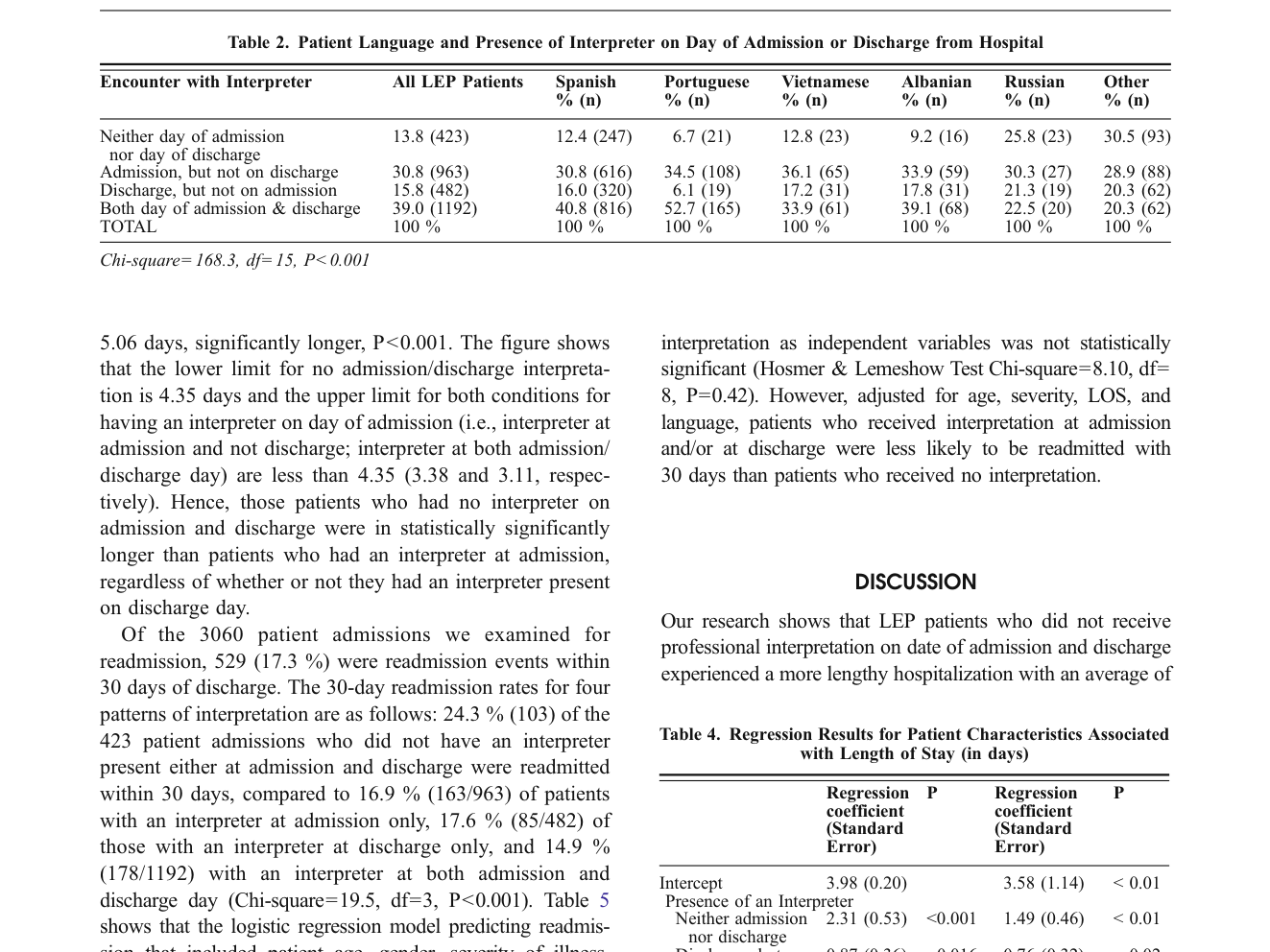
Despite all study patients having requested an interpreter and all having at least one interpreter encounter during their stay, professional interpretation was used at suboptimal rates across the full hospitalization. Of hospitalized LEP patients, 39% (1192) received language interpretation services on both the day of admission and the day of discharge, while 13.8% (423) had interpreters on neither the day of admission nor the day of discharge (Table 2). Spanish- and Portuguese-speaking patients were most likely to have interpreters at both admission and discharge, whereas patients speaking less prevalent languages were most likely to have no interpretation on either day (chi-square=168.3, df=15, P<0.001).
"Table 2 shows that 39 % of hospitalized LEP patients had language interpretation services on both day of admission and day of discharge, while 14 % had interpreters neither on day of admission or day of discharge." (Lindholm, 2012, p. 1296)
"Neither day of admission nor day of discharge ... All LEP Patients 13.8 % (423) ... Both day of admission & discharge ... 39.0 % (1192). Chi-square=168.3, df=15, P<0.001." (Lindholm, 2012, p. 1297)
Methods Context #
What? #ⓘ
The observable: the pattern of professional-interpreter presence on the days of admission and discharge, tabulated as four categories (neither day, admission only, discharge only, both days) overall and by language group.
"For each patient, we created a single categorical indicator that defined four possible patterns between hospital dates and encounter with an interpreter." (Lindholm, 2012, p. 1295)
How? #ⓘ
Merged language-services encounter data with hospital administrative data; for each patient, compared the dates of interpretation with admission and discharge dates to assign the four-level interpretation pattern. Differences across language groups tested with a chi-square test.
"Using encounter data to assess whether or not interpretation occurred at admission and discharge, we compared date of interpretation with admission and discharge dates." (Lindholm, 2012, p. 1295)
Who? #ⓘ
3071 LEP admissions (aged ≥18) who both spoke a language other than English and requested an interpreter, at a tertiary care, university hospital, 2004–2007; 65.4% Spanish, 10.2% Portuguese, with 65 different languages overall.
"Of the 3071 patients in the study population ... 90 % spoke 1 of 5 languages." (Lindholm, 2012, p. 1295)
Other Notes #
Patients without recorded interpretation may still have received unqualified interpretation (family/untrained staff) or had interpreter encounters not recorded on the formal admission day; the authors note this as a measurement limitation.