Adjusted mean length of stay was 5.06 days with no interpreter vs 2.57 days with interpreters on both admission and discharge
Source
Lindholm (2012). Professional language interpretation and inpatient length of stay and readmission rates. Journal of General Internal Medicine.
Description #
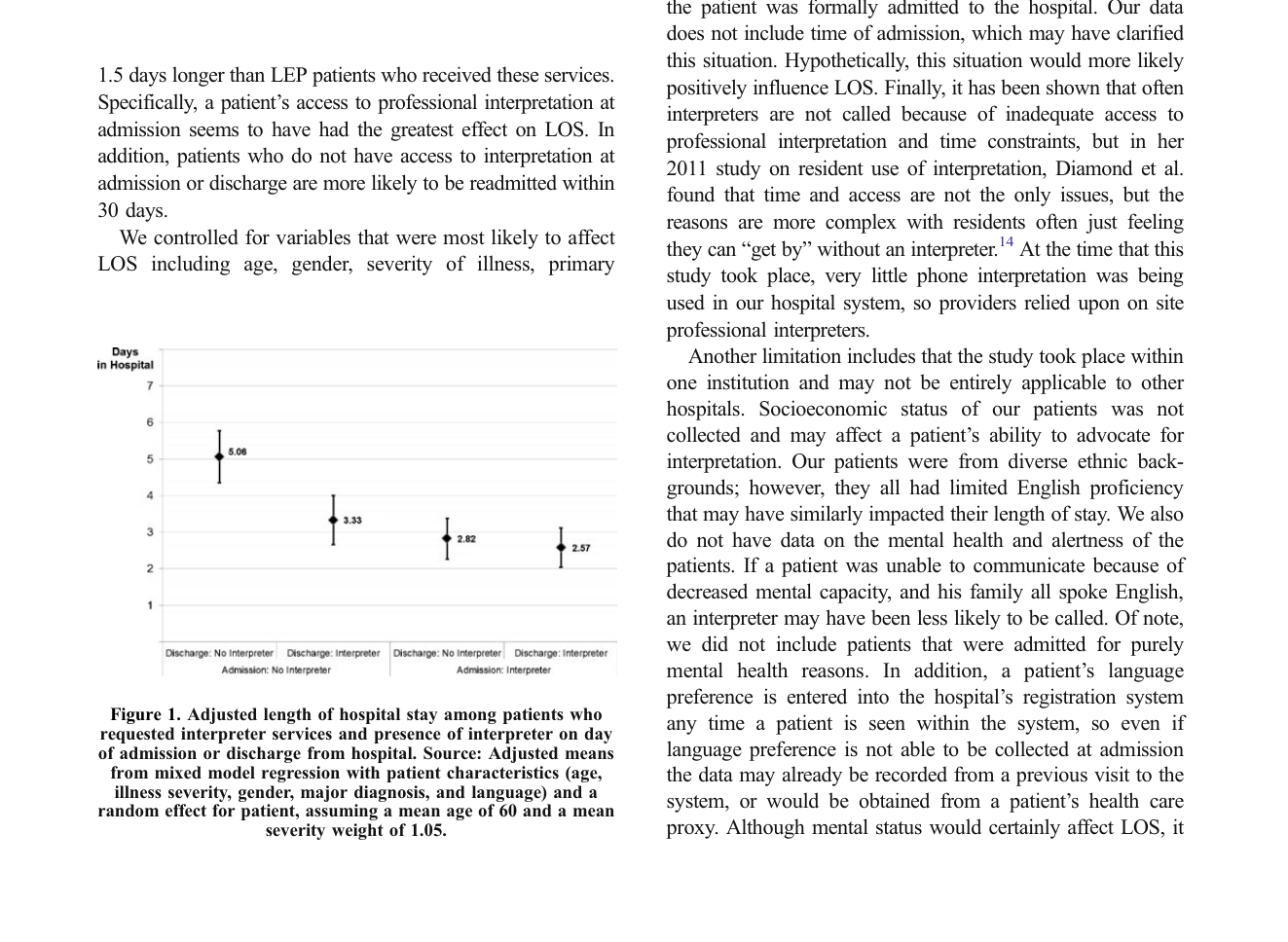
Figure 1 reports the mean adjusted length of stay for the four interpretation conditions, controlling for age, illness severity, and other patient characteristics (means computed for a female 60-year-old patient with a severity index of 1.05). LEP patients who received interpreters on both admission and discharge had a mean adjusted LOS of 2.57 days, whereas patients who received interpretation neither on admission nor discharge had a mean adjusted LOS of 5.06 days — significantly longer (P<0.001). The intermediate conditions (admission only, discharge only) fell between these values. The lower confidence limit for the no-interpreter condition (4.35) exceeded the upper limit for having an interpreter at admission, indicating a statistically significant separation.
"Patients who received interpreters on both admission and discharge days had a mean LOS of 2.57, whereas patients who received interpretation neither on admission nor discharge had a mean adjusted LOS of 5.06 days, significantly longer, P<0.001." (Lindholm, 2012, p. 1296)
"The figure shows that the lower limit for no admission/discharge interpretation is 4.35 days and the upper limit for both conditions for having an interpreter on day of admission ... are less than 4.35 (3.38 and 3.11, respectively)." (Lindholm, 2012, p. 1297)
Methods Context #
What? #ⓘ
The observable: mean adjusted length of stay in days for each of the four interpreter-presence conditions, derived from the regression model and plotted with confidence intervals.
"Figure 1 shows the mean adjusted LOS for the four interpretation conditions, controlling for age, illness severity and other patient characteristics." (Lindholm, 2012, p. 1296)
How? #ⓘ
Adjusted means from a mixed-model regression with patient characteristics (age, illness severity, gender, major diagnosis, language) and a random effect for patient, assuming a mean age of 60 and a mean severity weight of 1.05. Means displayed for a female, 60-year-old patient with severity index 1.05.
"Source: Adjusted means from mixed model regression with patient characteristics (age, illness severity, gender, major diagnosis, and language) and a random effect for patient, assuming a mean age of 60 and a mean severity weight of 1.05." (Lindholm, 2012, p. 1298)
Who? #ⓘ
The 3071 LEP admissions (aged ≥18, requested an interpreter) at a tertiary care, university hospital, 2004–2007; adjusted means represent a reference female 60-year-old with average illness severity.
"The study population includes 3071 admissions with a LOS between 1 and 85 days." (Lindholm, 2012, p. 1295)
Other Notes #
The study has no English-speaking comparison group; the contrast is internal to the LEP population across interpreter-access patterns.
Caveats #
- No English-speaking comparison group and unmeasured informal interpretation limit causal inference in the Lindholm interpretation findings The analysis is a single-institution retrospective study with no English-speaking comparison group, so it can only contrast LEP patients by interpreter-access pattern rather than against fully language-concordant care. Critically, the data do not record how often family members or untrained staff provided informal interpretation, nor whether bilingual providers spoke directly with patients — both unmeasured factors could confound the association between recorded professional interpretation and length of stay or readmission. The authors also note socioeconomic status, mental status, and exact day-of-admission interpreter use were not captured, and the single-site setting limits generalizability.