Post-RR activation mortality among LEP patients decreased from 7.42% to 6.09% with special cause variation after the intervention
Source
Lauren Raff (2024). A Quality Improvement Project to Reduce Rapid Response System Inequities for Patients with Limited English Proficiency at a Quaternary Academic Medical Center. Journal for General Internal Medicine.
Description #
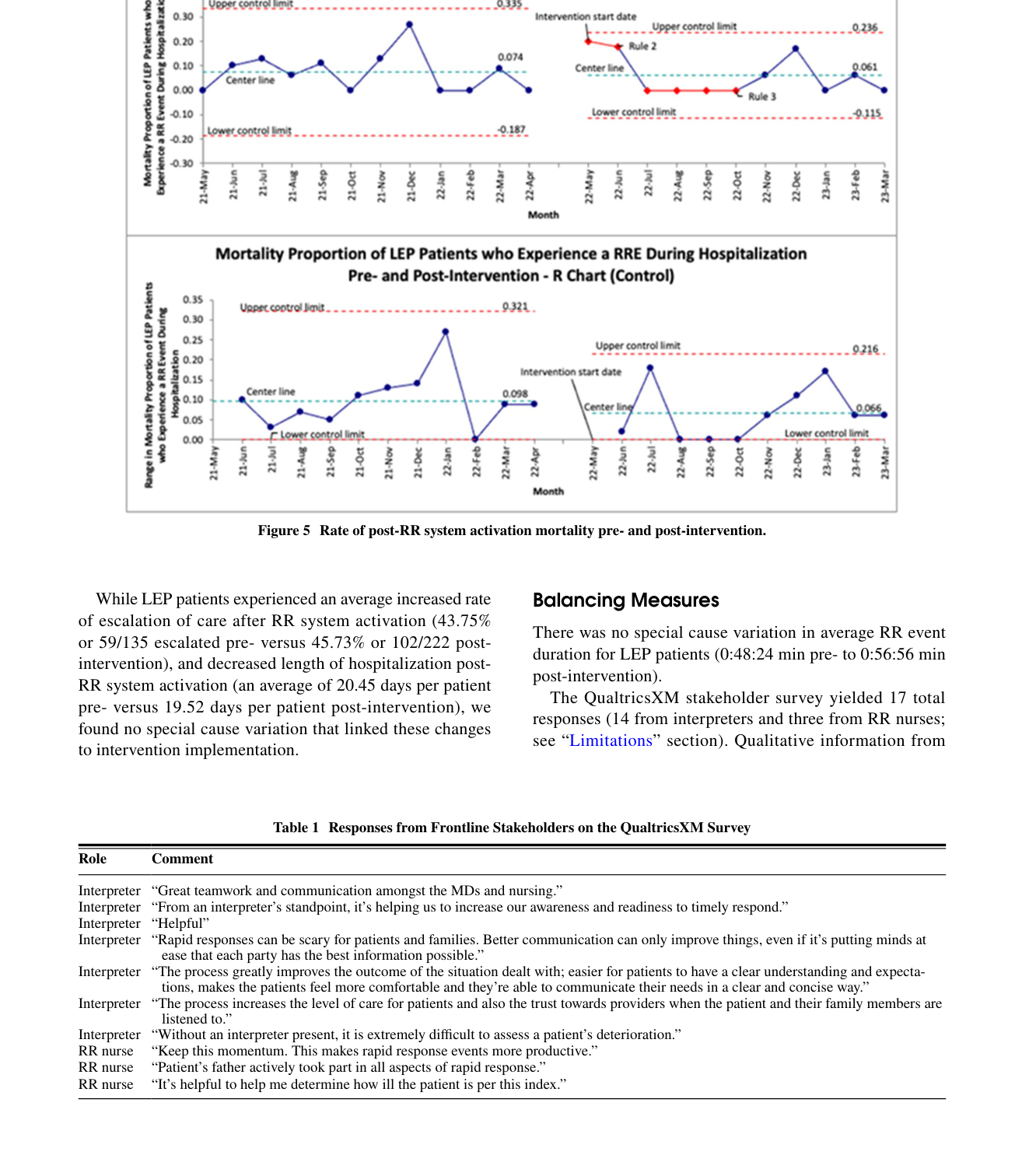
After implementing a modified rapid response (RR) system for limited-English-proficiency (LEP) patients — EHR-dashboard monitoring of early warning scores plus systematic interpreter engagement — the average monthly post-RR-activation mortality rate fell from 7.42% (8/107) pre-intervention to 6.09% (7/115) post-intervention. Statistical process control charts showed special cause variation (Nelson rules 2 and 3) on the mortality X bar chart, with the R chart showing no systematic variation, which the authors interpret as the decrease being attributable to the intervention (Fig. 5).
"LEP patients experiencing RR system activation post-intervention compared to those experiencing RR system activation pre-intervention showed special cause variation indicating a decreased mortality rate (X bar chart, Fig. 5) by Nelson rules 2 and 3." (Raff, 2024, p. 1108)
"These findings strongly suggest that the observed decreased mortality (7.42% [n = 8/107] pre- to 6.09% [n = 7/115] post-intervention) after RR system activation is due to the intervention." (Raff, 2024, p. 1108)
Methods Context #
What? #ⓘ
The observable: monthly mortality rate among LEP patients experiencing an RR system activation, plotted on pre/post X bar and R statistical-process-control charts.
"Our main outcome measures were monthly mortality rate among patients experiencing a RR system activation, monthly average escalation of care... and monthly average length of hospitalization post-RR system activation." (Raff, 2024, p. 1106-1107)
How? #ⓘ
Quasi-experimental pre-post quality-improvement design using statistical process control. Pre- and post-intervention X bar and R control charts were built from monthly cross-sectional aggregates; special cause variation was identified using the Nelson Rules. The intervention combined an EHR dashboard of Deterioration Index (DI) early warning scores, RR-nurse monitoring, EWS-triggered RR activation, and systematic interpreter integration into the RR team (see ART - LEP-prioritized EHR dashboard plus interpreter-integrated rapid response system).
"Pre- and post-intervention X bar and R control charts were developed with Microsoft Excel QI Macros Statistical Process Control Software. Special cause variation was identified using the Nelson Rules (see Appendix 4)." (Raff, 2024, p. 1107)
Who? #ⓘ
All adult, non-intensive-care hospitalized patients with a documented preferred language other than English who experienced an RR system activation at a 950-bed quaternary academic medical center (UNCMC, Chapel Hill, NC), May 2021–March 2023. In total 222 individual LEP patients experienced 302 RR system activations; patients admitted after May 2022 were exposed to the intervention.
"Throughout the combined pre- and post-intervention periods (from May 1, 2021, to March 31, 2023), a total of 222 individual LEP patients experienced 302 RR system activations." (Raff, 2024, p. 1108)
Other Notes #
This was a single-center pilot study; the absolute mortality difference rests on small counts (8 vs 7 deaths). The authors note their design offers "only a limited capacity to determine causal relationships between the intervention and the observed outcomes" (Raff, 2024, p. 1110).
Caveats #
- Single-center pre-post QI pilot with a small sample and bundled intervention limits causal inference about the mortality effect This is a single-center, quasi-experimental pre-post pilot at one quaternary academic medical center, so findings may not generalize. The population was modest (222 patients; mortality counts of 8 pre vs 7 post) and the project period was constrained. The design supports only limited causal inference: the multi-component "bundle" (EWS dashboard, RR-nurse monitoring, EWS-triggered activation, and interpreter integration) was implemented together, so the mortality decrease cannot be attributed to interpreter integration specifically, and secular trends cannot be ruled out. The authors also could not comprehensively assess implementation fidelity or user perceptions of the intervention.