CP users identified engagement barriers (privacy, low literacy, lack of personal connection, repetitiveness) and requested more interactivity and personalization
Source
Kristen Petros De Guex (2023). Optimizing usability of a mobile health intervention for Spanish-speaking Latinx people with HIV through user-centered design: a post-implementation study. JSMIA Open.
Description #
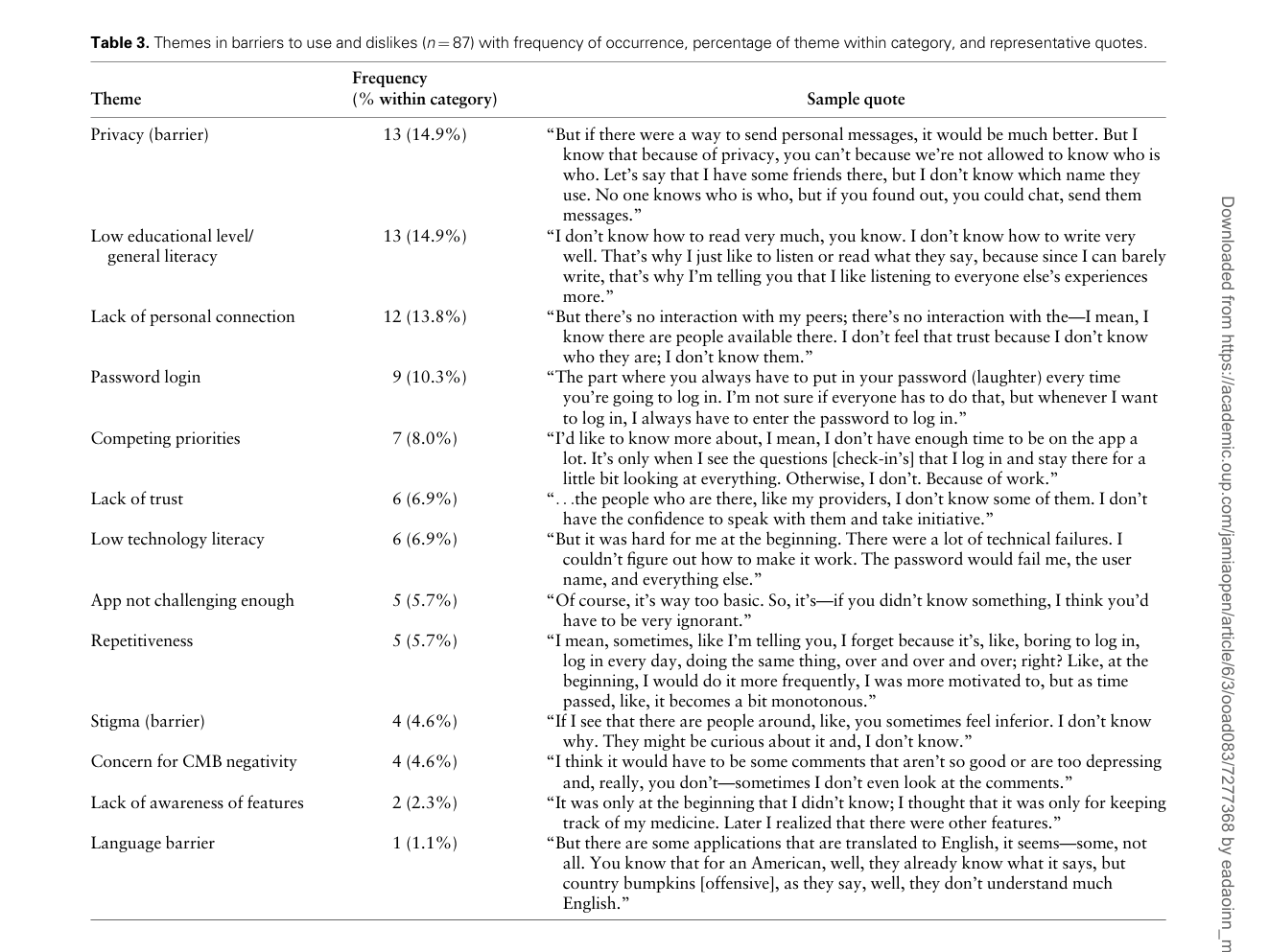
Two of the four interview theme categories captured engagement barriers and improvement suggestions for CP. Barriers to use and dislikes were mentioned 73 times; the most frequent were privacy (14.9%), low educational level/general literacy (14.9%), and lack of personal connection (13.8%), with repetitiveness and password/login difficulty also noted (password/login difficulty mentioned by 8 of 20 participants, 40%). Repetitiveness of daily check-ins was described as reducing motivation over time. Suggestions to improve CP were dominated by requests for more information on HIV/stigma (11.8%), more interactive elements (11.8%), and more personalization (8.5%, e.g., manually setting check-in times); more interactive elements was the single most common suggestion, mentioned by 10 of 20 participants (50%). These engagement-related findings directly informed the user-centered iterative design agenda.
"Barriers to use and dislikes regarding CP (Table 3) were mentioned 73 times. Of these barriers, privacy (14.9%), low educational level/general literacy (14.9%), and lack of personal connection (13.8%) were the most frequently mentioned." (Kristen, 2023)
"In general, participants requested more information about HIV and stigma (11.8%) and more interactive application elements (11.8%). They also called for more personalization within CP; specifically, users wanted to manually set CP's medication or mood/stress check-in times (8.5%)." (Kristen, 2023)
"Looking at code presence across interviews, more interactive elements was the most common suggestion, mentioned at least once by 10 out of 20 participants (50%), followed by more information on HIV/stigma, mentioned by 9 (45%)." (Kristen, 2023)
Methods Context #
What? #ⓘ
The observable: frequency of coded themes for barriers/dislikes and for improvement suggestions, with code-presence counts across interviews, capturing what reduced engagement and what users wanted changed.
"Thematic analysis was performed to identify what participants liked or disliked about the application and how this could be improved." (Kristen, 2023)
How? #ⓘ
Semistructured user-centered-design interviews with users of A-0002ArtifactA-0002Initial AI draftConexionesPositivas (CP) Spanish-language mHealth platform for Latinx people with HIVTo improve access to, and engagement in, HIV care for Spanish-speaking Latinx people with HIV (PWH) in the United States — a population for whom most existing mHealth apps, built for English speakers, are less accessible…, thematically coded in Dedoose by 3 coders; theme categories for likes/dislikes/suggestions were informed by the user-centered design framework.
"Theme categories related to likes, dislikes, and suggestions for the app were informed by the user-centered design framework, intended to capture relevant aspects of participants’ app usage experience and input for improvement." (Kristen, 2023)
Who? #ⓘ
20 Spanish-speaking Latinx CP users with HIV recruited through a single Latinx-serving CBO in the Southern US; both monolingual Spanish and bilingual speakers.
"Participants included both monolingual Spanish speakers and individuals who are bilingual in English and Spanish." (Kristen, 2023)
Other Notes #
The repetitiveness barrier is tied to engagement decay over time: "as time passed, like, it becomes a bit monotonous." (Kristen, 2023) The authors propose tiered quiz difficulty and more interactivity to sustain daily engagement.
Caveats #
- Single-site sample without demographics and with self-selection and prompting bias limits the CP usability findings Participants were recruited from a single site in Virginia (via one Latinx-serving CBO), so transferability to Spanish-speaking PWH in other contexts may be limited. Individual-level demographics were deliberately not collected to protect privacy, leaving gaps in understanding which factors drive CP usage challenges. Selection bias may inflate the favorable usability and engagement picture: individuals motivated to join a research study may be more active or higher-technology-literacy CP users than non-participants. The sample was also small (n=20) and qualitative. Separately, the perceived-impact figures (e.g., positive impact on medication adherence, mood/stress) were elicited by direct prompting in the interview guide rather than measured, so they reflect self-reported perceptions, not adherence or clinical outcomes.