CP users perceived positive impacts of the app on medication-adherence self-monitoring, mood-stress check-ins, and provider communication
Source
Kristen Petros De Guex (2023). Optimizing usability of a mobile health intervention for Spanish-speaking Latinx people with HIV through user-centered design: a post-implementation study. JSMIA Open.
Description #
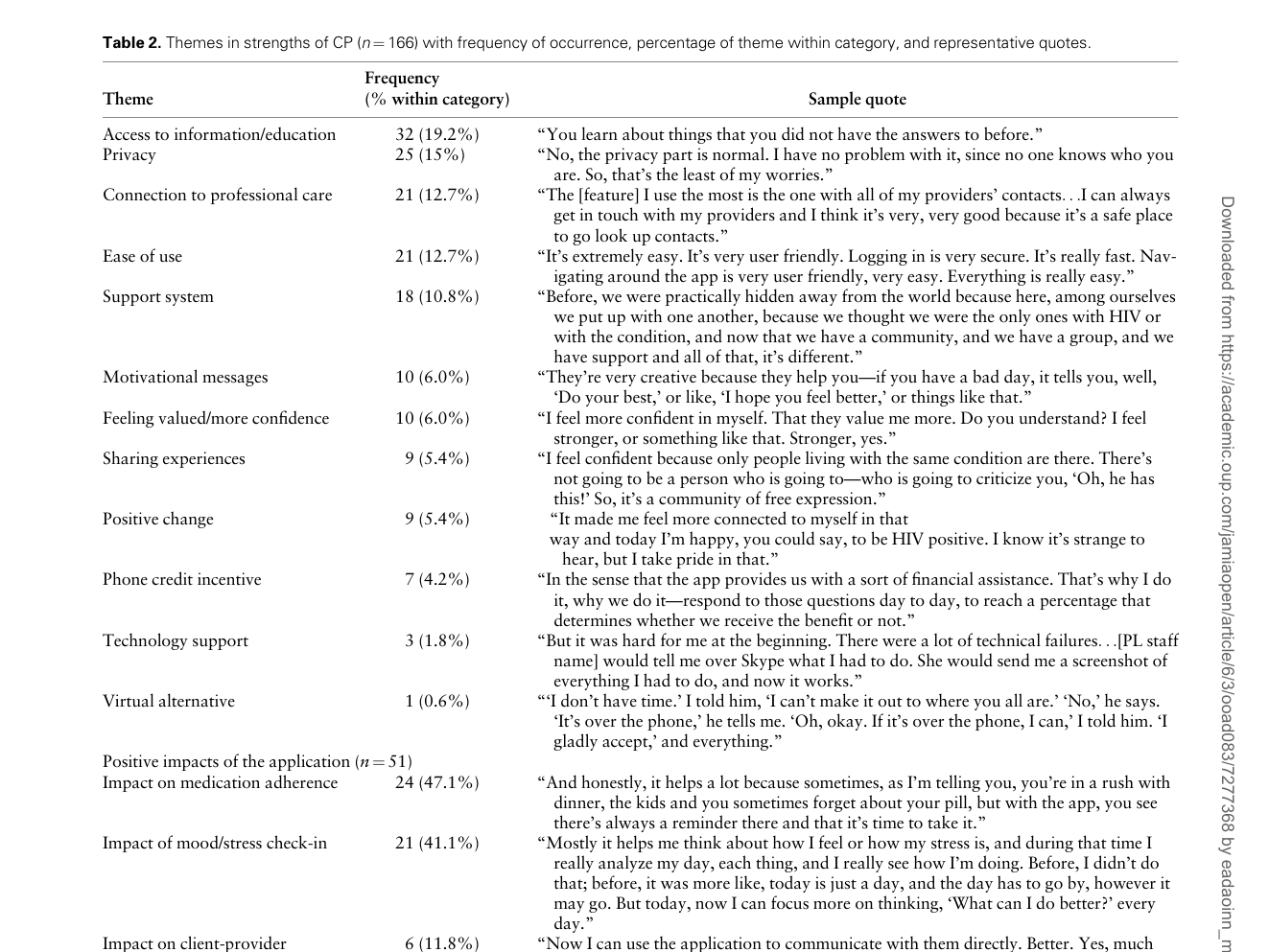
In thematic coding of interviews with the 20 CP users, "strengths of CP" was one of four theme categories, mentioned 125 times across participants. The most frequently mentioned strengths were access to information/education (19.2%), privacy (15%), and connection to professional care (12.7%). Of 51 mentions of a perceived positive impact of the app, 47.1% expressed a positive impact on medication adherence, 41.1% on mood/stress, and 11.8% on client-provider communication. This is a self-reported perceived-impact finding (acceptability/perceived benefit from a self-monitoring app), not a measured change in actual adherence; the interview guide specifically prompted participants about CP's impact on medication adherence and mood/stress, and no participant reported a negative impact (others reported neutral effects).
"CP's strengths (Table 2) were mentioned 125 times by the 20 participants. Of these strengths, access to information/education (19.2%), privacy (15%), and connection to professional care (12.7%) were the most frequently mentioned." (Kristen, 2023)
"Of the 51 times that a positive impact of the application was mentioned, 47.1% expressed a positive impact on medication adherence, 41.1% on mood/stress, and 11.8% on client-provider communication." (Kristen, 2023)
"Respondents who did not report a positive impact of CP stated its effects as neutral with none giving a negative impact." (Kristen, 2023)
Methods Context #
What? #ⓘ
The observable: frequency of coded themes describing CP's strengths and perceived positive impacts, drawn from participant interviews; percentages are code applications for a theme divided by total code applications within its category.
"For each table, percentages are reported as the number of code applications for each theme divided by the total code applications within that category." (Kristen, 2023)
How? #ⓘ
Thematic coding in Dedoose by 3 coders of transcribed/translated semistructured interviews with users of A-0002ArtifactA-0002Initial AI draftConexionesPositivas (CP) Spanish-language mHealth platform for Latinx people with HIVTo improve access to, and engagement in, HIV care for Spanish-speaking Latinx people with HIV (PWH) in the United States — a population for whom most existing mHealth apps, built for English speakers, are less accessible…; codebook refined via constant comparison to intercoder reliability and thematic saturation.
"Each of the interviews was independently coded and then reviewed altogether to resolve any discrepancies until consensus was reached. The codebook was refined iteratively using constant comparisons methodology, until intercoder reliability and thematic saturation were achieved." (Kristen, 2023)
Who? #ⓘ
20 Spanish-speaking Latinx CP users with HIV, active for at least 1 month, recruited through a Latinx-serving CBO in the Southern US (interviews conducted February–March 2021).
"Twenty participants were enrolled through a Latinx-serving CBO." (Kristen, 2023)
Other Notes #
The authors caution the perceived-impact figures were elicited by direct prompting: "It is notable that they were specifically asked about CP’s impact on mood and stress and medication adherence in the study interview guide. In contrast, the client-provider communication was not consistently prompted and may have been mentioned less frequently as a result." (Kristen, 2023)
Caveats #
- Single-site sample without demographics and with self-selection and prompting bias limits the CP usability findings Participants were recruited from a single site in Virginia (via one Latinx-serving CBO), so transferability to Spanish-speaking PWH in other contexts may be limited. Individual-level demographics were deliberately not collected to protect privacy, leaving gaps in understanding which factors drive CP usage challenges. Selection bias may inflate the favorable usability and engagement picture: individuals motivated to join a research study may be more active or higher-technology-literacy CP users than non-participants. The sample was also small (n=20) and qualitative. Separately, the perceived-impact figures (e.g., positive impact on medication adherence, mood/stress) were elicited by direct prompting in the interview guide rather than measured, so they reflect self-reported perceptions, not adherence or clinical outcomes.