Dietary self-efficacy, weight, and HbA1c trended better with integrative counseling but no clinical or attitudinal outcome reached significance
Source
Ho (2020). Pilot Cluster Randomized Controlled Trial of Integrative Nutritional Counseling Versus Standard Diabetes Self-Management Education for Chinese Americans with Type 2 Diabetes. Health Equity.
Description #
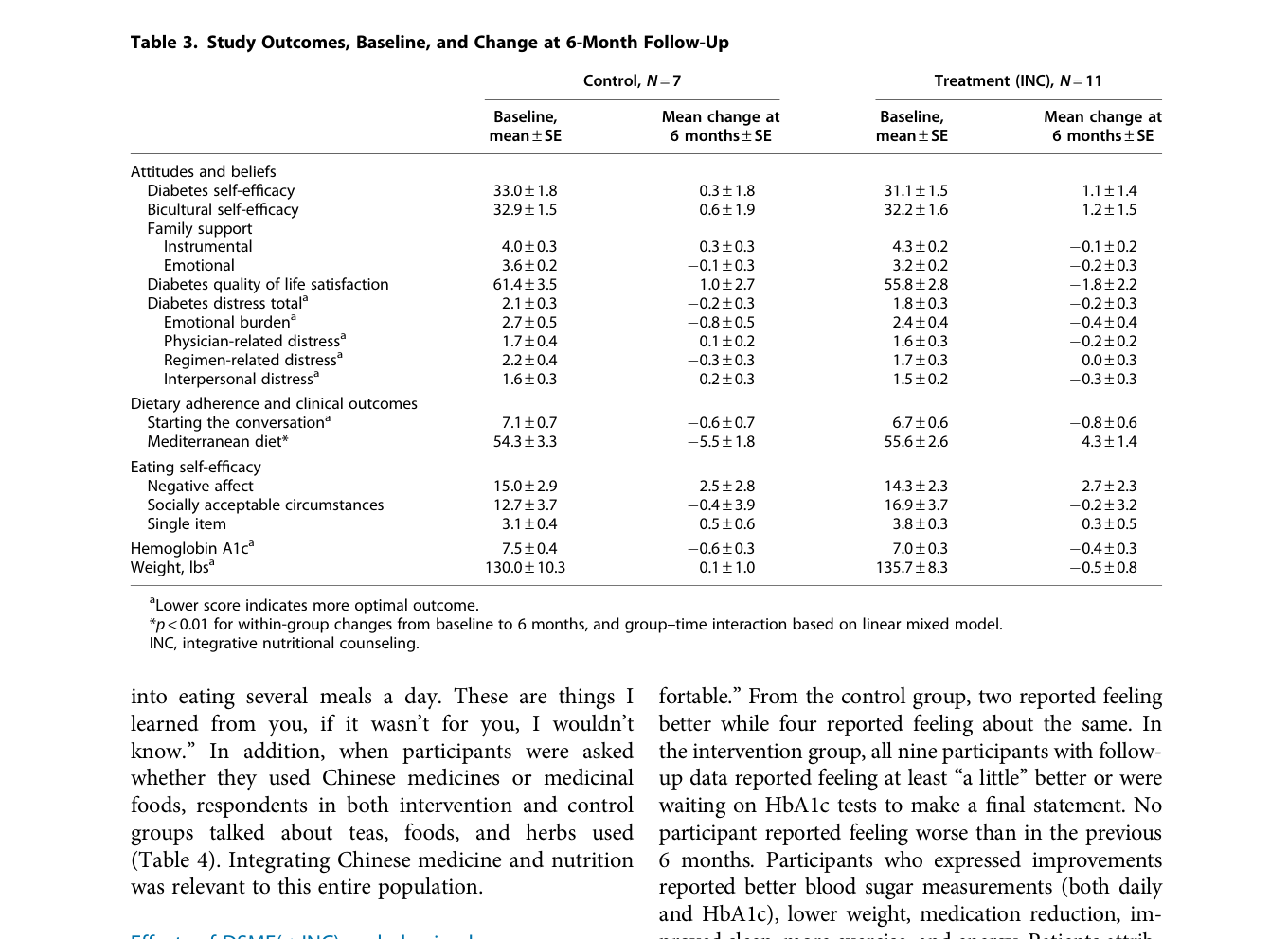
Apart from dietary adherence, no attitudinal or clinical outcome differed significantly between the integrative counseling (DSME+INC) and usual DSME arms. Dietary self-efficacy improved more in DSME+INC than DSME, but not significantly; diabetes distress improved nonsignificantly in both groups. Weight and HbA1c improved in the intervention group but were not statistically significant: at 6 months HbA1c changed −0.4 (INC) vs −0.6 (control) and weight changed −0.5 lbs (INC) vs +0.1 lbs (control) (Table 3). The authors attribute the lack of significance largely to the small sample.
"Pre to post intervention outcomes indicated greater improvements in dietary self-efficacy among DSME+INC than DSME, but these differences were not statistically significant. Nonsignificant improvements in diabetes-related distress were also observed in both groups (Table 3)." (Ho, 2020)
"Weight and HbA1c improved in the intervention group but were not statistically significant (Table 3)." (Ho, 2020)
"Hemoglobin A1ca7.5±0.4−0.6±0.37.0±0.3−0.4±0.3Weight, lbsa130.0±10.30.1±1.0135.7±8.3−0.5±0.8" (Ho, 2020)
Methods Context #
What? #ⓘ
The observables: dietary self-efficacy and diabetes distress (validated scales), weight (lbs), and glycemic control (HbA1c), each measured at baseline and 6-month follow-up.
"Weight was measured using the same scale and glycemic control was measured by HbA1c." (Ho, 2020)
How? #ⓘ
Pilot cluster RCT comparing usual DSME with DSME+INC; linear mixed models with random effects for persons nested within clusters and fixed effects of group, time, and group–time interaction tested change in each outcome from baseline to 6 months. HbA1c was drawn at two time points. See ART - Integrative Nutritional Counseling (INC) curriculum.
"Data collection was feasible in this population, including Chinese-translated survey measures and HbA1c draws at two time points." (Ho, 2020)
Who? #ⓘ
18 fluent Cantonese-speaking Chinese American type 2 diabetes/prediabetes patients (7 control, 11 intervention) enrolled in DSME at the Chinatown Public Health Center; 15 (6 control, 9 intervention) had 6-month follow-up data. The authors note randomizing by course rather than individual further reduced statistical power.
"This study is limited by small sample size and future research should recruit more participants. We were also limited by the need to randomize by course rather than individual, which further reduced our power to assess differences between intervention groups." (Ho, 2020)
Other Notes #
The intervention's qualitative reception was more positive than the quantitative clinical signal: all nine intervention participants with follow-up reported feeling at least "a little" better, and no participant in either arm reported feeling worse than 6 months prior (Ho, 2020).
Caveats #
- Very small pilot sample with cluster (not individual) randomization limits power and generalizability of the integrative counseling findings Only 18 patients were enrolled (7 control, 11 intervention) and 15 completed 6-month follow-up, so the trial was a feasibility pilot underpowered to detect most differences. Randomization was by course (cluster) rather than individual, further reducing power. Because participants were recruited blind to assignment, it is unknown whether self-selection differed by interest in Chinese-medicine content. These constraints mean the single significant adherence finding, and the nonsignificant clinical trends, should be treated as preliminary and not generalized beyond this Cantonese-speaking safety-net population.