Culturally integrated nutrition counseling was feasible to deliver within an existing clinic and 100% of intervention participants rated the bilingual booklet as helping their learning
Source
Ho (2020). Pilot Cluster Randomized Controlled Trial of Integrative Nutritional Counseling Versus Standard Diabetes Self-Management Education for Chinese Americans with Type 2 Diabetes. Health Equity.
Description #
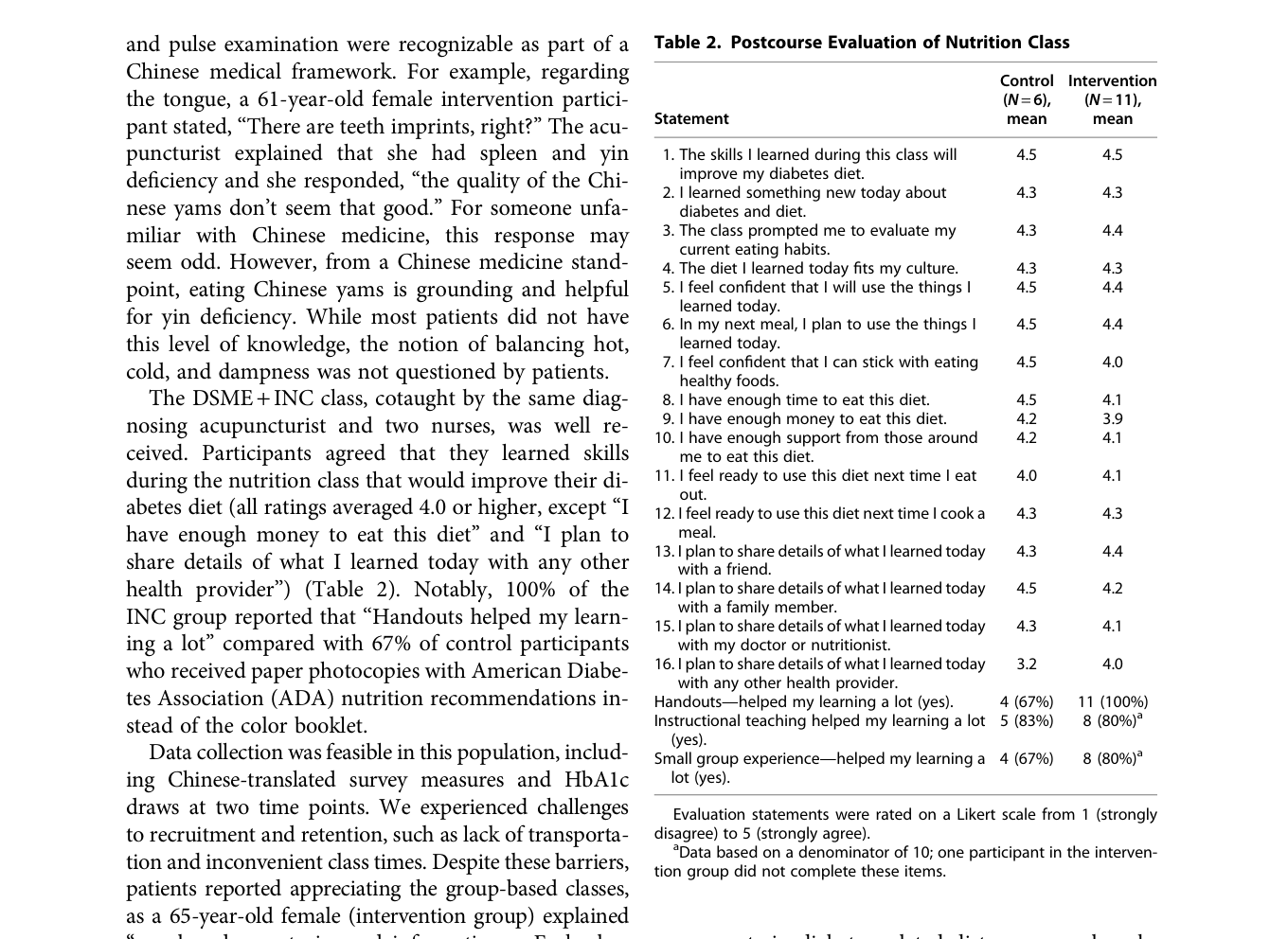
Delivering integrative nutritional counseling (INC) as part of existing diabetes self-management education (DSME) at a community clinic was feasible, with low added provider burden. The three educators (two RNs plus a licensed acupuncturist) spent a total of 2 hours on preparation and coordination and did not perceive it as burdensome. Acceptability was high: 100% of the INC (intervention) group reported that the bilingual English/Chinese color booklet "helped my learning a lot," compared with 67% of control participants who received photocopied ADA recommendations (Table 2).
"The three educators' preparation and coordination for the intervention (total 2 h) was not perceived as burdensome and they reported that the process was reasonable to deliver as a team." (Ho, 2020)
"Notably, 100% of the INC group reported that “Handouts helped my learning a lot” compared with 67% of control participants who received paper photocopies with American Diabetes Association (ADA) nutrition recommendations instead of the color booklet." (Ho, 2020)
"INC is feasible to deliver within existing community clinic settings with the main resource burden being the addition of a Chinese medicine practitioner to provide diagnoses and team teach. The coordination of care between the RNs and the Chinese medicine practitioner was not labor or time intensive and patients remarked on the benefit of having both at the educational session." (Ho, 2020)
Methods Context #
What? #ⓘ
The observables: provider-reported feasibility/burden of coordinating the team-taught intervention, and participant-rated acceptability of intervention materials (postcourse evaluation items on a 1–5 Likert scale plus yes/no helpfulness ratings).
"Feasibility and acceptability of the intervention were measured through postcourse evaluation that included open- and close-ended questions such as: what was your overall experience with diabetes nutrition education; would you recommend these classes to a friend with diabetes; is there anything you would change about the classes?" (Ho, 2020)
How? #ⓘ
Pilot cluster RCT embedding INC into routine quarterly group DSME at the clinic; intervention class cotaught by RN diabetes educators and the diagnosing acupuncturist, with a 44-page bilingual English/Chinese INC guidebook. Feasibility assessed via educator report and qualitative analysis; acceptability via postcourse evaluation. See ART - Integrative Nutritional Counseling (INC) curriculum.
"INC includes a 44-page color guidebook in English/Chinese and corresponding curriculum for a 2-h class (www.INCguide.org)." (Ho, 2020)
Who? #ⓘ
Cantonese-speaking Chinese American diabetes patients in two intervention DSME classes (n=11) and two control classes (n=7) at the Chinatown Public Health Center, San Francisco — a safety-net clinic where over 80% of patients speak Cantonese as their primary language — plus the three educators delivering the intervention.
"Over 80% of CPHC patients speak Cantonese as their primary language, most patients are low income, with high school or lower education, and diabetes is the fourth most common diagnosis for patient visits." (Ho, 2020)
Other Notes #
One intervention participant appreciated the class because "doctors could never spend this much time covering diabetes education with all patients" (Ho, 2020), illustrating the role of dedicated educator time in this population.