Dietary adherence (adapted Mediterranean diet score) significantly improved with culturally integrated nutrition counseling but worsened with usual DSME
Source
Ho (2020). Pilot Cluster Randomized Controlled Trial of Integrative Nutritional Counseling Versus Standard Diabetes Self-Management Education for Chinese Americans with Type 2 Diabetes. Health Equity.
Description #
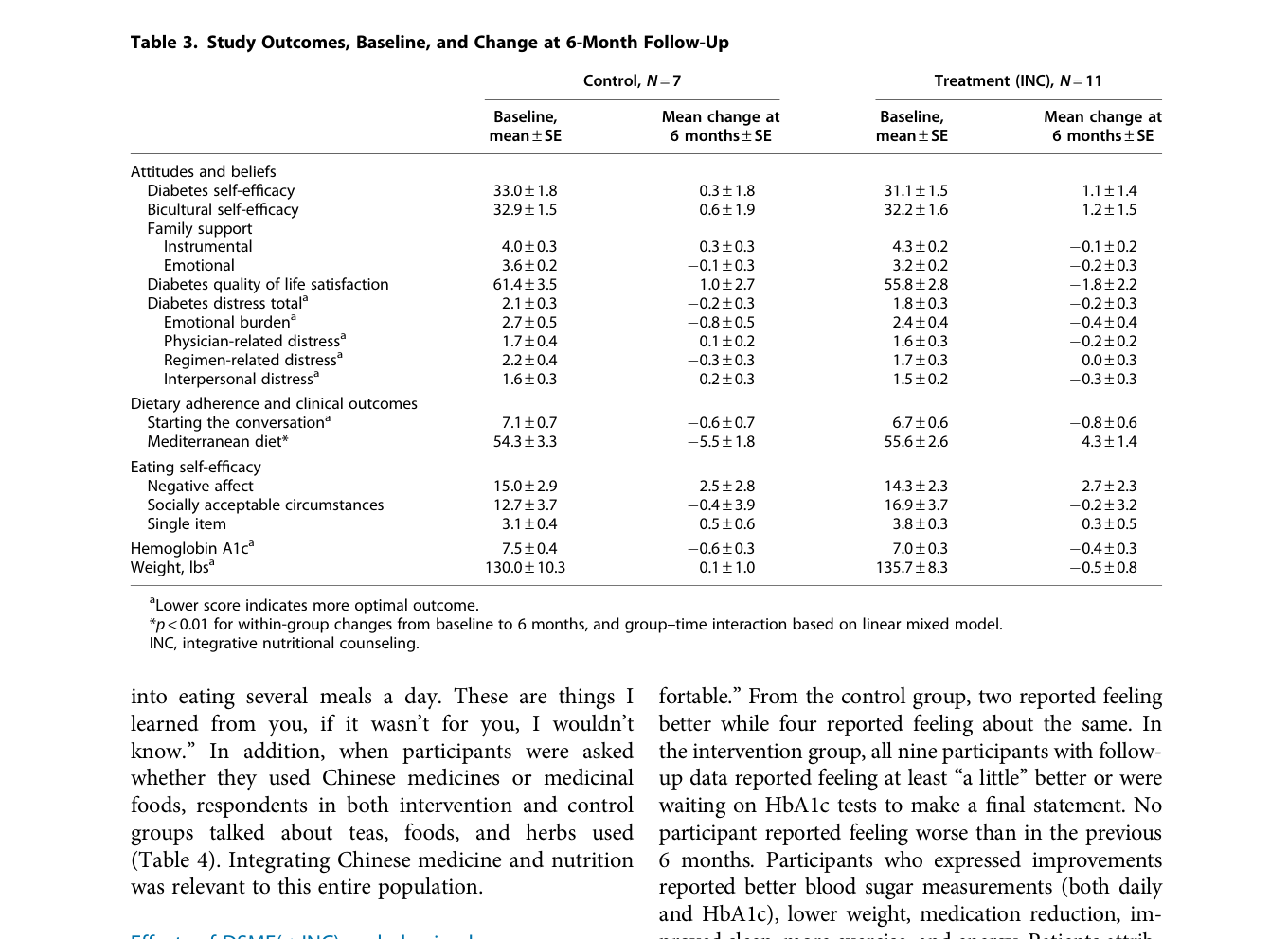
In this pilot cluster RCT of Cantonese-speaking Chinese American (CA) diabetes patients (n=18 baseline; 15 at follow-up), dietary adherence measured by an adapted Mediterranean diet score (16 items, range 0–80) improved among participants who received the integrative nutritional counseling curriculum (DSME+INC) but worsened among participants who received usual diabetes self-management education (DSME). At baseline the scores were similar (control 54.3, INC 55.6), but at 6 months the control group declined by 5.5 points while the INC group rose by 4.3 points, a significant group–time interaction (z=4.26, p<0.001) (Table 3). This was the study's only significant behavioral outcome.
"Food frequency, as measured by the adapted Mediterranean Diet score, improved among participants in DSME+INC, but worsened for DSME participants (significant group–time interaction z=4.26, p<0.001)." (Ho, 2020)
"Mediterranean diet*54.3±3.3−5.5±1.855.6±2.64.3±1.4" (Ho, 2020)
"*p<0.01 for within-group changes from baseline to 6 months, and group–time interaction based on linear mixed model." (Ho, 2020)
Methods Context #
What? #ⓘ
The observable: dietary adherence operationalized as a food-frequency score on a culturally adapted Mediterranean diet scale (16 items, possible range 0–80), measured at baseline and 6-month follow-up.
"Participants were asked about dietary adherence through two validated measures of food frequency: Starting the Conversation (8 items, possible range 0–16) and a culturally sensitive adaption of the Mediterranean diet score (16 items, possible range 0–80). … We adapted the scale by including Chinese-specific foods, such as dumplings, fried dim sum, and sweet boba drinks." (Ho, 2020)
How? #ⓘ
Pilot two-arm cluster RCT; DSME classes randomized to usual nutrition curriculum (ADA-based) vs. INC curriculum (ADA + Chinese medicine principles, cotaught by a nurse educator and a licensed acupuncturist). Linear mixed models with random effects for persons nested within clusters and fixed effects of group, time, and group–time interaction tested change in adherence from baseline to 6 months. See ART - Integrative Nutritional Counseling (INC) curriculum.
"Linear mixed models (LMMs) were used to test significance of change in means in dietary self-efficacy, dietary adherence, weight, HbA1c, and other outcomes of interest. LMMs included random effects for persons nested within clusters and fixed effects of treatment group (DSME vs. DSME+INC), time, and group–time interaction." (Ho, 2020)
Who? #ⓘ
18 fluent Cantonese-speaking/reading Chinese Americans ≥21 with type 2 diabetes or prediabetes enrolled in DSME classes at the Chinatown Public Health Center, San Francisco (7 control, 11 intervention); predominantly female (83%), older (mean age 62), low income (100% <$50,000); 15 completed 6-month follow-up (6 control, 9 intervention).
"Participants were Cantonese-speaking patients with diabetes, 83% female, 100% with income < $50,000, with an average age of 62 years, and slight preference for western medicine over Chinese medicine." (Ho, 2020)
Other Notes #
The companion food-frequency measure (Starting the Conversation, 0–16) showed no significant group difference (control −0.6, INC −0.8 at 6 months) (Table 3).
Caveats #
- Very small pilot sample with cluster (not individual) randomization limits power and generalizability of the integrative counseling findings Only 18 patients were enrolled (7 control, 11 intervention) and 15 completed 6-month follow-up, so the trial was a feasibility pilot underpowered to detect most differences. Randomization was by course (cluster) rather than individual, further reducing power. Because participants were recruited blind to assignment, it is unknown whether self-selection differed by interest in Chinese-medicine content. These constraints mean the single significant adherence finding, and the nonsignificant clinical trends, should be treated as preliminary and not generalized beyond this Cantonese-speaking safety-net population.