Among LEP patients who followed medical recommendations after a Spanish-spoken encounter, most were seen by curriculum-trained residents
Source
Stoneking (2016). Does Spanish instruction for emergency medicine resident physicians improve patient satisfaction in the emergency department and adherence to medical recommendations?. Advances in Medical Education and Practice.
Description #
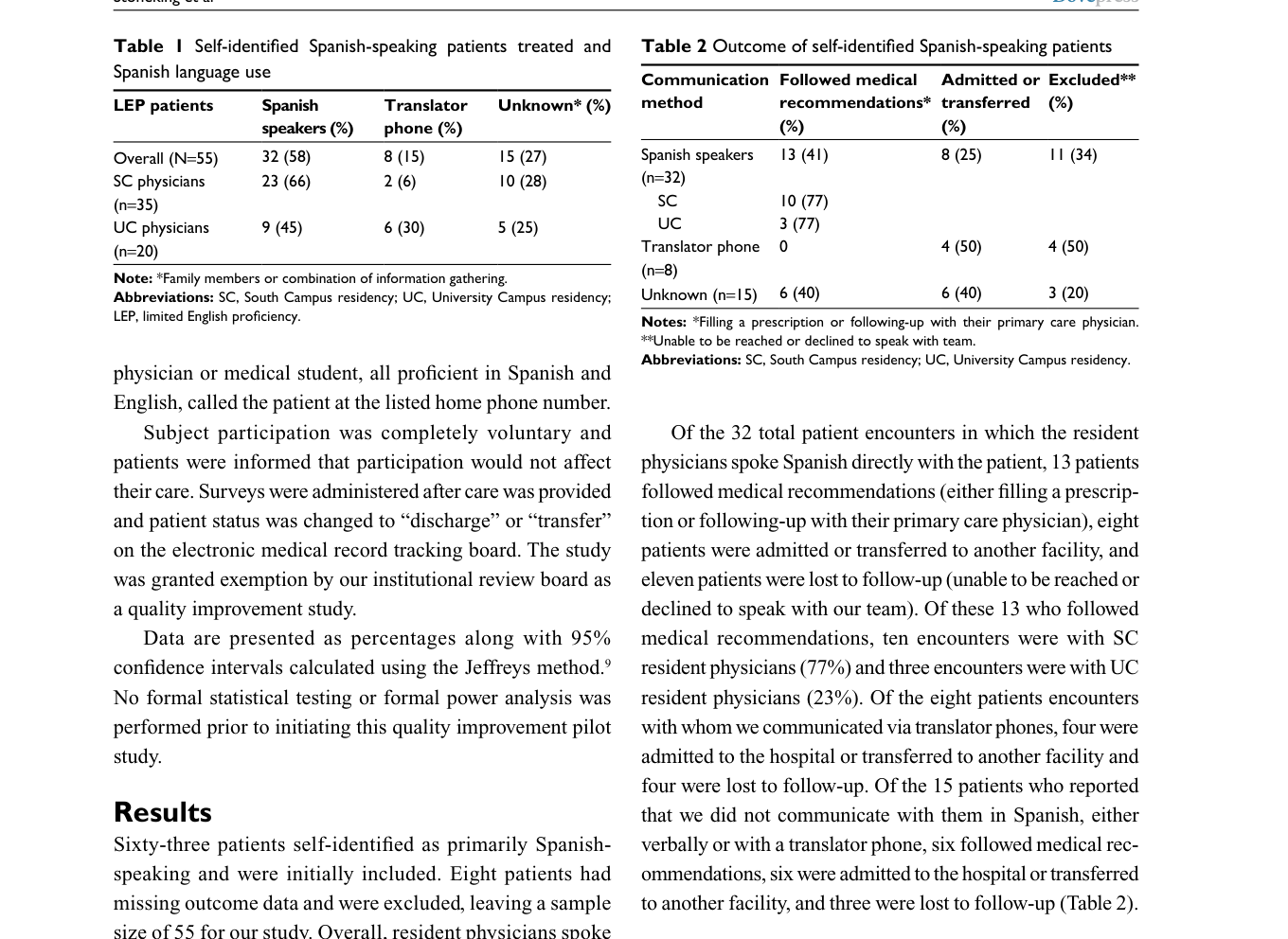
Of the 32 encounters in which a resident spoke Spanish directly with the LEP patient, 13 patients followed medical recommendations (filling a prescription or following up with their primary care physician); 8 were admitted/transferred and 11 were lost to follow-up. Of those 13 who followed recommendations, 10 (77%) were encounters with South Campus (SC, curriculum-trained) residents and 3 (23%) were with University Campus (UC) residents (Table 2). The authors themselves caution that with only 13 comparable patients this is far too small to be statistically meaningful, but the direction favors the Spanish-curriculum program.
"Of the 32 total patient encounters in which the resident physicians spoke Spanish directly with the patient, 13 patients followed medical recommendations (either filling a prescription or following-up with their primary care physician), eight patients were admitted or transferred to another facility, and eleven patients were lost to follow-up (unable to be reached or declined to speak with our team)." (Stoneking, 2016)
"Of these 13 who followed medical recommendations, ten encounters were with SC resident physicians (77%) and three encounters were with UC resident physicians (23%)." (Stoneking, 2016)
Methods Context #
What? #ⓘ
The observable: whether the patient adhered to discharge instructions, operationalized as filling a prescription or following up with their primary care physician, assessed on a follow-up phone call ~1 week after the visit.
"Follow-up phone calls were performed to assess patient satisfaction and adherence to discharge instructions ~1 week later." (Stoneking, 2016)
How? #ⓘ
Cross-sectional convenience sample; adherence ascertained by a follow-up phone call from a Spanish-/English-proficient caller. Counts cross-tabulated by treating program (SC curriculum-trained vs UC) among the subset of encounters where the resident spoke Spanish directly. No formal statistical testing or power analysis.
"However, after removing patients without complete information and patients who were lost to follow-up or admitted or transferred to another facility, we were left with only 13 patients to compare." (Stoneking, 2016)
Who? #ⓘ
The 32 Spanish-spoken encounters within the 55-patient sample of primarily Spanish-speaking LEP patients at an urban academic ED in Tucson, Arizona; the adherence comparison rests on just 13 patients with complete follow-up.
"Although ten of these 13 encounters were with SC residents compared to three encounters with UC residents, this number was too low from which to draw any statistically significant meaning." (Stoneking, 2016)
Other Notes #
For context, of the 15 patients reported NOT communicated with in Spanish (verbally or via translator phone), 6 followed medical recommendations, 6 were admitted/transferred, and 3 were lost to follow-up (Table 2).
Caveats #
- Single-center underpowered pilot with no statistical testing limits the medical Spanish curriculum findings This was a single-center quality-improvement pilot at one urban academic ED, limiting generalizability. An EHR default that auto-set primary language to English under-captured enrollment, so the sample (55 patients) was not large enough to detect a significant difference, and the adherence comparison rested on only 13 patients (10 SC vs 3 UC) — too few to draw statistically significant meaning. No formal statistical testing or power analysis was performed, and program exposure could be contaminated (some SC/UC mixing on afternoons after didactics; possible use of family members or uncertified residents attempting Spanish), so the curriculum-vs-no-curriculum contrast is confounded and statistically fragile.