Residents trained in a medical Spanish curriculum spoke Spanish with more LEP patients and used translator phones less
Source
Stoneking (2016). Does Spanish instruction for emergency medicine resident physicians improve patient satisfaction in the emergency department and adherence to medical recommendations?. Advances in Medical Education and Practice.
Description #
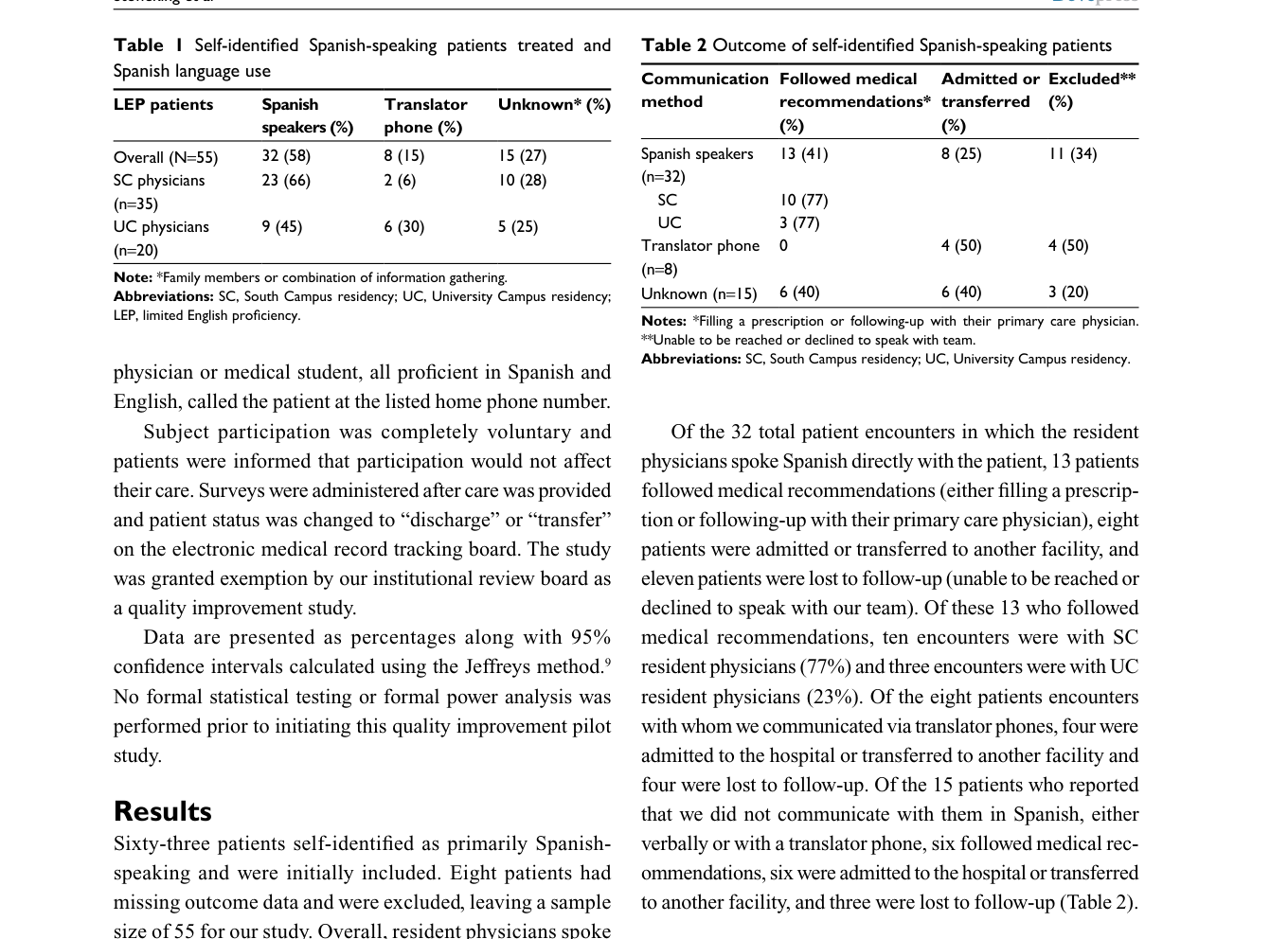
In a cross-sectional convenience sample of 55 Spanish-speaking LEP patients in an academic ED, residents from the South Campus (SC) program — which integrates a longitudinal medical Spanish and cultural competency curriculum into didactics — spoke Spanish directly with 66% (23/35) of their patients, versus 45% (9/20) for University Campus (UC) residents without the curriculum. Correspondingly, SC residents fell back on translator phones in only 6% (2/35) of encounters versus 30% (6/20) for UC residents (Table 1). Overall, residents spoke Spanish 58% (32/55) of the time and used translator phones in 15% (8/55). This is consistent with the hypothesis that the curriculum increases the number of language-concordant encounters and reduces reliance on phone interpreting.
"Overall, resident physicians spoke Spanish 58% (32/55 patients; 95% confidence interval 45.0–70.5) of the time and used translator phones in 15% (8/55; 95% confidence interval 7.1–25.6) of the encounters." (Stoneking, 2016)
"SC resident physicians spoke Spanish with 66% (23/35) of their patients versus 45% (9/20) for UC resident physicians. SC resident physicians used translator phones in 6% (2/35) of encounters while UC resident physicians used them in 30% (6/20) of encounters" (Stoneking, 2016)
Methods Context #
What? #ⓘ
The observable: for each patient encounter, whether the treating resident communicated in the patient's native Spanish directly versus used an interpreter (translator) phone, captured on a real-time survey.
"Surveys identified the treating resident physicians and assessed whether they communicated in the patient's native Spanish language or used interpreter phones." (Stoneking, 2016)
How? #ⓘ
Cross-sectional convenience sample. The medical Spanish and cultural competency curriculum was integrated biweekly into SC residency didactics; surveys were scheduled on Tuesdays and Wednesdays so that SC residents staffed the ED on one day and UC residents on the other, contrasting the curriculum-exposed program against the non-exposed program. Data reported as percentages with 95% confidence intervals (Jeffreys method); no formal statistical testing or power analysis.
"Surveys were conducted on Tuesdays and Wednesdays to control for providers who participate in the medical Spanish curriculum. Therefore, most surveys conducted on Tuesdays were from SC residents and those conducted on Wednesdays were from UC residents." (Stoneking, 2016)
"Data are presented as percentages along with 95% confidence intervals calculated using the Jeffreys method." (Stoneking, 2016)
"No formal statistical testing or formal power analysis was performed prior to initiating this quality improvement pilot study." (Stoneking, 2016)
Who? #ⓘ
Patients who self-identified as primarily Spanish-speaking in the EHR at registration in an urban academic ED (~45,000 visits/year) in Tucson, Arizona; 63 enrolled, 8 excluded for missing data, leaving 55 (SC n=35, UC n=20). Generalizes to Spanish-speaking LEP ED patients treated by emergency medicine residents.
"Sixty-three patients self-identified as primarily Spanish-speaking and were initially included. Eight patients had missing outcome data and were excluded, leaving a sample size of 55 for our study." (Stoneking, 2016)
Other Notes #
The authors note that SC's 66% Spanish-speaking rate "seems unusually high" given only nine dual-role-certified resident interpreters, raising the possibility that non-certified residents attempted Spanish exams rather than using translator phones as the protocol required.
Caveats #
- Single-center underpowered pilot with no statistical testing limits the medical Spanish curriculum findings This was a single-center quality-improvement pilot at one urban academic ED, limiting generalizability. An EHR default that auto-set primary language to English under-captured enrollment, so the sample (55 patients) was not large enough to detect a significant difference, and the adherence comparison rested on only 13 patients (10 SC vs 3 UC) — too few to draw statistically significant meaning. No formal statistical testing or power analysis was performed, and program exposure could be contaminated (some SC/UC mixing on afternoons after didactics; possible use of family members or uncertified residents attempting Spanish), so the curriculum-vs-no-curriculum contrast is confounded and statistically fragile.