Adults with LEP were more likely to be prescribed ART than EP adults (89.7% vs 83.5%) but ART adherence did not differ
Source
Padilla (2021). Limited English proficiency among adults with HIV in the United States - Medical Monitoring Project, 2015-2018. AIDS Care.
Description #
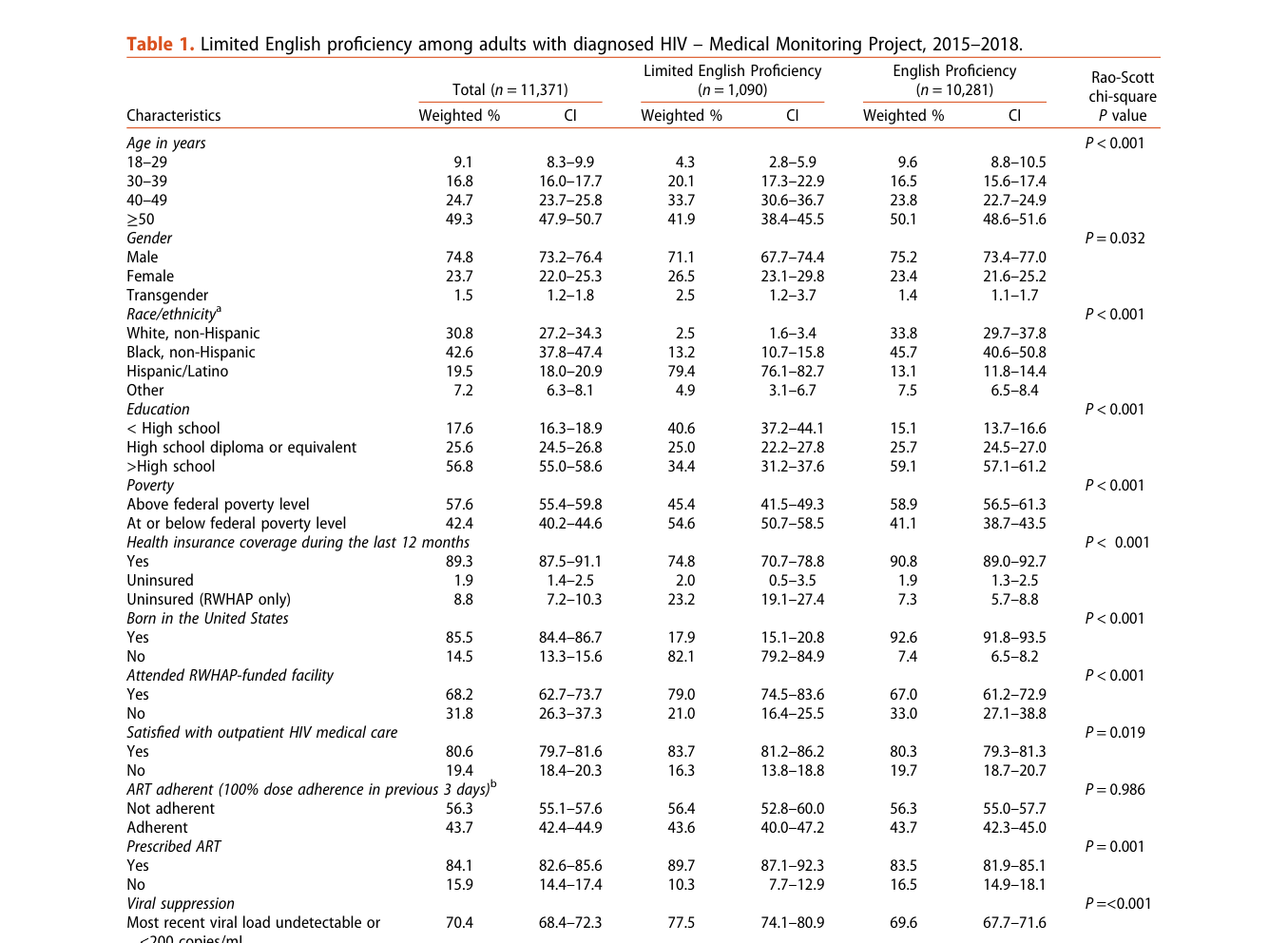
A higher percentage of adults with LEP than adults with EP were prescribed antiretroviral therapy (ART) (89.7% vs. 83.5%), a statistically significant difference (Table 1). However, there was no statistically significant difference in self-reported ART adherence between the LEP and EP groups. Thus LEP was associated with greater ART prescribing but not with measurably worse adherence in this sample.
"Higher percentages of adults with LEP, compared with adults with EP, received care at RWHAP-funded facilities (79.0% vs. 67.0%), were satisfied with their HIV care (83.7% vs. 80.3%), were prescribed ART (89.7% vs. 83.5%), were virally suppressed (77.5% vs. 69.6%), and received STD testing (49.9% vs. 33.4%). We found no statistically significant differences in ART adherence (Table 1)." (Padilla, 2021)
Methods Context #
What? #ⓘ
Two observables: whether the participant was prescribed ART, and ART adherence over the past 3 days (classified as adherent if no doses were missed), each compared as a weighted percentage between LEP and EP groups.
"Respondents were asked about adherence to ART during the past 3 days using a validated three-item adherence scale (Wilson et al., 2014; Wilson et al., 2016). Respondents who reported not missing a dose during the past 3 days were classified as ART-adherent." (Padilla, 2021)
How? #ⓘ
Weighted percentages with 95% CIs were computed from pooled interview and medical-record data; modified Rao-Scott chi-square tests compared LEP and EP groups (P < .05 significant) in SAS 9.3. Adherence data were self-reported.
"We computed frequencies and weighted percentages describing characteristics of adults with diagnosed HIV and 95% confidence intervals (CIs) for these descriptive parameters." (Padilla, 2021)
Who? #ⓘ
Nationally representative sample of adults aged ≥18 with diagnosed HIV living in US states (N = 11,371; LEP n = 1,090), from the Medical Monitoring Project two-stage probability survey, June 2015–May 2018. LEP was defined as speaking a language other than English at home and self-rating English ability below "very well."
"Respondents who spoke a language other than English at home and selected any option less than 'very well' were classified as having LEP (n = 1,090)." (Padilla, 2021)
Other Notes #
The null adherence finding contrasts with prior literature cited by the authors reporting lower medication adherence among persons with LEP. Because adherence was measured by self-report over only the past 3 days, the measure is subject to social-desirability and recall bias.
Caveats #
- Cross-sectional self-reported data with no measure of language-service access prevents causal inference about the LEP outcome paradox The data are cross-sectional, so causality cannot be inferred from the association between LEP and better clinical outcomes. Critically, the authors did not measure access to language services among persons with LEP, so the proposed mechanism (that interpreter and support services at RWHAP-funded facilities drive the better outcomes) is not directly tested. Behavioral measures, including ART adherence, were self-reported and subject to social-desirability and recall bias. Finally, the analysis only includes adults aware of their HIV diagnosis, and because LEP is a barrier to HIV testing, persons with LEP may be disproportionately undiagnosed and excluded, potentially biasing the sample toward those already engaged in care.