Adults with LEP and diagnosed HIV were more virally suppressed than EP adults (77.5% vs 69.6%)
Source
Padilla (2021). Limited English proficiency among adults with HIV in the United States - Medical Monitoring Project, 2015-2018. AIDS Care.
Description #
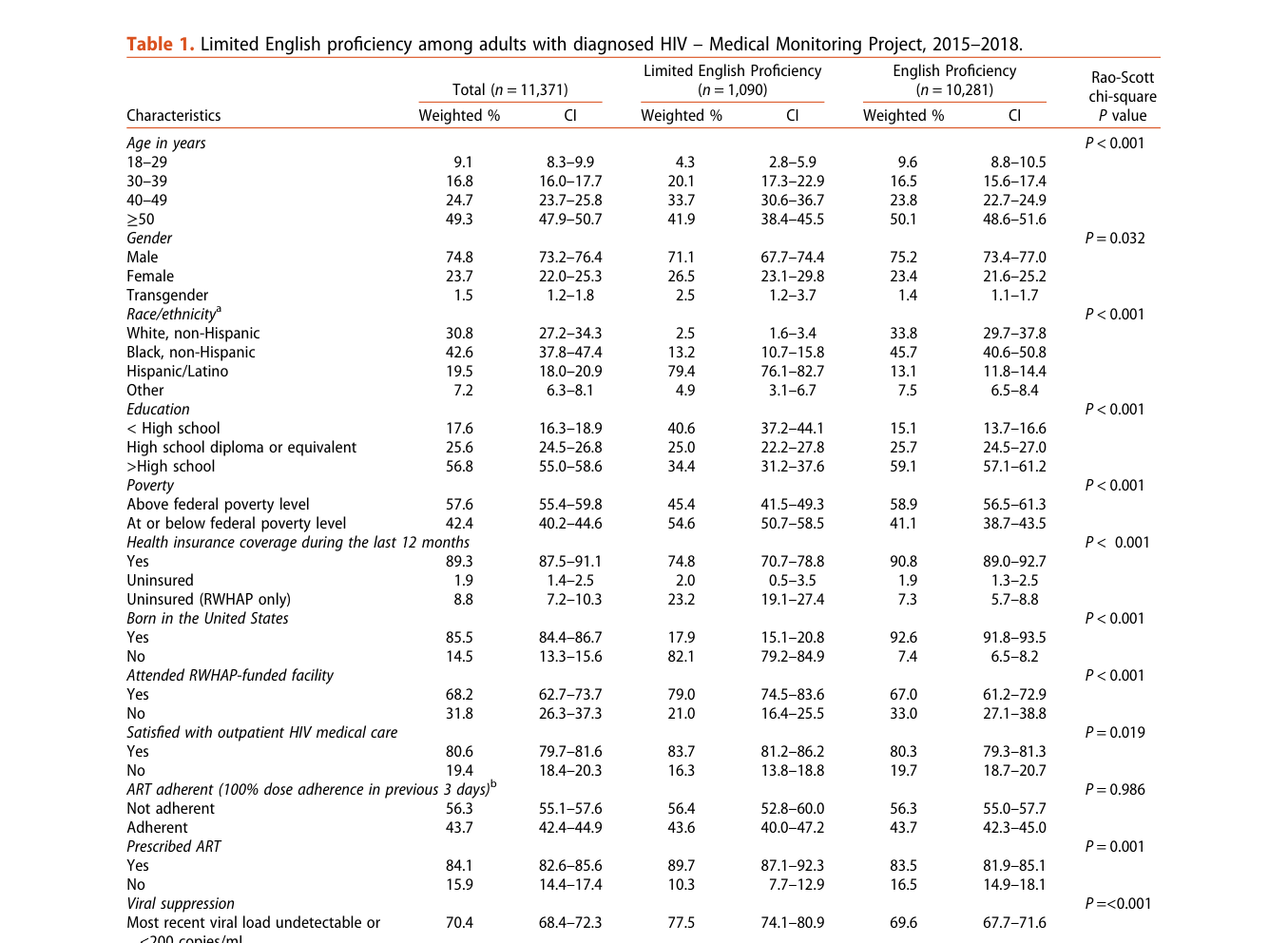
In this nationally representative survey of US adults with diagnosed HIV, a higher percentage of adults with limited English proficiency (LEP) than adults with English proficiency (EP) were virally suppressed (77.5% vs. 69.6%), a statistically significant difference (Table 1). This "seeming paradox" occurred despite adults with LEP having fewer socioeconomic resources, and is the paper's central clinical finding.
"Higher percentages of adults with LEP, compared with adults with EP, received care at RWHAP-funded facilities (79.0% vs. 67.0%), were satisfied with their HIV care (83.7% vs. 80.3%), were prescribed ART (89.7% vs. 83.5%), were virally suppressed (77.5% vs. 69.6%), and received STD testing (49.9% vs. 33.4%)." (Padilla, 2021)
"Although adults with LEP lack resources to support health – including education, income, and health insurance – they were more likely than adults with EP to receive recommended HIV treatment and achieve viral suppression, which are both key to ending the HIV epidemic." (Padilla, 2021)
Methods Context #
What? #ⓘ
The observable: viral suppression, defined from medical records as the most recent viral load documented as undetectable or below 200 copies/mL, expressed as a weighted percentage with 95% CI and compared between LEP and EP groups.
"Viral suppression, measured by the most recent viral load documented as undetectable or <200 copies/mL, was determined from medical records." (Padilla, 2021)
How? #ⓘ
Weighted percentages and 95% CIs were computed from pooled interview and medical-record data; modified Rao-Scott chi-square tests assessed differences between LEP and EP groups (P < .05 significant), using SAS 9.3.
"We used modified Rao-Scott chi-square tests to assess sociodemographic, behavioral, and clinical differences between adults with LEP and EP (P < .05 considered significant)." (Padilla, 2021)
Who? #ⓘ
Nationally representative sample of adults aged ≥18 with diagnosed HIV living in US states (N = 11,371; LEP n = 1,090), from the Medical Monitoring Project, a two-stage probability-proportional-to-size survey, June 2015–May 2018. Puerto Rico was excluded.
"We excluded Puerto Rico from this analysis because English is not the main language spoken there; thus, our findings are limited to adults living in U.S. states (N = 11,371)." (Padilla, 2021)
Other Notes #
The authors propose that the paradox may be explained by adults with LEP disproportionately attending Ryan White HIV/AIDS Program (RWHAP)-funded facilities, which are "twice as likely as other facilities to provide support services – including interpreter and social services." Because causality cannot be inferred from cross-sectional data and access to language services was not measured, this remains an unconfirmed explanation.
Caveats #
- Cross-sectional self-reported data with no measure of language-service access prevents causal inference about the LEP outcome paradox The data are cross-sectional, so causality cannot be inferred from the association between LEP and better clinical outcomes. Critically, the authors did not measure access to language services among persons with LEP, so the proposed mechanism (that interpreter and support services at RWHAP-funded facilities drive the better outcomes) is not directly tested. Behavioral measures, including ART adherence, were self-reported and subject to social-desirability and recall bias. Finally, the analysis only includes adults aware of their HIV diagnosis, and because LEP is a barrier to HIV testing, persons with LEP may be disproportionately undiagnosed and excluded, potentially biasing the sample toward those already engaged in care.